By Lighting Engineering Team, MVS Lighting — outdoor lighting manufacturer with 5 production lines and 15+ years of outdoor lighting experience, serving global industrial and infrastructure projects. Last updated: 2026-06
If you are planning a lighting project for a parking lot, stadium, industrial facility, port, public square, building façade, or billboard, the right LED flood light is critical to project success.
Most failed projects fail not because of product quality, but because of incorrect specification at the design stage — insufficient brightness, uneven illumination, excessive energy use, or high maintenance cost.
This guide gives contractors, distributors, and procurement engineers a structured overview of every selection factor, and links to a dedicated deep-dive for each one. Use it as your starting map.
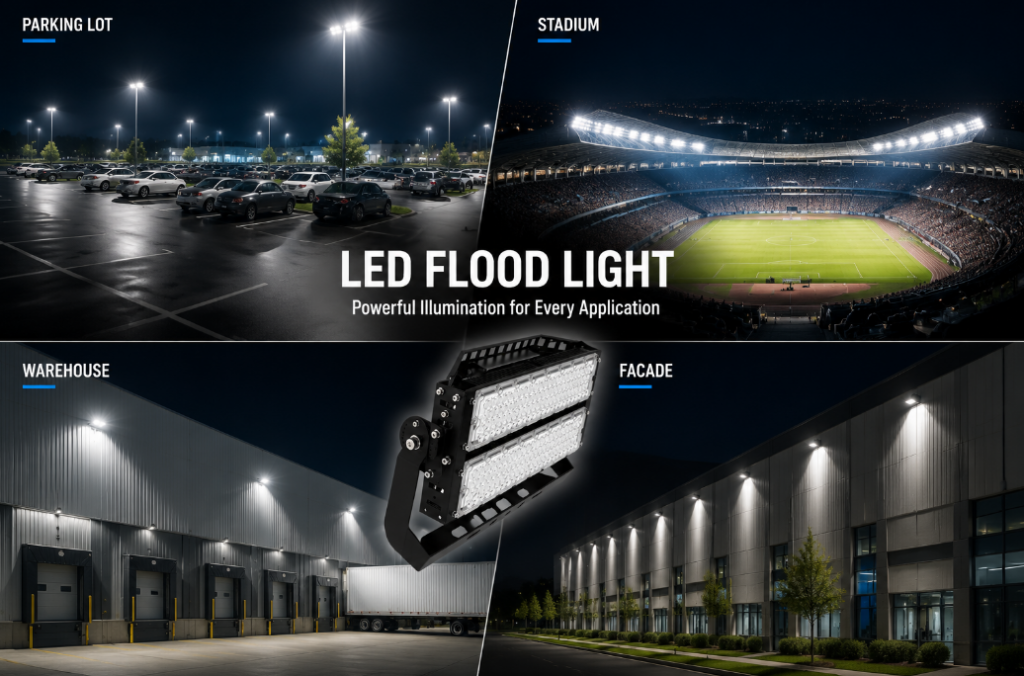
LED floodlight applications overview showing parking lot, stadium, warehouse, and building facade lighting scenarios with industrial LED floodlight
LED Flood Light vs LED Street Light — Choose the Type First
Both are outdoor products but solve different problems. Flood lights illuminate an area; street lights illuminate a road.
Type
LED Flood Light
LED Street Light
Primary use
Area lighting
Roadway lighting
Optics
Symmetric / asymmetric
Road-specific lens
Installation
Bracket, pole, building
Street pole
Typical use
Parking lots, stadiums, ports, façades
Roads, highways
Rule of thumb: lighting an area → flood light; lighting a road → street light.
Types of LED Flood Lights & Mounting Options
Confirm fixture structure and mounting before choosing wattage — they drive maintenance cost and optical flexibility.
Integrated (driver + module in one housing): lower cost, easy install — façades, squares, mid-scale parking.
Optics: symmetric for even area coverage (parking, warehouses); asymmetric for targeted throw (stadiums, billboards, façades).
Mounting: yoke bracket (adjustable), slip-fitter (round poles), or wall-mount.
👉 Optical distribution in depth: Floodlight Beam Angle Guide #04
Wattage, Lumens & Lux — How Brightness Is Defined
Many buyers start with “how many watts?” — but the real design target is illuminance (lux), not wattage. You set a target lux for the application, calculate the total lumens needed, then convert to wattage.
Typical target levels range from ~20–50 lux (parking) up to 500–1000+ lux (stadium events), per IES RP-8 / EN 12464-2.
👉 Set target lux & calculate total lumens: Floodlight Lux Guide #06
👉 Choose the right wattage: LED Flood Light Wattage Guide #03
👉 How many fixtures you need: How Many Floodlights Do I Need #13
👉 Replacing metal halide? See the conversion chart: LED vs Metal Halide Guide #07
Beam Angle & Optical Distribution
Beam angle decides whether light is thrown far or spread wide: narrow (≈30°) for stadiums and façades, wide (≈90–120°) for parking lots and warehouses. Glare control (UGR, spill-light/Dark-Sky compliance) matters most in stadiums, ports, and billboard lighting.
Mounting height, tilt, and pole spacing determine whether you get even light or hotspots and dark zones. As a rule, keep the spacing-to-height ratio in a controlled range and verify aiming in simulation.
👉 Pole spacing & layout: Floodlight Pole Spacing Guide #15
Electrical Protection & Input Voltage
Industrial sites need higher electrical protection — surge protection (SPD) typically 6kV/10kV/20kV, with wide input voltage (e.g. 100–277V / 277–480V) for unstable power.
👉 Surge protection in depth: LED Floodlight Surge Protection Guide #20
IP/IK Rating, Lifespan & Driver
IP65–IP66 suits most outdoor use; IK08–IK10 adds impact resistance. Real lifespan is defined by lumen maintenance (L70/L80), not just hours — quality fixtures reach 50,000–100,000h at L70. Driver quality (Philips, Inventronics, Mean Well), CCT (3000–5700K), CRI (≥80), and control (0–10V / DALI / DMX) round out the spec.
👉 IP rating: Best IP Rating for Outdoor Floodlights #14
👉 Why some last 10 years (lifespan/L70): Why Some LED Flood Lights Last 10 Years #16
👉 Color temperature: Floodlight Color Temperature Guide #12
👉 Dimming & control systems: DALI vs 0-10V Guide #08
Selection by Application
Each application has its own optics, mounting, and lux target — open the dedicated guide for layouts and design.
Parking lots — wide 60°–90° optics, 6–8 m poles, uniform illumination. → Parking Lot Lighting Design · Best Flood Lights for Parking Lots
Architectural façade — asymmetric optics for uniform vertical lighting.
Billboard / signage — high brightness, controlled beam for long-distance visibility.
Certifications, Procurement & Total Cost
Project buyers should confirm CE / CB (TÜV) / ENEC / RoHS, plus LM80 / IES photometric files and ISO9001 manufacturing. On cost, judge total cost of ownership (energy + maintenance + lifespan), not unit price alone.
Common procurement mistakes: choosing wattage without optical design, ignoring mounting height, ignoring driver quality, comparing only price, and missing photometric files.
👉 Certifications, pricing/TCO breakdown & how to vet a supplier: LED Flood Light Buying Guide #11
📌 Real Project Example
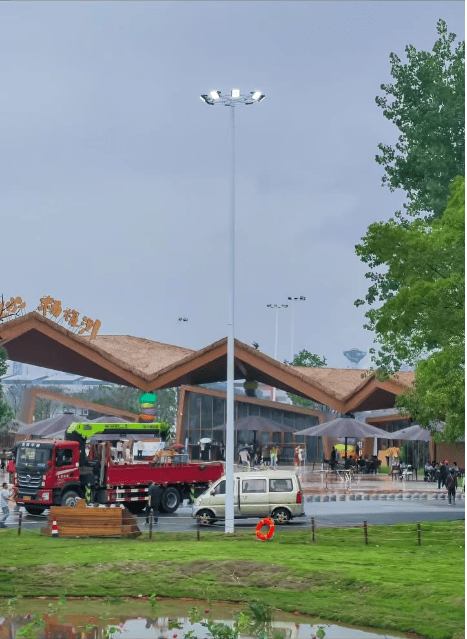
📌 Real Project Example — Scenic-Area Plaza High-Mast Floodlighting
Application: Open public plaza at a riverside scenic park (greenfield site, no previous lighting) · Mounting: 12 m high-mast poles with ring-mounted floodlight clusters · Fixtures: 8 poles × 8 × 150 W LED floodlights (64 units, 9.6 kW total connected load) · Optics: symmetric, wide distribution for even area coverage
This waterfront plaza was a newly built space with no existing lighting, so the goal was to cover a large open area evenly from a small number of mounting points rather than crowd the landscape with low poles. MVS supplied eight 12-meter high-mast poles, each carrying eight 150 W symmetric-optic LED floodlights on a fixed ring head, installed by truck-crane and aimed for uniform coverage with controlled glare. IP66 housings and surge protection were specified for the lakeside environment, and the all-LED design keeps connected load to just 9.6 kW across the whole plaza — a fraction of an equivalent metal-halide layout — for low running and maintenance cost over the fixture’s L70 lifespan.
(On-site illuminance was not measured on this project; lighting levels were set at the design stage to typical plaza targets.)
MVS LED Flood Light Solutions
Standard / High-Power / Stadium / Smart / Custom series. OEM/ODM support, free DIALux lighting design, and 5–7 year warranty.
Send your drawings / area size, mounting height, and target lux — our engineers return a free DIALux layout, fixture selection, and quote within 24 hours.Request My Free Lighting Plan →
Lighting Glossary
Lux illuminance · Lumen luminous flux · Beam angle light distribution · CCT color temperature · CRI color rendering · IP rating ingress protection
FAQ
How many watts do I need for my project? It depends on area, mounting height, and target lux — typically 100W–1000W per fixture. See the Wattage Guide #03.
What IP rating is required outdoors? IP65 is standard; IP66 for harsher weather. More in the IP Rating Guide #14.
How long do LED flood lights last? Typically 50,000–100,000 hours depending on driver and thermal design. See Why Some Last 10 Years #16.
Do you support OEM / ODM? Yes — full OEM/ODM including housing, wattage, optics, and branding.
What is the MOQ? Depends on model; flexible trial orders available for standard products.
Do you provide lighting design? Yes — free DIALux design and project simulation.
What is the lead time? Standard 25–40 days; samples 7–10 days.
Conclusion
A successful LED flood lighting project comes down to a structured approach: correct lux/lumen target, the right beam angle, suitable mounting, and a reliable IP/driver system. Use the linked guides above to go deep on each step.
For project-specific support, MVS provides free lighting design and quotation based on your drawings. 👉 View the full product range .
MVS Lighting
Professional LED Outdoor Lighting Supplier
Reply within 2 hours
Need LED lighting for your project?
WhatsApp Us
Online | Privacy policy
Get Quote on WhatsApp
Ask For A Quick Quote
We will contact you within 1 working day, please pay attention to the email with the suffix “info@ledmvs.com”.