
Author: By Lighting Engineering Team, MVS Lighting — outdoor lighting
manufacturer with 5 production lines and 15+ years experience
Choosing the correct beam angle can significantly reduce fixture quantity, improve lighting uniformity, and prevent over-illumination or dark zones in projects such as parking lots, warehouses, sports fields, and façades.
This guide is part of our LED floodlight selection series → LED Flood Lights: The Complete Buyer’s Guide
Quick Beam Angle Classification
- Narrow beam (15°–30°): long-throw applications — stadiums, high-mast, ports
- Medium beam (60°–90°): general-purpose industrial and commercial coverage — warehouses, parking lots
- Wide beam (100°–150°): broad-area, low-height coverage — façades, open yards, landscaping
Core principle: Higher mounting height → narrower beam. Lower mounting height → wider beam.
The full NEMA classification and application-based selection table below give you the precise engineering breakdown behind this quick rule.
What Is Beam Angle? Definition, Optical Principle & Field Angle
Beam angle refers to the angle at which light intensity drops to 50% of its peak value, defining the usable optical spread of an LED floodlight.
In practical engineering terms:
- Narrow beam → higher intensity, longer throw distance
- Wide beam → broader coverage, lower peak intensity
Incorrect beam angle selection often results in dark zones, over-illumination, excess energy consumption, and increased fixture quantity.
Beam Angle vs Field Angle
Beam Angle is the point where light intensity drops to 50% of peak output — this defines the core usable light zone. Field Angle is the point where intensity drops to 10% of peak output — this defines the total usable spread, and it’s what NEMA photometric classification is actually based on.
Note: This NEMA beam classification (Type 1–7, below) refers to photometric distribution standards — a different NEMA standard from NEMA mechanical mounting interfaces (e.g., C136.10/C136.20) used for pole-top fixture installation.
This distinction matters in practice: real projects require overlapping beam distribution between fixtures, not single-point coverage, because the field angle — not the beam angle — determines where one fixture’s light meaningfully ends and the next needs to begin.
Floodlight NEMA Beam Spread Classification (Type 1–7)
| NEMA Type | Beam Angle | Characteristics | Applications |
|---|---|---|---|
| Type 1 | 10°–18° | Very narrow | High mast, long throw |
| Type 2 | 18°–29° | Narrow | Stadium lighting |
| Type 3 | 29°–46° | Medium narrow | Sports fields |
| Type 4 | 46°–70° | Medium | Warehouses, roads |
| Type 5 | 70°–100° | Medium wide | Parking lots |
| Type 6 | 100°–130° | Wide | Floodlighting, façades |
| Type 7 | 130°+ | Very wide | Close-range lighting |
Official reference: NEMA Beam Distribution Standard
Beam Angle Coverage Calculation (Engineering Formula)
Coverage diameter formula: Beam Diameter = 2 × Distance × tan(Beam Angle ÷ 2)
Example 1: Mounting height 10m, beam angle 60° → Beam diameter ≈ 11.5m Example 2: Mounting height 25m, beam angle 15° (high-mast scenario) → Beam diameter ≈ 6.6m
Narrow beam → high lux concentration. Wide beam → uniform distribution.
Fixture spacing rule: Beam diameter ≥ fixture spacing.
Beam Angle Engineering Breakdown by Wattage
Beam angle availability varies by product series, not simply by wattage. Mid-range wattages offer both narrow and wide optical modules; the narrowest catalog options concentrate in the highest-wattage, longest-throw series — and beyond that, custom narrow-angle optics can be developed for specific project requirements (see Real Project Evidence below).
- 10°–25° (narrowest, long-throw): available in the 500W series. Ideal for stadium towers, bridges, and architectural highlighting. → 500W LED Floodlight
- 18°–40°: available in 500W and 750W series. Ideal for stadiums, seaports, and high-mast industrial zones. → 750W LED Floodlight
- 30°–90° (versatile mid-range): available across 50W, 65W, 100W, 150W, 200W, and 500W series — the most commonly specified range for warehouses, parking lots, and industrial facilities. → 50W / 65W / 100W / 150W / 200W
- 90°–145° (wide, asymmetric options): available in 100W/150W/200W C-series and D-series models. Suited for warehouses, workshops, and open-area coverage.
- 78°×136° single-lens wide beam: available in the compact 30W model, for small-scale pathway and landscape applications. → 30W LED Floodlight
Application-Based Beam Angle Selection Table
| Application | Beam Angle | NEMA | Related Solution |
|---|---|---|---|
| Stadium | 15°–30° | 1–2 | Stadium Lighting |
| Basketball court | 30°–60° | 2–4 | Basketball Lighting |
| Warehouse | 60°–90° | 4–5 | Warehouse Lighting |
| Parking lot | 60°–120° | 4–6 | Parking Lot Lighting |
| Façade lighting | 10°–120° | 1–6 | Façade Lighting |
| Accent / signage lighting | 10°–30° (custom options below 30° available) | 1–2 | Real Project Evidence |
Beam Angle vs Illuminance Distribution
Beam angle does not change total lumens, but it directly affects lux distribution, lighting uniformity, and glare level.
A common point of confusion: two fixtures with identical wattage but different beam angles will feel noticeably different on site — the wider-angle unit spreads the same lumen output over a larger area, lowering perceived brightness per square meter, while the narrower unit concentrates it. This is why wattage alone is never a reliable spec to design around.
Common Engineering Mistakes
- Using wide beam for high mast lighting → insufficient intensity
- Using narrow beam for parking lots → dark zones
- Designing based on wattage only → incorrect optical planning
- Skipping simulation and layout verification → real-world mismatch
- Uneven illumination in parking areas, excessive glare in sports facilities, and insufficient uniformity in warehouses are the most common results of beam angle mismatch — proper design requires verified simulation before installation.
Real Project Evidence
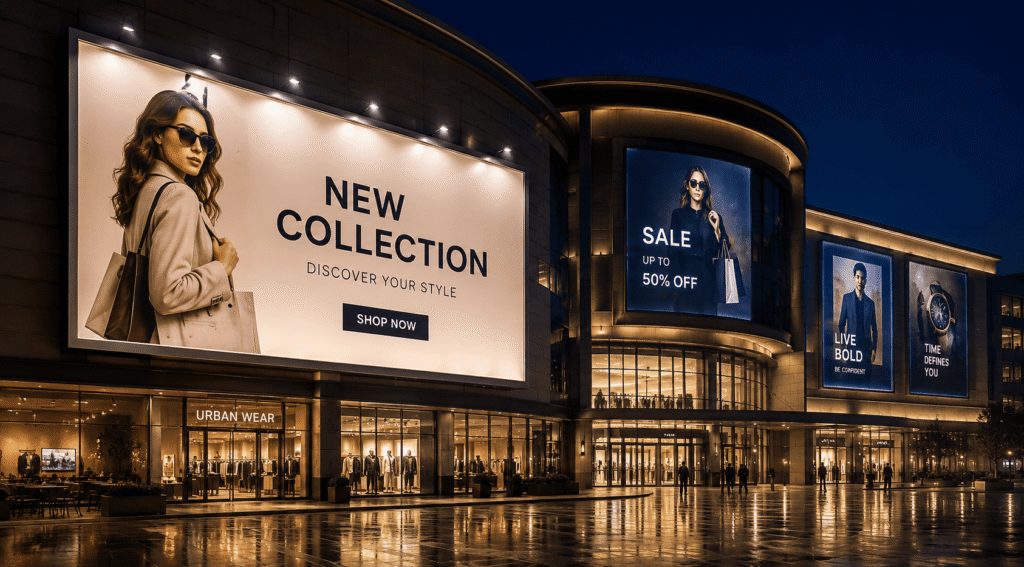
Middle East hotel signage project: a client required an ultra-narrow 25° beam angle to precisely illuminate a hotel signboard without spilling light onto surrounding façades. Since our standard 100W series ships with 30°/60°/90°/120° options, our engineering team developed a custom 25° optical module specifically for this project — demonstrating that beam angle customization extends beyond catalog options when project geometry demands it.
See full project details → Case Study page(#29)
FAQ
Q1: What beam angle is suitable for parking lots? 60°–120° (NEMA Type 4–6).
Q2: Why do stadiums use narrow beam angles? To achieve long throw distance and reduce light spill.
Q3: Is wider beam always better? No. It depends on mounting height and application.
Q4: Can beam angle be changed after installation? Only by replacing optical components (lens/reflector).
Q5: Does wattage affect beam angle? No. Wattage controls brightness, beam angle controls distribution.
Q6: Can I get a custom beam angle for my project? Yes. MVS supports beam angle customization across the 50W–1000W range, including angles below standard catalog options, as part of our OEM/ODM service.
Get Expert Support for Beam Angle Selection
Not sure which beam angle fits your project? Browse our LED Floodlight Series with multiple beam angle options across the 30W–1000W range, or send us your site layout for a free selection recommendation from our engineering team.
CTA View LED Floodlight Series → /led-floodlight-series/