
By Lighting Engineering Team, MVS Lighting — outdoor lighting manufacturer with 5 production lines and 15+ years experience.
Last updated: July 2026
Introduction
LED flood light cost can range from a few dozen dollars for a standard commercial fixture to several hundred dollars for a high-power industrial or stadium model. However, wattage alone does not determine the price.
Two floodlights marked with the same wattage may use completely different drivers, LED chips, housings, optical systems, surge protection devices and certifications. Order quantity, trade terms and exchange rates can also affect the final quotation.
This guide explains typical EXW factory budget ranges, cost per watt, procurement tiers, price differences between factories and distributors, and the information buyers should provide when requesting a quotation.
The prices shown below are based on selected MVS floodlight models. They are intended for preliminary project budgeting and quotation comparison—not as permanently fixed prices.
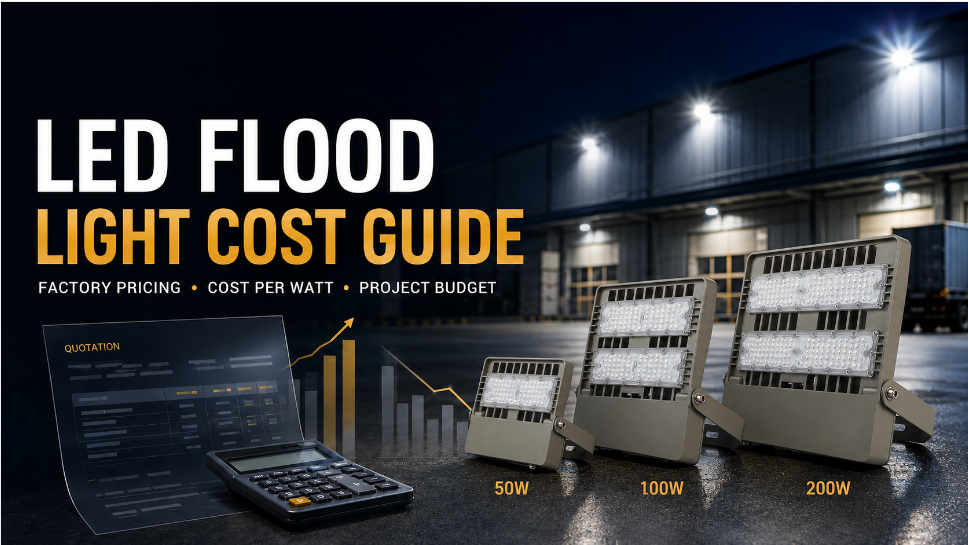
Quick LED Flood Light Cost Snapshot
The following prices are indicative EXW factory budget ranges based on selected MVS floodlight models.
| Wattage | Typical application | Indicative EXW budget |
|---|---|---|
| 50W | Small commercial areas and perimeter lighting | US$25–35/unit |
| 65W | Building exteriors and general outdoor lighting | US$30–40/unit |
| 100W | Commercial outdoor lighting projects | US$70–85/unit |
| 150W | Parking lots and medium industrial areas | US$95–115/unit |
| 200W | Industrial yards and large outdoor areas | US$140–165/unit |
| 300W | Heavy-duty industrial lighting | US$180–210/unit |
| 400W | High-output industrial and high-mast projects | Contact for current pricing |
| 500W | Ports, stadiums and high-mast lighting | Contact for current pricing |
| 750–1000W | Stadium and large-area lighting projects | Project quotation required |
Pricing note: The figures above are indicative EXW factory budget ranges based on selected standard MVS configurations. Final pricing depends on the product series, driver brand, optical system, surge protection, certification, order quantity, customization requirements and exchange rate at the time of quotation. Freight, taxes, installation and destination-market certification costs are not included.
High-wattage floodlights may use different housing platforms, drivers and optical systems. Therefore, price does not always increase proportionally with wattage.
What Determines LED Flood Light Cost?
Two LED floodlights with the same wattage can differ significantly in price. The difference usually comes from the components, construction and compliance requirements that determine how the fixture performs over its service life.
LED Chip and Driver Quality
The LED chip and driver have a major influence on both fixture cost and field reliability.
Recognized LED platforms and properly selected drivers generally deliver better efficiency, more stable output and slower lumen depreciation than low-cost alternatives.
Driver selection can be particularly important in areas with unstable voltage. A suitable quality driver helps protect the fixture against voltage fluctuations and reduces the likelihood of premature failure.
Buyers should therefore compare the actual driver model, operating voltage, power factor, efficiency and warranty—not only the driver brand printed on the specification sheet.
Housing and Thermal Design
The operating life of an LED floodlight depends heavily on thermal management.
A well-designed die-cast aluminum housing transfers heat away from the LED modules and driver. Housing thickness, aluminum quality, fin geometry and internal component layout all affect thermal performance and manufacturing cost.
A lower-priced housing may look similar in a product image but perform differently after thousands of hours of operation in a hot outdoor environment.
IP Rating and Environmental Protection
Outdoor floodlights are exposed to rain, dust, humidity and temperature changes.
Moving from IP65 to IP66 or IP67 may require different seals, cable glands, housing construction and testing. Coastal, chemical-processing and high-humidity environments may also require enhanced corrosion protection.
The correct protection level should be selected according to the installation environment rather than simply choosing the highest IP rating available.
External link to add: IEC 60529 information page
Suggested anchor text: IP protection ratings
Surge Protection Level
Surge protection is an important pricing difference between basic commercial products and fixtures designed for industrial or infrastructure projects.
A 6kV surge protection level may be suitable for some general commercial applications, while exposed industrial sites, high-mast installations and areas with unstable electrical grids may require 10kV or 20kV protection.
A higher protection level increases the initial product cost, but it can reduce the risk of expensive field failures—especially when the fixtures are installed at heights that require lifting equipment for maintenance.
External link to add: Relevant IEC surge protection information page
Suggested anchor text: surge protection levels
Certification and Market Compliance
Certification requirements depend on the destination market and project.
CE-related compliance and RoHS documentation may be requested for European markets. North American projects may specify UL, ETL, FCC or other applicable requirements. Australian projects may require relevant electrical safety and compliance documentation.
Certification should be confirmed according to the exact product model and destination market. A certificate held for one product series does not automatically apply to every floodlight supplied by the same manufacturer.
Testing, documentation and product-specific compliance requirements can all affect the final quotation.
External link to add: Official certification or market compliance source
Suggested anchor text: lighting certification requirements
LED Flood Light Cost per Watt
Cost per watt can help buyers compare floodlights, but it should only be used when the products have similar configurations.
Based on the current reference models used for the public price table, the approximate EXW budget per watt is:
| Wattage | Public budget range | Approximate cost per watt |
|---|---|---|
| 50W | US$25–35 | US$0.50–0.70/W |
| 65W | US$30–40 | US$0.46–0.62/W |
| 100W | US$70–85 | US$0.70–0.85/W |
| 150W | US$95–115 | US$0.63–0.77/W |
| 200W | US$140–165 | US$0.70–0.83/W |
| 300W | US$180–210 | US$0.60–0.70/W |
These figures are intended for preliminary comparison only.
Compare Products from the Same Series
Cost per watt is most useful when comparing fixtures that use a similar housing platform, driver grade, LED efficiency, protection level and certification.
Comparing a basic commercial floodlight with an engineered stadium floodlight solely by cost per watt can produce a misleading conclusion.
Cost per Watt Is Not Always Linear
Higher wattage does not automatically guarantee a lower cost per watt.
Although some fixed costs can be spread across a higher-powered fixture, large industrial and stadium floodlights may require:
- Larger and heavier housings
- More advanced thermal management
- Higher-grade drivers
- Specialized optical systems
- Stronger mounting brackets
- Higher surge protection
- Project-specific testing and certification
For this reason, 400W and higher-powered fixtures are normally quoted according to their actual configuration.
Compare Using the Same Order Quantity
A cost-per-watt comparison is only meaningful when suppliers quote against the same quantity and trade terms.
A 10-piece trial order and a 500-piece project order will not normally have the same unit price. Likewise, an EXW quotation should not be compared directly with an FOB, CIF or delivered price.
Procurement Budget Tiers
Beyond unit price, buyers should identify which procurement tier best matches the project. Each tier has different technical priorities and quotation requirements.
Entry Tier: 30–100W
This category normally covers small commercial areas, building exteriors, security lighting and perimeter lighting.
Orders may be relatively small, and purchasing decisions can often be made after confirming the basic specification and approving a sample.
Important factors include:
- Required brightness
- Installation position
- IP rating
- Housing size
- Driver configuration
- Required certification
Standard Tier: 150–200W
This category is commonly used for parking lots, medium-sized industrial areas and general outdoor projects.
At this level, photometric performance becomes more important. Fixture selection should consider installation height, pole spacing, beam angle and target illumination—not wattage alone.
Internal link to add: Article #03 Wattage Guide
Suggested anchor text: how to choose flood light wattage
Industrial Tier: 300–400W
This category is suitable for industrial yards, logistics centers, large outdoor areas and some high-mast installations.
Reliability becomes a major procurement priority because the cost of accessing and replacing a failed fixture may exceed the difference between two product quotations.
Buyers should pay particular attention to:
- Driver model
- Surge protection level
- IP rating
- Housing and thermal design
- Mounting structure
- Warranty conditions
- Photometric files
Infrastructure Tier: 500–1000W
High-power floodlights are used for stadiums, ports, airports, large industrial sites and high-mast lighting.
These products are usually selected according to a lighting design rather than a standard catalog price. Beam angle, aiming direction, installation height, glare control and structural requirements can substantially affect the product configuration.
For this reason, MVS provides project-specific quotations for most 400W–1000W floodlights.
Factory vs Wholesale vs Retail Pricing
Where a buyer purchases the product can affect the final price as much as the product specification.
EXW and FOB Factory Pricing
An EXW price generally covers the product made available at the supplier’s factory. The buyer or buyer’s forwarder is responsible for collection, export arrangements and transportation.
An FOB quotation normally includes the agreed costs required to deliver and load the goods at the named port of shipment, subject to the applicable Incoterm.
CIF pricing includes agreed freight and insurance to the named destination port but does not automatically include all destination charges, import duties or local delivery.
When comparing quotations, buyers should confirm that every supplier is using the same Incoterm and named location.
MOQ-Based Pricing
Unit price usually changes according to order quantity because material purchasing, packaging, production setup and quality-control costs are distributed differently.
A general purchasing structure may look like this:
| Order quantity | Typical pricing treatment |
|---|---|
| 1–10 pieces | Sample or trial-order pricing |
| 10–50 pieces | Small-order pricing |
| 100–500 pieces | Project pricing |
| More than 500 pieces | Volume quotation |
The table above describes a general pricing structure. The applicable MOQ and unit price still depend on the specific model.
Container Load and Landed Cost
Freight cost per unit generally falls when the buyer consolidates more products into a full container.
A small reduction in the factory unit price does not always produce the largest overall saving. In some cases, packaging optimization or more efficient container loading can reduce landed cost more effectively.
Buyers should evaluate:
- Product unit price
- Export packing volume
- Total gross weight
- Container utilization
- Origin charges
- Ocean or air freight
- Destination charges
- Import duties and taxes
- Local transportation
Internal link to add: MVS Floodlight Series collection page
Suggested anchor text: MVS LED Floodlight Series
Real Project Cost Breakdown
Catalog prices only provide an initial reference. The final project cost depends on the required wattages, product configuration, order quantity and shipping arrangements.
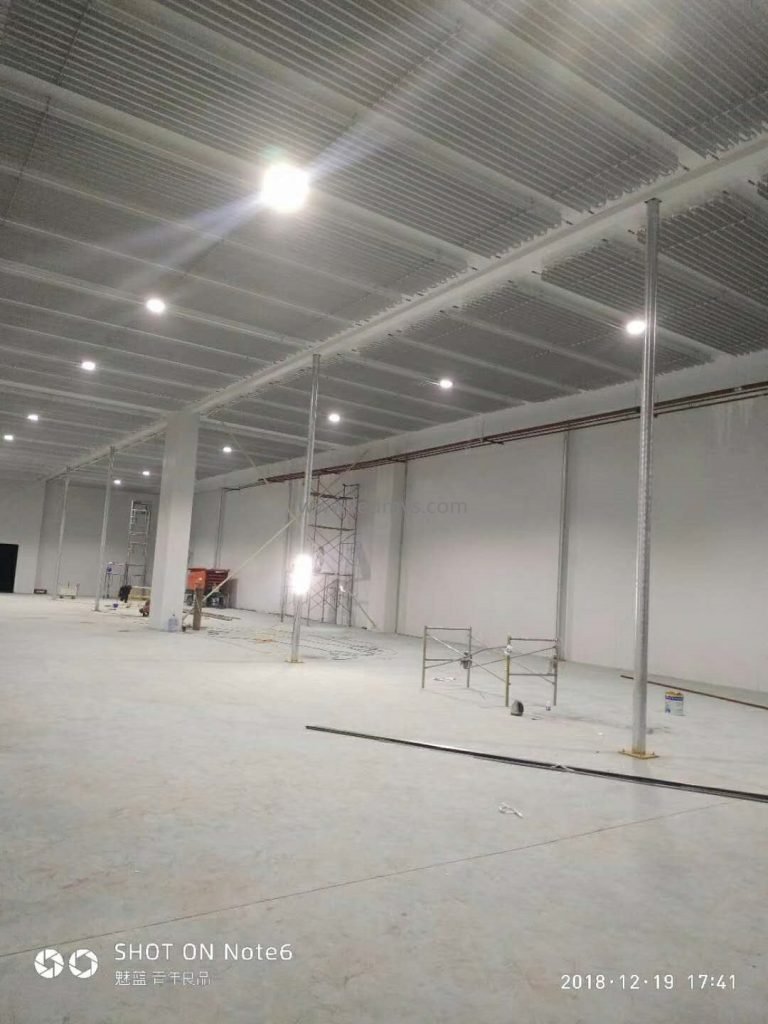
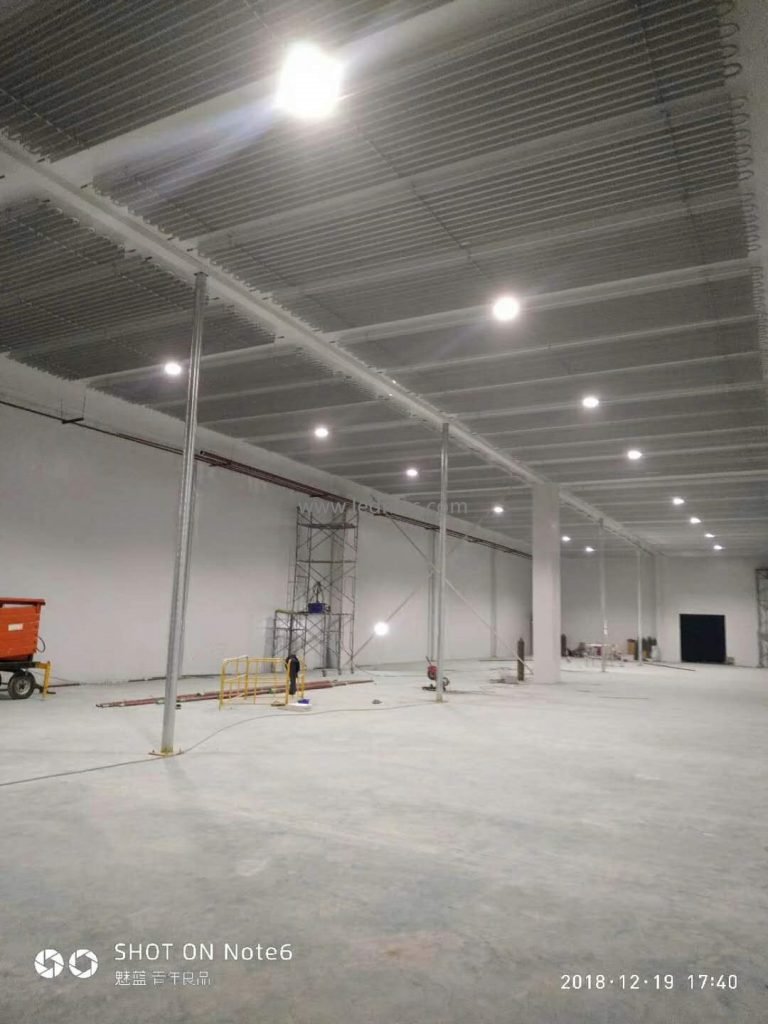
The following anonymized case demonstrates how an actual industrial buyer selected multiple floodlight wattages and a specific component configuration for one order.
Case: Mixed-Wattage Floodlights for an Industrial Lighting Project in South Korea
An industrial customer in South Korea required multiple floodlight wattages for different lighting areas within the same project.
Instead of applying one wattage across the entire site, the order combined four wattage levels:
| Floodlight wattage | Quantity |
|---|---|
| 50W | 30 units |
| 100W | 20 units |
| 200W | 20 units |
| 300W | 6 units |
| Total | 76 units |
The floodlights were configured with Philips LED chips and Mean Well drivers. At the customer’s request, the drivers were packed and shipped separately from the floodlight fixtures.
Using several wattages in one order allowed the buyer to match the lighting output to different industrial areas rather than over-specifying every installation point.
The selected component configuration also affected the final product cost. Philips LED chips and Mean Well drivers were specified instead of a lower-cost standard configuration, while the separate packing and shipping arrangement required additional order coordination.
The order has been completed and shipped. The customer’s company name and specific project location have been withheld for confidentiality.
Procurement takeaway: For mixed-wattage industrial projects, buyers should compare the complete configuration rather than unit price alone. Driver brand, LED platform, wattage distribution, packaging and special shipping arrangements can all affect the final EXW quotation.

External link to add: industray
Using several wattages in one order allowed the buyer to match the lighting output to different [industrial yard lighting applications] rather than over-specifying every installation point.
LED vs Traditional Lighting: Total Cost of Ownership
The purchase price of a fixture is only one part of the total lighting cost.
Compared with metal halide and other traditional lighting technologies, LED floodlights may require a higher initial investment but can reduce energy and maintenance costs over the operating period.
Initial Investment
LED floodlights may cost more at the purchasing stage, especially when the specification includes high-efficiency LEDs, a premium driver, advanced optics and higher surge protection.
Energy Consumption
A correctly selected LED system can provide the required illumination while using less power than an older metal-halide system.
The actual saving depends on:
- Existing lamp and system wattage
- LED replacement wattage
- Daily operating hours
- Electricity price
- Lighting-control strategy
- Required illumination level
Maintenance and Replacement
LED systems generally require fewer lamp-replacement cycles than traditional discharge lighting.
Maintenance savings are especially important for fixtures installed on high poles, stadium structures or difficult-to-access industrial buildings because replacement may require lifting equipment, traffic control and additional labor.
Total Cost Calculation
A simplified total-cost calculation can be written as:
Total project cost = fixture cost + freight + installation + electricity consumption + maintenance and replacement costs
The lowest initial quotation does not necessarily produce the lowest total cost over five or ten years.
How to Get an Accurate LED Flood Light Price
An accurate quotation depends on actual project requirements rather than a generic wattage request.
Required Project Information
To prepare a useful quotation, buyers should provide:
- Required wattage or target illumination
- Application, such as parking lot, industrial yard, port or stadium
- Installation height
- Pole spacing or site dimensions
- Required quantity
- Input voltage
- Color temperature
- Beam-angle requirement
- Driver preference
- Surge-protection requirement
- Required certification
- Destination country
- Trade term, such as EXW or FOB
- OEM or packaging requirements
- Required delivery date
If the customer does not know the correct wattage, a site drawing, pole layout or lighting requirement can help the supplier recommend an appropriate configuration.
Why Fixed Price Lists Are Limited
A fixed price list cannot cover every commercial or industrial project.
OEM branding, driver changes, certification, optical design, packaging and project-specific protection requirements can all change the bill of materials.
Exchange-rate movements and material-cost changes may also affect the final quotation. Therefore, public price information should be used for budgeting, while the formal quotation should be based on confirmed technical requirements.
Quotation Workflow
A typical MVS project quotation follows this process:
- The buyer submits the project requirements.
- MVS confirms the technical configuration.
- MVS provides an EXW, FOB or other requested quotation.
- A sample is prepared when required.
- The buyer approves the sample or technical specification.
- MVS confirms the bulk order and production schedule.
Request Pricing for 400W–1000W Floodlights
High-power floodlights normally require project-specific configurations.
Send us the required wattage, quantity, installation height, destination market, preferred driver brand and beam angle. MVS Lighting will provide a current quotation based on the actual project requirements.
Request the Current LED Flood Light Price List
Contact MVS Lighting with your required wattage, quantity, destination country and product configuration to receive an updated quotation.
Frequently Asked Questions
How much does an LED floodlight cost?
Based on selected MVS models, indicative EXW factory budgets start from approximately US$25–35 for a standard 50W floodlight. A standard 300W model may fall within an indicative budget of approximately US$180–210.
These are preliminary reference ranges rather than fixed quotations. Final pricing depends on the product series, configuration, quantity, certification and exchange rate.
What is the average LED flood light cost per watt?
Based on the selected 50W–300W reference models in this guide, indicative EXW cost is approximately US$0.46–0.85 per watt.
Cost per watt should only be compared across products with similar drivers, housings, protection levels, optics, certifications, order quantities and trade terms.
Why do LED flood light prices vary so much?
Price differences normally come from the LED chip, driver, thermal design, housing, IP rating, surge protection, optical system, certification and warranty.
Two floodlights with the same rated wattage may use very different components and may not offer the same reliability or lighting performance.
Is a factory price cheaper than a retail price?
Factory-direct purchasing can remove some distributor and retail margins. However, buyers should also consider MOQ, export logistics, certification, payment terms and after-sales responsibilities.
The factory price should be compared using the same product configuration and Incoterm.
How do you calculate total project cost?
Start with the fixture unit cost multiplied by the required quantity. Then add freight, installation, certification, import costs and local delivery.
For sites that operate for long hours, buyers should also calculate electricity consumption and expected maintenance costs over the operating period.
What factors affect LED flood light pricing most?
The most important product factors include the driver, LED chip, housing, optical system, surge protection and certification.
Order quantity, customization, trade terms, exchange rate and freight conditions can also affect the final project cost.
Why are prices for 400W and higher floodlights not listed?
High-power floodlights often use different housing platforms, drivers, optical systems and mounting structures. They may also require project-specific beam angles, surge protection and certification.
For this reason, MVS quotes most 400W–1000W floodlights according to the actual project requirements.
Conclusion
LED flood light cost depends on much more than wattage.
Specification, product series, driver, optical design, certification, order quantity and trade terms all affect the final price. The indicative EXW ranges in this guide can help buyers prepare an initial budget, but a formal quotation requires technical and commercial confirmation.
Buying factory-direct can reduce intermediate costs, but buyers should still compare quotations according to equivalent specifications, quantities and Incoterms.
For an accurate quotation, send MVS Lighting your project application, wattage, quantity, installation height, destination market and required delivery date.
Next Step
- Request a factory quotation
- Send your project lighting plan
- Get current MVS LED Floodlight Series pricing
Internal link to add: MVS Floodlight Series collection
Suggested anchor text: request current factory pricing
Internal link to add: Article #01 Buying Guide
Suggested anchor text: LED flood light buying guide
Internal links to add: Relevant parking lot, industrial yard and stadium application pages