
By Lighting Engineering Team, MVS Lighting — outdoor lighting manufacturer with 5 production lines and 15+ years experience
Color temperature (CCT), measured in Kelvin (K), describes how warm or cool a light source appears — from the yellowish glow of 2700K to the crisp blue-white of 6500K. For LED flood lights, the right CCT affects visibility, perceived security, and how comfortable a space feels at night — and getting it wrong is a common, avoidable spec mistake.
This guide covers the Kelvin scale, which CCT range fits which outdoor application, and how CCT relates to (and differs from) color rendering.
For the full floodlight selection framework, see our Complete LED Flood Light Guide or How to Choose the Right LED Flood Light.
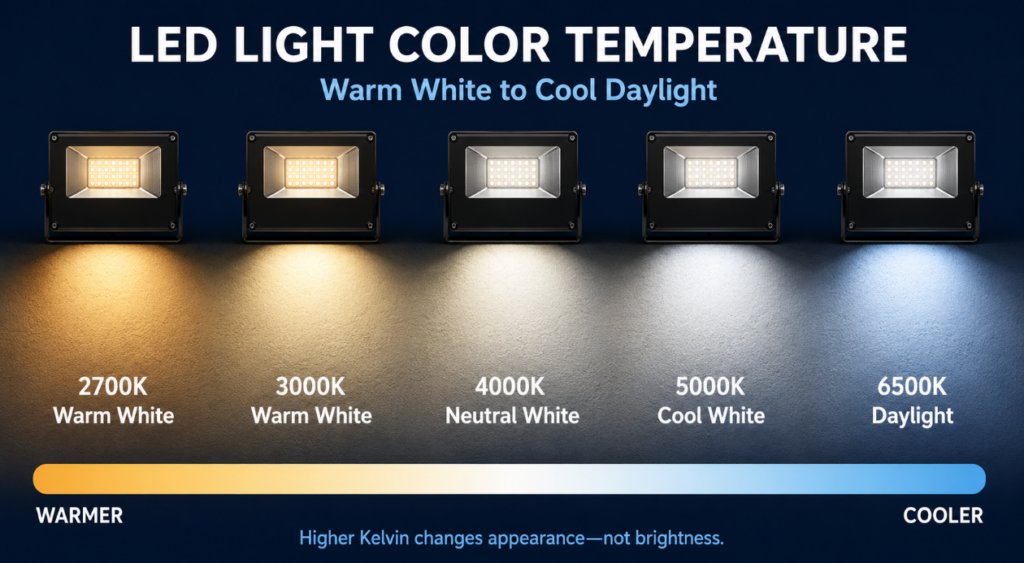
The Kelvin Scale: What the Numbers Mean
| Range | Appearance | Common Use |
|---|---|---|
| 2700K–3000K | Warm white — yellowish, soft | Residential, hospitality, ambiance-focused spaces |
| 3500K–4100K | Neutral white — balanced | Offices, retail interiors, smaller enclosed outdoor areas |
| 5000K–6500K | Cool white / daylight — crisp, bluish | Parking lots, warehouses, security lighting, sports fields |
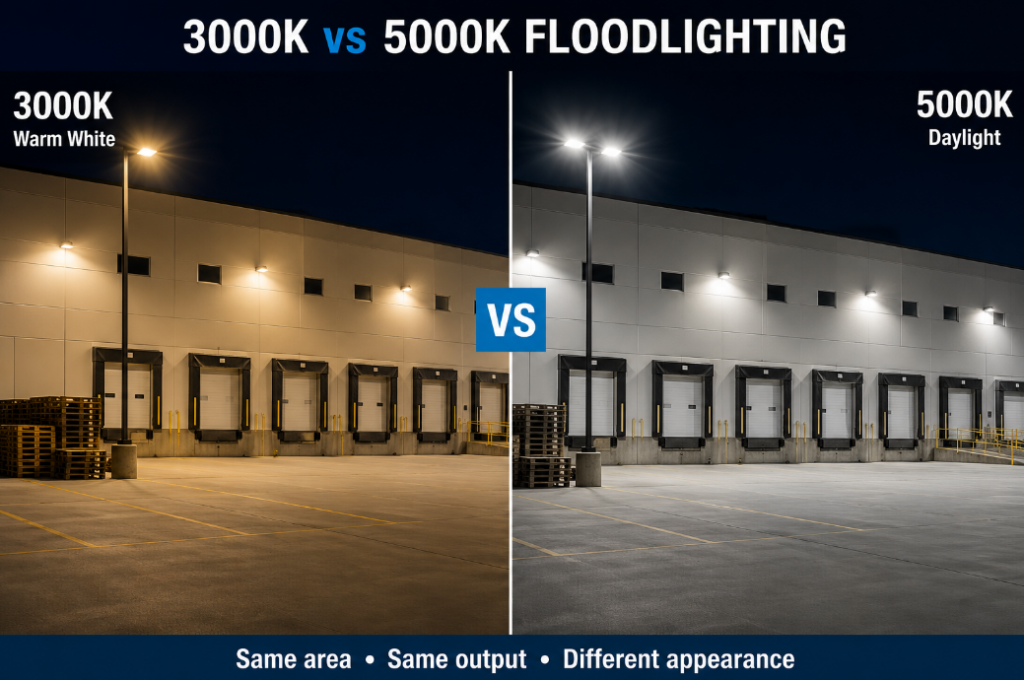
Lower Kelvin numbers don’t mean “less bright” — CCT describes color appearance, not lumen output. A 3000K fixture and a 5000K fixture can produce identical lumens; they’ll just render the same space very differently.
Recommended CCT for LED Flood Lights
5000K–6500K (cool white / daylight) is the default for most commercial and industrial outdoor floodlight applications. It mimics daylight, maximizes contrast for object and facial recognition, and is what most security cameras are tuned to work best under.
4000K (neutral white) suits smaller or semi-enclosed outdoor areas — loading docks close to a building, covered walkways, smaller perimeter zones — where a slightly softer appearance is preferred without losing much visibility. It’s also worth checking local requirements before defaulting to 5000K: some municipalities and planning boards favor 4000K or below for commercial exterior lighting, citing glare and light-pollution concerns — 5000K’s crisper appearance can also mean more perceived glare at the same intensity. Confirm local codes before finalizing, not just visibility preference.
3000K and below is uncommon for commercial floodlights specifically, but shows up in landscape, façade, or hospitality-adjacent outdoor lighting where ambiance matters more than maximum contrast.
🖼️ 5000K daylight floodlight vs 3000K warm white floodlight, same area side by side
CCT vs CRI: Not the Same Thing
CCT and CRI (Color Rendering Index) get confused constantly, and they measure different things:
- CCT — how warm or cool the light appears (the Kelvin number).
- CRI — how accurately the light renders actual colors compared to natural daylight, on a 0–100 scale.
A 5000K fixture with a CRI of 65 and a 5000K fixture with a CRI of 90 will look similarly “cool” and “bright” side by side, but the CRI 90 unit will render skin tones, vehicle colors, and signage far more accurately. Recommendations vary by source: CRI 70 is a common minimum for commercial outdoor projects, with 80+ preferred where color accuracy matters more — camera-heavy security zones, retail frontage, or signage-dependent areas.
Illuminance (how much light reaches the ground) is a separate question from both of these — see our [Lux Levels Guide — 待补:#6尚未上线,暂无真实URL] for how to size that.
Recommended CCT by Application
| Application | Typical CCT | Full Guide |
|---|---|---|
| Parking lot | 4000K–5000K | Parking Lot Lighting Design |
| Sports & stadiums | 5000K–5700K | Sports Lighting Standards |
| Basketball court | 5000K–5700K | Basketball Court Lighting |
| Warehouse / industrial yard | 5000K–6500K | Industrial Yard Flood Lights |
| Street / roadway lighting | 4000K–5000K | No dedicated guide yet — general outdoor range applies |
CCT Spec Mistakes We See in Real RFQs
- “Warmer” or “cooler” requested with no Kelvin number attached. A buyer asking for something “a bit warmer” without a target K value forces back-and-forth before a quote can even be prepared — always confirm a specific range, not a relative description.
- CCT assumed to guarantee color accuracy. Specifying “5000K” doesn’t say anything about CRI — a project that needs accurate color rendering (security footage, retail frontage) needs to specify CRI separately, not assume a cool CCT covers it.
- One CCT specified across a mixed-use site without checking each zone’s actual need. A site with both a security-camera-heavy perimeter and a landscaped entrance may genuinely benefit from two different CCTs — defaulting to one blanket spec across the whole site isn’t always the right call.
- CCT consistency across fixtures not confirmed. Two fixtures both labeled “5000K” can still show a visible tint difference if they’re not binned consistently — for large sites with many fixtures, ask the supplier about binning tolerance, not just the labeled CCT.
Frequently Asked Questions
What color temperature is best for outdoor commercial lighting? 5000K to 6500K is the most common choice for parking lots, warehouses, and security-focused outdoor lighting — it maximizes visibility and contrast, closest to natural daylight.
Is 4000K or 5000K better for a parking lot? Both are used. 5000K is more common for larger, open lots where maximum visibility and security are the priority; 4000K suits smaller or more enclosed lots, and is sometimes preferred by local zoning or planning boards for glare and light-pollution reasons — check local requirements before finalizing.
Does a higher Kelvin number mean brighter light? No. Kelvin measures color appearance, not brightness. A 3000K and a 5000K fixture can output the same lumens — they’ll just look different. Brightness on the ground is a lux/lumen question, not a CCT question.
What’s the difference between CCT and CRI? CCT describes how warm or cool light appears (measured in Kelvin). CRI describes how accurately that light renders real colors (measured 0–100). A fixture can have an ideal CCT and still render colors poorly if its CRI is low.
Can I mix color temperatures on the same site? Yes, if there’s a functional reason — different zones with different visibility or ambiance needs. What matters more is consistency within each zone, since mismatched CCT in the same sightline reads as a lighting defect even when both fixtures are within spec individually.
Conclusion
For most commercial and industrial LED floodlight projects, 5000K–6500K is the practical default — it maximizes visibility and works well with security camera systems. 4000K remains a reasonable choice for smaller or more enclosed areas. Whichever range you choose, confirm CRI separately if color accuracy matters, and specify an exact Kelvin value rather than a relative description like “warm” or “cool.”
Need help matching CCT to your project? [Talk to our lighting team — free →]