Long-Range Communication Low-Data Lighting Network Distributed Outdoor Projects

LoRa System for Smart Lighting

A LoRa lighting control system uses long-range, low-data wireless communication to connect compatible fixture controllers with a gateway. It is particularly useful when lighting assets are distributed over a wide site and installing new communication cables would be difficult.

As one communication option within an MVS smart lighting system , LoRa can support remote switching, scheduled dimming and available operating-data collection. Network range and performance must be evaluated according to terrain, obstructions, antenna placement, interference and local frequency requirements.

Communication Foundation

LoRa and LoRaWAN for Lighting Control

LoRa and LoRaWAN are related, but they describe different parts of the communication system. Distinguishing them helps buyers evaluate device, gateway and platform compatibility correctly.

Radio Technology

What Is LoRa?

LoRa is a long-range wireless modulation technology designed to transmit relatively small data packets with low power consumption. In lighting projects, it can carry switching, dimming, device-status and sensor data between compatible field nodes and gateways.

Network Protocol

What Is LoRaWAN?

LoRaWAN is a network protocol defined by the LoRa Alliance. It specifies how LoRa-based end devices, gateways, network servers and application platforms communicate, manage device identities and protect transmitted information.

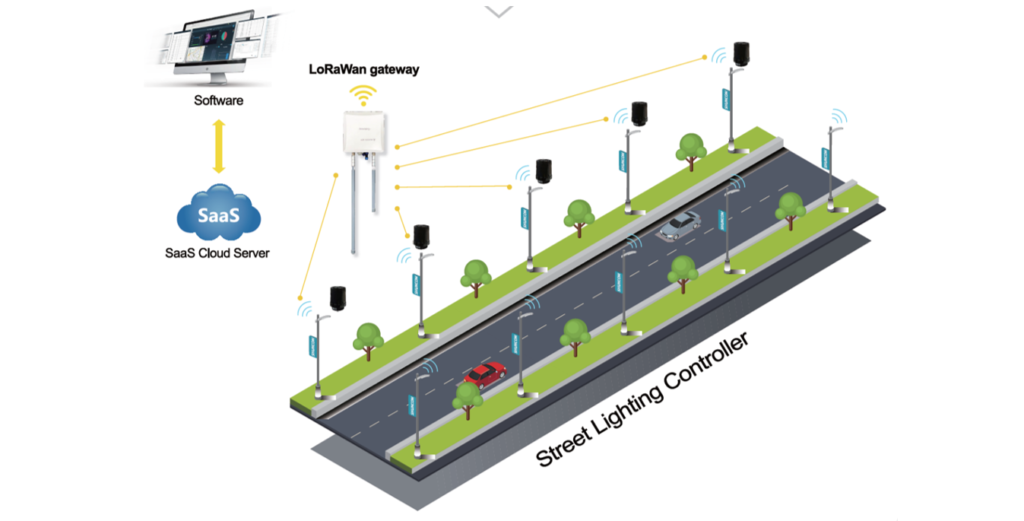
Typical LoRaWAN Lighting Network

LoRaWAN commonly uses a star-of-stars structure. Lighting controllers communicate wirelessly with available gateways, while the gateways use Ethernet, cellular or another backhaul connection to reach the network server and management platform.

01

Lighting Controller

A compatible node controls the fixture or lighting group and sends available status information.

02

LoRa Gateway

One or more gateways receive wireless messages from field nodes and forward them through the backhaul network.

03

Network Server

The server manages network communication, device sessions and message delivery between gateways and applications.

04

Lighting Platform

Authorized users create schedules, send commands and review available lighting and maintenance information.

Advantages for Lighting Projects

  • Long-range coverage for widely distributed lighting assets
  • Low communication power and relatively small data requirements
  • No SIM subscription for a properly deployed private LoRaWAN network
  • Flexible expansion when gateway capacity and coverage are planned correctly
  • Useful for retrofit projects where new communication cabling is difficult

Limitations to Consider

  • Low data rate makes it unsuitable for video or other high-bandwidth services
  • Latency may be higher than required for some immediate-response applications
  • Downlink capacity is more limited than simple uplink sensor reporting
  • Gateway placement and channel planning are necessary to prevent coverage gaps
  • Regional duty-cycle and transmission rules may limit message frequency
Regional frequency requirement: LoRa and LoRaWAN commonly operate in license-exempt Sub-GHz bands, but permitted frequencies, transmission power and duty-cycle rules differ by country or region. Hardware and network settings must be selected for the destination market.
`LoRaWAN smart street lighting control system with gateway and cloud software`
Lighting Operations

What a LoRa Lighting Control System Can Do

LoRa provides the wireless communication path. The available control, monitoring and reporting functions depend on the connected lighting controllers, LED drivers, sensors, gateways and management platform.

01

Remote Switching and Dimming

Compatible lighting controllers can receive remote on/off and dimming commands through the LoRa network.

  • Control by project, zone or lighting group
  • Individual fixture control when addressing is supported
  • Manual commands from an authorized platform
02

Scheduled Lighting Strategies

The system can apply different operating periods and brightness levels according to approved project schedules.

  • Timed on/off operation
  • Staged nighttime dimming
  • Separate schedules for different zones
03

Status and Fault Information

When supported by the controller and driver, operating information can be returned through the LoRa network for maintenance review.

  • Controller communication status
  • Configured abnormal-operation alerts
  • Faster identification of affected fixtures
04

Energy and Operating Records

Compatible metering equipment can provide selected energy and operating-hour information for project analysis.

  • Energy-use records by fixture or zone
  • Operating-time comparison
  • Review of schedule and dimming performance

LoRa Communication Does Not Create These Functions Alone

LoRa is the communication layer. It does not directly dim an LED driver, detect a failed lamp or calculate energy consumption. Those functions must be provided by compatible controllers, drivers, sensors, meters and software.

Procurement specifications should define both the required lighting functions and the communication architecture so suppliers do not quote a LoRa module without the necessary control and monitoring equipment.

Lighting Operations

What a LoRa Lighting Control System Can Do

LoRa provides the wireless communication path. The available control, monitoring and reporting functions depend on the connected lighting controllers, LED drivers, sensors, gateways and management platform.

01

Remote Switching and Dimming

Compatible lighting controllers can receive remote on/off and dimming commands through the LoRa network.

  • Control by project, zone or lighting group
  • Individual fixture control when addressing is supported
  • Manual commands from an authorized platform
02

Scheduled Lighting Strategies

The system can apply different operating periods and brightness levels according to approved project schedules.

  • Timed on/off operation
  • Staged nighttime dimming
  • Separate schedules for different zones
03

Status and Fault Information

When supported by the controller and driver, operating information can be returned through the LoRa network for maintenance review.

  • Controller communication status
  • Configured abnormal-operation alerts
  • Faster identification of affected fixtures
04

Energy and Operating Records

Compatible metering equipment can provide selected energy and operating-hour information for project analysis.

  • Energy-use records by fixture or zone
  • Operating-time comparison
  • Review of schedule and dimming performance

LoRa Communication Does Not Create These Functions Alone

LoRa is the communication layer. It does not directly dim an LED driver, detect a failed lamp or calculate energy consumption. Those functions must be provided by compatible controllers, drivers, sensors, meters and software.

Procurement specifications should define both the required lighting functions and the communication architecture so suppliers do not quote a LoRa module without the necessary control and monitoring equipment.

Project Suitability

Suitable Applications for LoRa Lighting Control

LoRa is most useful when lighting assets are widely distributed and exchange relatively small control or monitoring messages. Final suitability still depends on coverage, response requirements and local frequency regulations.

Strong Fit

Municipal Road Networks

LoRa can connect distributed street-light controllers across main roads, secondary roads and residential streets where installing new communication cables would be costly.

Strong Fit

Rural and Remote Roads

Long-distance communication can suit lighting assets installed across less densely developed areas, subject to gateway coverage, terrain and available backhaul connectivity.

Strong Fit

Industrial and Logistics Sites

Industrial parks, ports and logistics areas can use LoRa to coordinate lighting zones and return available status data across large outdoor sites.

Suitable

Campuses and Public Facilities

Schools, communities and public sites can manage distributed paths, roads and parking-area lighting through one compatible network.

Field Test Required

Tunnels and Obstructed Areas

LoRa may be used in tunnels or structurally complex locations, but gateways, antennas and repeater arrangements require site testing because concrete and metal can affect signal performance.

Not the Main Purpose

High-Data or Instant-Response Services

LoRa is not intended for continuous video, large data transfers or applications requiring consistently high-speed real-time response. Another network may be more suitable for those services.

Inputs Needed for LoRa Network Planning

These details help determine gateway quantity, placement, field-device configuration and whether LoRa is appropriate for the project.

  • Site layout and total coverage area
  • Fixture and controller quantities
  • Pole spacing and mounting height
  • Buildings, terrain and major obstructions
  • Required command-response time
  • Status-reporting frequency
  • Gateway power and backhaul availability
  • Destination-market frequency regulations
Safety-critical lighting: emergency or life-safety lighting should not depend solely on a remote LoRa command path. Required local control, emergency power and fail-safe operating logic must follow the applicable project standards and local regulations.
Buyer Questions

LoRa Lighting Control FAQ

These answers cover the main technical and procurement questions that should be confirmed before selecting LoRa communication for an outdoor lighting project.

Q

What is the difference between LoRa and LoRaWAN?

LoRa is the wireless modulation technology used to transmit relatively small data packets over long distances. LoRaWAN is the network protocol that defines how end devices, gateways, network servers and application platforms communicate and manage network access.

Q

What is the practical range of LoRa lighting control?

There is no single guaranteed range. Performance depends on terrain, buildings, antenna height, interference, transmission settings and gateway placement. Coverage should be evaluated through a site survey and field test before full deployment.

Q

Does a LoRa lighting network require a gateway?

A managed LoRaWAN system normally requires one or more gateways to forward messages between field controllers and the network server. Gateway quantity depends on the coverage area, node distribution, obstructions, redundancy requirements and practical capacity.

Q

Will the lights stop working if internet access is lost?

The lighting should retain a defined local fallback strategy. Supported controllers or gateways may store schedules and temporary data locally, while remote commands and cloud monitoring remain unavailable until the backhaul connection is restored.

Q

Can the same LoRa equipment be used in every country?

Not automatically. Permitted Sub-GHz frequency bands, transmission power and duty-cycle rules vary by market. Controllers, gateways, antennas and network settings must match the regulations of the destination country or region.

Q

Can LoRa control be added to existing LED street lights?

It may be possible when the existing fixture has a compatible dimming driver, suitable installation space and an appropriate controller interface. The power supply, enclosure, surge protection and gateway coverage must be checked before confirming a retrofit design.

Before ordering: confirm the regional frequency plan, controller and driver compatibility, gateway backhaul, practical node capacity, local fallback rules and required platform functions.

Case Studies

LoRa-based street lighting has already been deployed in multiple regions worldwide, proving its reliability and cost-effectiveness.

Transform Your Lighting Infrastructure with LoRa

LoRa smart street lighting has become a cornerstone of smart city infrastructure, offering long-range communication, low power consumption, and scalable integration. By adopting this solution, municipalities can achieve significant energy savings, simplify operations, and prepare for future urban innovations. Whether for new projects or retrofitting existing systems, LoRa provides a cost-effective and sustainable path toward intelligent lighting.

Ready to explore LoRa street lighting for your project? Contact us today to receive a tailored proposal and technical consultation.

Ask For A Quick Quote

We will contact you within 1 working day, please pay attention to the email with the suffix “info@ledmvs.com”.