
By Lighting Engineering Team, MVS Lighting — outdoor lighting manufacturer with 5 production lines and 15+ years experience
DALI and 0-10V are the two dimming protocols you’ll run into on most commercial LED floodlight projects. The short version: 0-10V is simpler and cheaper but one-way and unaddressed; DALI is digital, addressable, and reports data back — at a higher wiring and commissioning cost. Which one fits your project depends less on which is “better” and more on how much control granularity and feedback the project actually needs.
This guide covers how each protocol works, where each one wins, and what to check before you specify either one.
For the full floodlight selection framework, see our Complete LED Flood Light Guide or How to Choose the Right LED Flood Light.
What Is 0-10V Dimming?
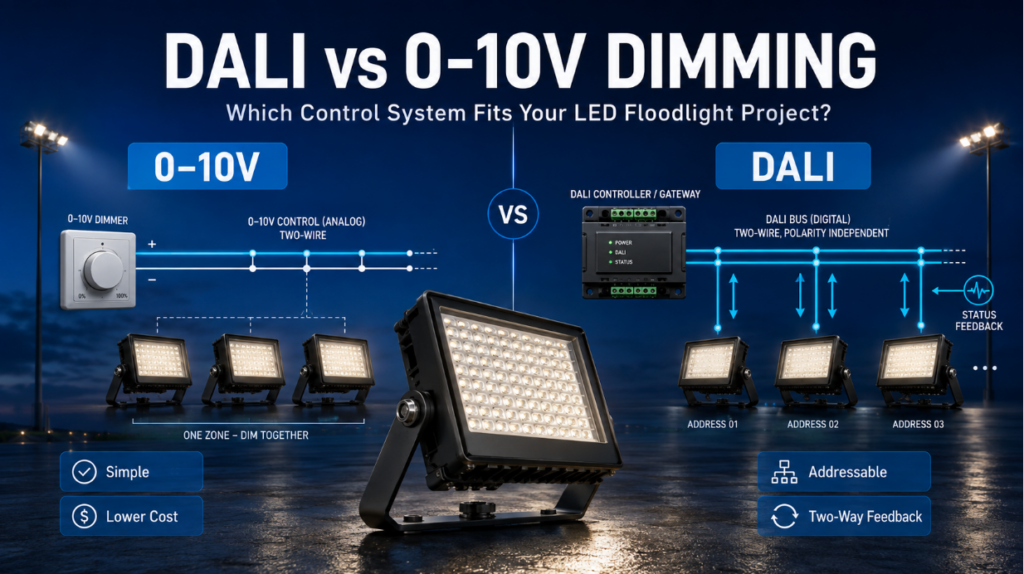
A 0-10V dimming system is an analog dimming method that adjusts brightness through voltage signals ranging from 0 to 10 volts. The system sends a low-voltage signal to the driver, which adjusts its output current to the LED load accordingly. At 10V, the floodlight runs at full brightness; at 0V, it dims to its minimum output or turns off, depending on driver configuration.
In a typical setup, three components are involved: a 0-10V dimmer/controller, the LED driver, and the floodlight itself.
- Dimmer outputs 10V → floodlight at 100% brightness
- Dimmer outputs 0V → floodlight at 0% or the driver’s preset minimum
- Intermediate voltages (1–9V) → proportional brightness
This is a linear, easy-to-wire, low-failure-rate system, widely valued for simplicity, broad compatibility, and cost.
What Is DALI?
DALI (Digital Addressable Lighting Interface) is a digital dimming protocol standardized under IEC 62386. Instead of a voltage level, DALI sends encoded digital commands over a 2-wire bus. Every DALI-enabled fixture on that bus has a unique address, so the controller can command individual fixtures, groups, or pre-set scenes — not just “everything on this circuit.”
The wiring itself is polarity-independent (it doesn’t matter which of the two wires connects to which terminal), which simplifies field wiring compared to 0-10V’s positive/negative requirement.
The key structural difference from 0-10V: DALI is bi-directional. The controller can query each fixture’s status, detect a failed unit, and in many systems read back energy or dimming-level data — none of which 0-10V can do, since its signal only travels one way, from dimmer to driver.
A single DALI bus supports up to 64 individually addressable devices.
DALI vs 0-10V: Core Technical Differences
| Factor | 0-10V | DALI |
|---|---|---|
| Signal type | Analog voltage (0–10V) | Digital, encoded commands (IEC 62386) |
| Direction | One-way (dimmer → driver only) | Two-way (controller ↔ fixture) |
| Addressability | Not addressable — all fixtures on a channel move together | Individually addressable, up to 64 devices per bus |
| Status feedback | None — no way to confirm a fixture actually dimmed or is still working | Yes — fault detection, dimming-level confirmation, and (on many systems) energy data |
| Wiring | Positive/negative polarity matters; each dimming channel needs its own wiring run | Polarity-independent 2-wire bus |
| Grouping / scenes | Requires separate wiring per group | Reconfigurable in software — no rewiring to change groups |
| Typical fixtures per controller | Roughly 10–15, depending on driver load | Up to 64 per bus |
| Commissioning complexity | Low — no addressing, no software | Higher — requires addressing and a DALI-capable controller/gateway |
| Relative cost | Lower upfront cost | Higher upfront cost; commissioning and documentation add to project cost |
| Best fit | Simple zones, fixed schedules, budget-driven projects | Projects needing fault reporting, energy monitoring, BMS integration, or frequently reconfigured zones |
Which Should You Choose?
The right protocol depends on what the project actually needs to do, not on which one is newer.
0-10V tends to fit:
- Straightforward area lighting where all fixtures in a zone dim together — parking lots, warehouse yards, industrial yards
- Budget-sensitive projects where commissioning simplicity matters more than data feedback
- Sites without an existing building management system (BMS) to integrate into
DALI tends to fit:
- Projects that need to know if a fixture has failed without sending someone to look — large sites with many fixtures, where manual fault-checking isn’t practical
- Sites targeting LEED, WELL, or similar certifications that require energy-monitoring data
- Facilities with an existing DALI-compatible BMS, or sports/stadium projects with complex, frequently-adjusted zone and scene requirements
- Layouts that change often — DALI groups can be reassigned in software instead of rewiring
Neither protocol fixes a poorly specified fixture. The driver, optics, and wiring still need to be right — the protocol only decides how much control and visibility you have over what you’ve installed.
Advantages and Limitations of 0-10V
Advantages:
- Simple, low-voltage analog system — easy to install and scale
- Wide dimming range, down to 1% or lower depending on driver quality
- Generally resilient to electrical noise
- Lower setup cost than DALI or DMX512
- Compatible with a wide range of common drivers and control brands
Limitations:
- Voltage signal can degrade over long wiring runs
- Each dimmable channel needs its own wiring back to the controller
- No feedback — the system cannot confirm a fixture is working or dimming correctly
- Dimming smoothness depends on installation quality (shielded wiring, proper grounding)
Advantages and Limitations of DALI
Advantages:
- Individually addressable — control single fixtures, groups, or scenes from one bus
- Bi-directional — detects faults and can report status/energy data
- Polarity-independent 2-wire bus, simpler physical wiring than 0-10V’s per-channel runs
- Groups and scenes are reconfigurable in software, without rewiring
- Standardized under IEC 62386, so DALI-certified components from different brands are designed to interoperate
Limitations:
- Higher component and commissioning cost than 0-10V
- Requires a DALI-capable controller/gateway and addressing at setup — not plug-and-play
- Commissioning needs more technical familiarity than a 0-10V install
- Overkill for a simple zone that just needs to dim up and down together
What to Check Before You Buy
Whichever protocol you’re specifying, confirm these before placing an order:
- Driver authenticity — confirm the driver supports native 0-10V or DALI input, not a simulated/converted signal
- Heat management — the housing needs adequate heat sinking to keep dimming performance stable over time
- Certifications — CE, RoHS, UL, or DLC compliance, as required for your project’s bidding documentation
- Signal compatibility — test against your existing building automation or dimming controller before committing to a quantity
- Dimming test reports — request IES files and dimming curves to confirm flicker-free, smooth output
- Supplier support — confirm the manufacturer can provide wiring diagrams, DALI addressing guidance (if applicable), and after-sales support
Dimming Spec Mistakes We See in Real RFQs
- “Dimmable” specified with no protocol named. A spec sheet or RFQ that just says “dimmable” doesn’t tell a supplier whether to quote a 0-10V driver or a DALI driver — the two aren’t interchangeable, and re-quoting after the fact delays the order.
- DALI specified assuming feedback data “just works.” DALI’s fault-reporting and energy data depend on the controller/gateway on the other end actually reading and displaying it — a DALI driver alone doesn’t give you a dashboard. Confirm the head-end system before assuming this capability is included.
- 0-10V wired with reversed polarity. Because 0-10V is polarity-sensitive and DALI isn’t, crews used to DALI wiring sometimes carry that habit into a 0-10V job and get inconsistent dimming as a result.
- Zone count decided after fixture count, not before. 0-10V’s per-channel wiring means the number of independent dimming zones should be decided at the design stage — retrofitting more zones later usually means adding wiring runs, not just a settings change.
Frequently Asked Questions
Can DALI and 0-10V be used on the same site? Yes, in different zones — for example, DALI in areas needing monitoring or scene control, and 0-10V in simpler perimeter or yard zones. They aren’t cross-compatible on the same wiring run without a dedicated interface converting between the two.
Is DALI always the “better” choice? Not necessarily. DALI adds cost and commissioning complexity that isn’t justified if a project just needs a zone to dim on a schedule with no fault reporting or scene requirements. 0-10V is often the more practical choice for straightforward area lighting.
How many fixtures can one 0-10V controller handle? Typically around 10–15, depending on the driver load per fixture and the controller’s rated capacity — always confirm against the specific controller’s datasheet rather than assuming a fixed number.
Does 0-10V support grouping and scenes like DALI? Not natively. Different groups on 0-10V require separate wiring runs from the controller, while DALI groups and scenes are configured in software without rewiring.
What happens if a 0-10V fixture fails — will I know? Not automatically. 0-10V has no feedback path, so a failed fixture typically isn’t detected until someone notices it visually or during a site walk. This is one of the main reasons larger or unattended sites often lean toward DALI.
Conclusion
0-10V and DALI solve the same basic problem — controlling brightness — with different trade-offs between simplicity/cost and control/visibility. For straightforward zone dimming on a budget, 0-10V remains a proven, cost-effective choice. For projects that need fault detection, energy monitoring, or software-configurable zones and scenes, DALI’s added cost is usually justified by what it gives back in visibility and flexibility.
If you need help specifying the right protocol for your project, our technical team can review your site requirements and provide wiring diagrams, IES files, and driver recommendations tailored to either system.
💡 Need help designing a custom dimming solution? [Contact MVS Lighting for technical drawings and driver configurations →]