01
Maintain Ball Visibility
Lighting must support clear visual tracking during serves, volleys and high shots. Adequate vertical illumination is important because the ball frequently travels above normal eye level.

Tennis court lighting must keep the ball visible during fast movement while limiting glare for players looking upward. Pole positions, mounting height, beam distribution and aiming therefore need to be planned as one complete lighting system.
MVS supplies IP65/IP66 LED floodlights with multiple optical options, optional lighting controls and a 5-year warranty. We support overseas contractors and project buyers with IES files, DIALux simulations and product selection based on the actual court layout.
A tennis court cannot be evaluated by brightness alone. Players must be able to follow a small, fast-moving ball across the full playing area without losing visibility against glare, shadows or uneven light.
Lighting must support clear visual tracking during serves, volleys and high shots. Adequate vertical illumination is important because the ball frequently travels above normal eye level.
Players often look upward when serving or following a lob. Floodlights must therefore be positioned and aimed to reduce direct glare within common playing and viewing directions.
Large brightness differences between the baseline, service boxes and net area make it harder to follow the ball. The layout should provide balanced coverage across the complete playing surface.
Outdoor courts may be close to homes, roads or other sports areas. Suitable optics and aiming help keep useful light on the court while reducing unnecessary light beyond the project boundary.
Pole height, pole position, court arrangement, beam angle, luminaire quantity and aiming direction must be assessed together before the final floodlight specification is confirmed.
The required lighting level depends on how the court will be used. Recreational play, club training and competition projects require different levels of visibility, uniformity and glare control.
| Application Level | Typical Use | Preliminary Illuminance | Design Priority |
|---|---|---|---|
| Recreational | Community courts, schools and casual evening play | Approximately 200 lux | Practical visibility, balanced coverage and controlled project cost |
| Club and Training | Tennis clubs, academies and regular training facilities | Approximately 300 lux | Improved uniformity, ball tracking and player comfort |
| Competition | Tournament courts and higher-level match venues | 500 lux or project-specific | Higher visual performance, stricter uniformity and detailed glare assessment |
A single court and a multi-court facility require different pole positions, quantities and aiming strategies.
Higher mounting can improve coverage but requires suitable output, optical control and structural support.
Pole locations should support cross-court coverage without interfering with normal play or player sightlines.
Nearby buildings, roads and residential boundaries may require tighter beam control and lower spill light.
Planning note: These values are preliminary reference points, not a final project specification. Required illuminance, uniformity and glare limits must be confirmed against the applicable local standard, competition level and client requirements.
MVS reviews the court arrangement and installation conditions before recommending floodlight wattage, beam distribution or quantity. This helps project buyers compare a complete layout instead of selecting products from wattage alone.
Confirm court dimensions, surrounding clearance, project boundaries and whether the facility contains one court or multiple courts.
Review the available pole locations, mounting heights and structural limitations that affect luminaire quantity and projection distance.
Match the beam angle and lumen output to the actual mounting geometry, target lighting level and required spill-light control.
Use photometric simulation to check average illuminance, uniformity, darker areas and the effect of each floodlight aiming direction.
Our team can prepare a preliminary DIALux lighting calculation using MVS photometric files. The proposal can be adjusted when pole locations, project targets or court arrangements change during the planning stage.
Practical guidance for contractors, facility owners and procurement teams planning an outdoor tennis court lighting project.
There is no fixed quantity for every court. The answer depends on court dimensions, pole quantity, mounting height, floodlight output, beam distribution and the required lighting level. A DIALux calculation should be completed before the final quantity is confirmed.
A preliminary reference is approximately 200 lux for recreational play, 300 lux for club or training use, and 500 lux or more for competition projects. The final requirement must follow the relevant local standard and project classification.
Mounting height should be determined together with pole position, court arrangement and beam angle. Higher poles may support broader coverage, but they can also require higher-output luminaires and different optics. Structural and local planning requirements must also be considered.
Glare can be reduced through suitable side-line pole positions, controlled beam distributions and accurate aiming. Floodlights should be kept away from important player sightlines, especially the upward viewing directions used during serves and high shots.
IP65 can be suitable for many outdoor projects, while IP66 provides stronger protection against water jets and severe weather exposure. The appropriate rating should be selected according to rainfall, cleaning methods, site exposure and local project requirements.
Yes, but the replacement should not be based only on the wattage of the old lamp. Existing pole height, bracket condition, circuit load, aiming direction and target lighting level should be checked before the LED floodlight model is selected.
Yes. Depending on the project, MVS floodlights can support options such as DALI or 0–10V dimming. The system can provide different lighting modes for maintenance, training and full-court use when matched with a suitable control design.
Please provide the court dimensions, site drawing, pole positions, mounting heights, supply voltage, target lighting level and any restrictions from nearby roads or properties. MVS can then prepare product recommendations and a preliminary lighting simulation.
MVS supports tennis court contractors and project buyers with outdoor LED floodlights, optical selection and preliminary lighting calculations based on real installation conditions.
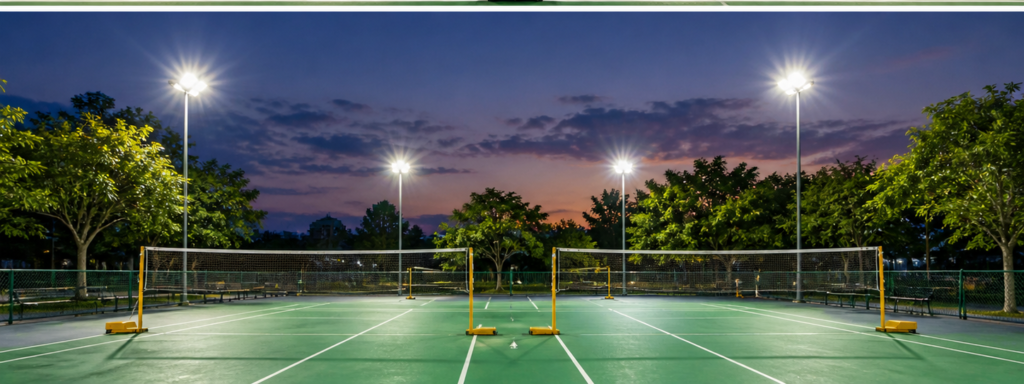
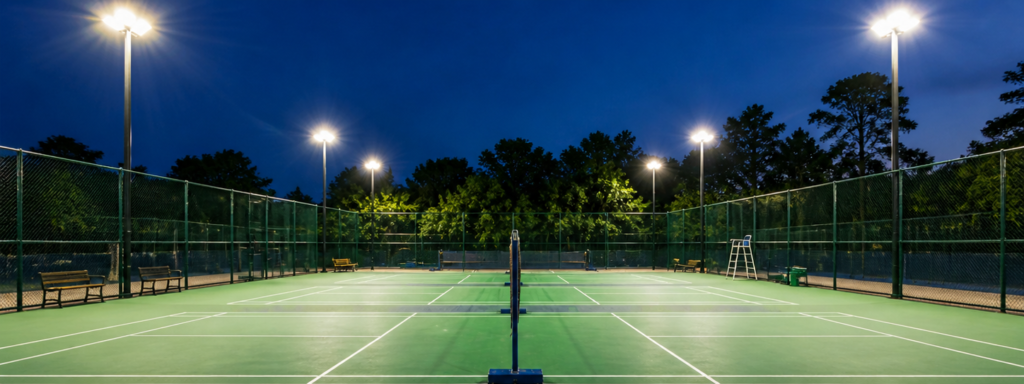
Project-grade LED floodlights for single courts, multi-court facilities, tennis clubs and training centres. Select the model according to pole height, projection distance, target lighting level and required beam control.
MVS Lighting
Professional LED Outdoor Lighting Supplier
Reply within 2 hours
Need LED lighting for your project?
WhatsApp Us
Online | Privacy policy
Get Quote on WhatsApp