
Home > LED Flood Lights > LED Floodlight Wattage Guide
By Lighting Engineering Team, MVS Lighting — outdoor lighting manufacturer with 5 production lines and 15+ years of outdoor lighting experience, serving global industrial and infrastructure projects. Last updated: 2026-July
If you are selecting LED flood lights for parking lots, industrial areas, sports facilities, or outdoor architectural lighting, the most important decision is not the brand — it is the wattage.
If the wattage is too low, illumination will not meet project requirements. If it is too high, both installation cost and long-term energy consumption increase unnecessarily. For most outdoor projects, correct wattage selection directly improves cost efficiency and reduces redesign risk.
So what is right for your project — 100W, 200W, 300W, or 500W? This guide shows you how to decide using application logic and a simple engineering calculation.
👉 Browse the full range: LED Flood Light Series → All Models & Specifications
What Does LED Flood Light Wattage Actually Mean?
Wattage is one of the most misunderstood parameters in lighting selection.
- Wattage = energy consumption
- Lumens = actual light output
Wattage does not directly define brightness.
| Power | Efficacy | Luminous Flux |
|---|---|---|
| 100W | 100 lm/W | 10,000 lm |
| 100W | 150 lm/W | 15,000 lm |
Even at the same wattage, brightness differs significantly depending on efficiency — which is why you should compare fixtures by lumens and efficacy, not watts alone.
👉 To set your target brightness in lux and convert it correctly, see the Floodlight Lux Guide #06.
Why Do Two 200W Flood Lights Perform Differently?
Two products with identical wattage can deliver very different results, for three reasons.
1. Luminous efficacy
- Entry level: 90–110 lm/W
- Engineering grade: 140–160 lm/W
At the same wattage this alone creates a 30–60% brightness gap.
2. LED chip quality
Premium chips such as Lumileds, Osram, and Cree provide higher output, better efficiency, and slower degradation over the product’s life.
3. Driver efficiency and thermal design
A high-quality driver ensures stable current output, lower heat, and longer lifespan. A weak driver lowers both brightness and life.
👉 Want fixtures that hold their output for years? See Why Some LED Flood Lights Last 10 Years #16.
LED Flood Light Wattage by Application
A quick engineering reference for field selection — pick your application, then open the dedicated guide for the full design.
| Application | Recommended Wattage | Product Direction |
|---|---|---|
| Billboards / building entrances | 50–100W | — |
| Small parking lots / warehouse perimeter | 150–200W | — |
| Basketball courts / logistics areas | 300–500W | → 300W LED flood light / 500W LED flood light |
| Stadiums / ports / airports | 750–1000W | → High-mast LED flood light system |
Target illuminance should follow recognized standards for each application — for example IES RP-8 for roadway and parking areas, and EN 12464-2 for outdoor work places.
Parking lots
Recommended: 150–200W 👉 Full design: Parking Lot Lighting Design Guide #10 · compare top fixtures: Best Flood Lights for Parking Lots #17
Stadium
Recommended: 150–200W 👉 Detailed guide: Stadium lighting Guide19
Basketball & sports courts
Recommended: 300–500W 👉 Court design: Basketball Lighting Design Guide #09 · lighting standards: Sports Field Lighting Standards #18
High-mast & large-area lighting
Recommended: 750–1000W 👉 Installation logic: Floodlight Mounting Height Guide #05
How to Calculate the Right Wattage
Once you know your total lumen requirement (see Floodlight Lux Guide #06 for how to calculate it), wattage can be estimated with one conversion:
Wattage = Total Lumens Required ÷ Luminous Efficacy
Example:
- Required lumens: 60,000 lm
- Efficacy: 150 lm/W
- Result:
60,000 ÷ 150 =400W total LED output
This tells you the total wattage your system needs. How many fixtures deliver that output — and how to space them — is a separate step: see How Many Floodlights Do I Need #13.
100W vs 200W vs 300W vs 500W — Quick Selection
| Wattage | Typical application |
|---|---|
| 100W | Small commercial areas, signage |
| 200W | Parking lots, warehouse zones |
| 300W | Basketball courts, sports fields |
| 500W | Ports, high-mast lighting |
Beyond wattage, a project-grade fixture should also have the right IP rating #14 and surge protection #20, plus a reliable driver (Philips, Mean Well, MOSO).
Free Lighting Design for Your Project
Not sure which wattage is correct for your site? Our engineering team will provide a free DIALux lighting plan.
You will receive:
- Wattage recommendation
- Lighting layout
- Fixture quantity
- Illumination simulation
- Project quotation
Just send us:
- Project area size
- Mounting height
- Target lux level
📩 Request My Free Lighting Plan → (delivered within 24 hours)
LED Flood Light vs Metal Halide Upgrade
Upgrading from metal halide depends on project conditions and target lux. 👉 For the full MH-to-LED conversion chart, see: LED vs Metal Halide Guide #07.
📌 Real Project Example
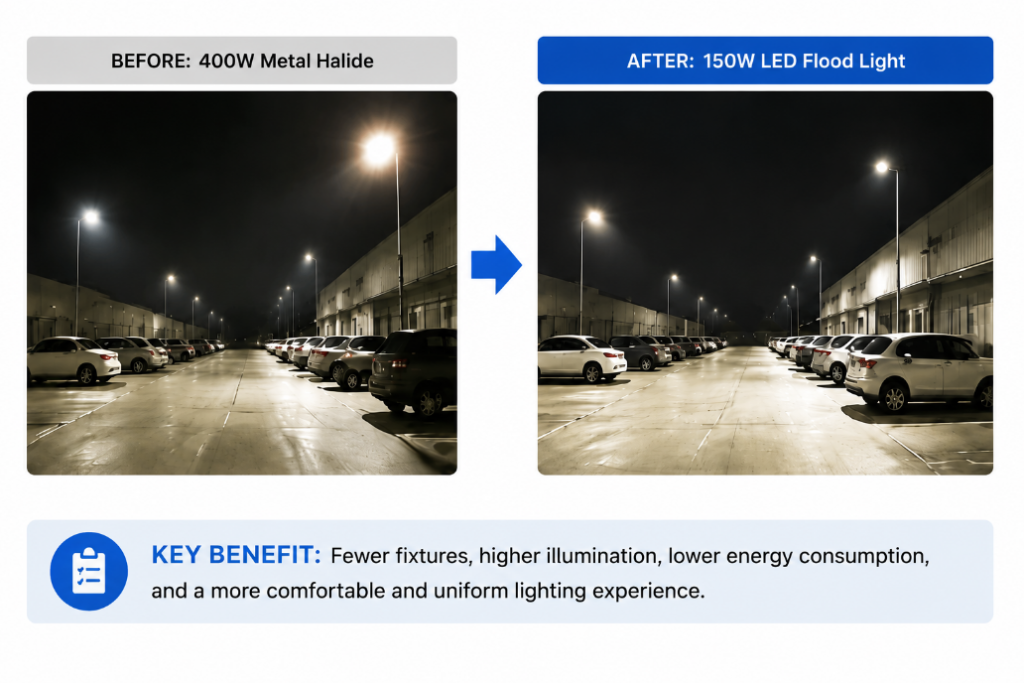
A 1,200 m² parking lot in Southeast Asia originally ran on 400W metal halide fixtures. After redesign:
- Replaced with 150W LED flood lights
- Total fixture count reduced by 28%
- Measured illumination improved from 120 lux to 160 lux
- Energy consumption reduced significantly
The improvement came from the LED system’s higher optical utilization and precise aiming — directional LED optics place usable light onto the target area, while the old metal halide fixtures lost much of their output to spill and glare.
FAQ
What wattage is suitable for parking lots? Most parking lots use 150W–300W depending on pole height and layout. See the Parking Lot Lighting Design Guide #10 for the full layout.
How large an area can a 200W flood light cover? It depends on mounting height, beam angle, and target lux level — there is no fixed value. Use the wattage calculation above to size it for your site.
What wattage is needed for basketball courts? Typically 300W or higher, depending on the required illumination level and layout. See Basketball Lighting Design Guide #09.
Is 500W always better than 300W? No. If 300W already meets the required lux level, 500W only adds cost and energy use with no benefit.
Does higher wattage always mean brighter light? No. Luminous efficacy and optical design matter more than wattage alone.