
Written by Chris Choi, Technical Sales Manager at MVS Lighting, with practical experience supporting overseas buyers on LED street lighting projects.
An LED street light is compatible with a project only when the site supply voltage falls within the rated input range of its LED driver. A 100–277V AC street light can generally operate on common 120V, 220V, 230V, 240V and 277V supplies, but it must not be connected directly to a 347V or 480V circuit unless the driver is specifically rated for that voltage. Before ordering, buyers should confirm the nominal voltage, frequency, wiring method, and permitted voltage fluctuation — not just the destination country.
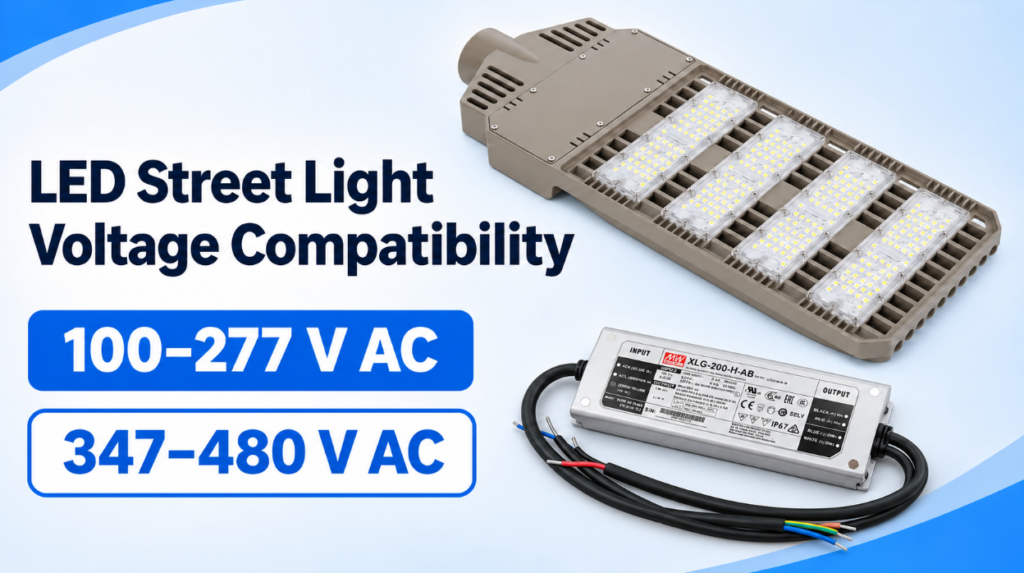
Street Light Voltage Compatibility Chart
| Power Supply | 100–277V Driver | 347–480V Driver | Project Action |
|---|---|---|---|
| 120V | Compatible | Not applicable | Confirm frequency and wiring |
| 220–240V | Compatible | Not applicable | Common export project range |
| 277V | Near upper limit | Not applicable | Confirm driver label and tolerance |
| 347V / 480V | Not compatible | Requires dedicated driver | Specify high-voltage driver or transformer solution |
120V Power Supply
120V generally falls within a 100–277V driver’s input range, but frequency and any project-specific requirements should still be checked.
220–240V Power Supply
220V, 230V, and 240V are typically supported by a wide-range 100–277V driver, and this is a common supply range for export projects.
277V Power Supply
277V can sit near the upper limit of a 100–277V driver’s input range — confirm the driver label and the permitted voltage tolerance before assuming compatibility.
347V and 480V Power Supply
These require a driver explicitly rated for 347–480V input, or a project-level voltage conversion solution. Don’t assume a particular country always uses one fixed voltage — the actual circuit on a given project can differ.
For a broader overview of road lighting fixtures and project planning, see our LED street light guide.
How to Read the Driver Input Label
Rated Input Voltage
Driver labels state an input range, such as 100–277V AC or 220–240V AC — this is the number to check first.
Input Frequency
Also check whether the driver supports 50Hz, 60Hz, or both (50/60Hz).
Voltage Tolerance
Actual grid voltage fluctuates around its nominal value — don’t rely on a single fixed number when checking compatibility.
AC Input and DC Output
The fixture receives AC power, and the LED driver converts it to the DC output the LED modules require. This guide doesn’t go into driver circuit design in detail.
What Does 100–277V Mean?
Common Supported Voltages
A wide-range 100–277V driver typically covers most common low-voltage lighting circuits used internationally.
Automatic Input Adaptation
A qualified wide-range driver operates automatically within its labeled range — there’s usually no manual switch between a “120V mode” and a “230V mode.”
Limits of a 100–277V Driver
A few limits are worth stating plainly:
- 277V is already near the top of this range.
- 347V and 480V fall outside it entirely.
- A matching plug or wiring type doesn’t mean the voltage is compatible.
- The driver nameplate and datasheet are the final reference, not assumptions based on region.
When Is a 347–480V Driver Required?
High-Voltage Lighting Circuits
Some industrial, municipal, or large infrastructure projects run on 347V, 480V, or other high-voltage lighting circuits.
Dedicated High-Voltage Drivers
These projects need a driver explicitly rated for the corresponding input range — simply rewiring a standard fixture isn’t sufficient.
Transformer Alternative
Some projects use a transformer to supply a compatible voltage instead. This is a project-level electrical decision that should be confirmed by a qualified electrical engineer, not assumed at the fixture level.
Confirm Before Production
A high-voltage driver can affect:
- Internal fixture space
- Driver model
- Wiring method
- Certification scope
- Cost and lead time
This needs to be confirmed before quotation and production, not after.
Global Voltage Guide for Buyers
This section is a starting reference, not a country-by-country encyclopedia.
120V Projects
Confirm the site actually uses a 120V lighting circuit, along with frequency and wiring conditions — don’t assume based on country alone.
220–240V Projects
220V, 230V, and 240V are generally covered by a wide-range 100–277V driver.
277V Projects
Check whether the actual voltage fluctuation still falls within the driver’s permitted range.
347–480V Projects
These require specifying a high-voltage driver upfront, or providing the project’s electrical drawings.
Project Voltage Matters More Than Country
The same country can have residential, commercial, industrial, and municipal circuits running at different voltages — a country name alone isn’t enough to confirm compatibility.
Check the Wiring Configuration
Line-to-Neutral Voltage
Confirm whether the voltage the project has provided is the actual supply voltage measured between line and neutral.
Line-to-Line Voltage
Voltage measured between two line conductors can differ from what the fixture actually receives — this distinction matters on three-phase systems.
Grounding Requirements
Fixture grounding must follow the project’s electrical code and installation requirements.
Ask for the Electrical Diagram
If the project uses 347V, 480V, or three-phase distribution, request the electrical diagram or distribution documentation from the buyer. This section only helps confirm the fixture’s actual input voltage — it doesn’t cover distribution system design.
How Incorrect Voltage Damages a Street Light
Overvoltage
Input voltage above the driver’s rated range can trigger protection circuits, cause overheating, or damage the driver.
Undervoltage
Voltage below the rated range can cause failure to start, flickering, or abnormal output.
Repeated Voltage Fluctuation
Ongoing unstable supply can reduce the long-term reliability of the driver and other electronic components.
Wrong Driver Configuration
Even with identical housing and LED modules, the wrong driver input range can make a fixture unusable on site.
Voltage Compatibility vs Surge Protection
This is the boundary between this guide and our surge protection guide.
Operating Voltage
This guide covers whether a fixture can operate continuously under normal grid conditions.
Transient Surge Voltage
A surge is a brief high-voltage event caused by lightning, switching operations, or grid disturbances — it’s a different condition from normal operating voltage.
Both Requirements Must Be Confirmed
Supporting a 240V or 480V normal input doesn’t by itself mean a fixture has adequate surge protection.
Normal input voltage and transient surge protection are different requirements. Review our LED street light surge protection guide when specifying SPD levels for the project. 6kV, 10kV, 20kV ratings, SPD selection, and grounding principles are covered there, not here.
What Buyers Should Confirm
- Nominal supply voltage — the fixture’s actual connection voltage, not just a country name.
- Frequency — 50Hz, 60Hz, or other project requirement.
- Voltage fluctuation — the maximum and minimum input range permitted by the local grid or project documentation.
- Wiring method — line-to-neutral or another configuration.
- Driver and certification requirements — confirming whether the specified driver, high-voltage version, and certifications cover the actual input voltage.
Voltage compatibility should be checked together with wattage, optics, protection, and control requirements when you choose LED street lights for a road project.
Common Voltage Selection Mistakes
Providing the Country Only
A country name doesn’t substitute for actual supply parameters.
Confusing 277V With 347V
These aren’t interchangeable — a driver rated for one isn’t automatically compatible with the other.
Assuming All Drivers Are Universal
A “wide-range” driver still has a defined upper and lower input limit.
Ignoring Voltage Fluctuation
Confirming only the nominal voltage, without checking the site’s actual maximum voltage.
Confirming Voltage After Production
A high-voltage driver can affect structure, cost, certification, and lead time — this should be settled before production starts, not after.
Confirm Voltage Before Ordering
LED street light voltage compatibility is determined by the driver’s rated input range. A 100–277V fixture generally covers common 120V and 220–240V projects, while 347V or 480V circuits require a dedicated high-voltage driver or an approved voltage-conversion solution. Buyers should confirm the actual circuit voltage, frequency, wiring, and voltage tolerance before approving the product configuration.
After confirming the project power supply, review our LED streetlight series for fixtures that can be configured with suitable input-voltage and driver options.
Not sure whether the street lights are compatible with your local power supply? Send MVS Lighting the nominal voltage, frequency, wiring diagram, required wattage, quantity, and destination. Our team can check the driver compatibility and confirm the correct electrical configuration before quotation and production.
Frequently Asked Questions
1. Can the same LED street light work on both 120V and 240V?
Yes, if its driver is rated for an input range that includes both voltages, such as 100–277V AC. Confirm the input frequency and wiring requirements in the driver datasheet before ordering.
2. Can I connect a 100–277V LED street light directly to 480V?
No. A 480V supply exceeds its rated input range. Specify a driver rated for the actual 480V circuit or have the project’s electrical engineer confirm a suitable voltage-conversion solution.
3. Does a 10kV surge protection rating mean the street light supports 480V input?
No. A 10kV surge rating concerns brief transient events. Continuous operating voltage depends on the driver’s rated AC input range. Confirm both specifications separately.
4. Can I change a street light’s input voltage by replacing its driver?
A driver replacement may be possible, but the manufacturer must check LED output compatibility, installation space, thermal conditions, wiring, control compatibility, and certification coverage. Confirm the complete fixture configuration before approving the replacement.
5. What power supply information should I provide when requesting a quotation?
Provide the actual voltage across the fixture’s supply conductors, frequency, wiring configuration, and expected voltage fluctuation. Include an electrical drawing when available, especially for 347V, 480V, or three-phase distribution projects.
[Check Voltage Compatibility] [Send Your Electrical Requirements]