
By Lighting Engineering Team, MVS Lighting — outdoor lighting manufacturer with 5 production lines and 15+ years experience
Introduction
If you’re evaluating whether to convert your existing metal halide (MH) floodlights to LED, the answer is clear for most parking lots, warehouses, industrial parks and high-mast projects: LED wins on energy, maintenance, lifespan and long-term operating cost. The real question is no longer whether to switch, but how to convert and how fast it pays back.
The most common mistake in any conversion is replacing watt-for-watt, which usually leads to under-lighting or over-spending. The right approach is to size by lumens and target lux, not wattage. This guide gives you a complete metal halide to LED conversion chart, a transparent ROI model, and the three retrofit paths (including conversion kits) — so procurement and engineering teams can move quickly.
For the full floodlight selection logic across all project scenarios, see our Complete LED Flood Light Guide.
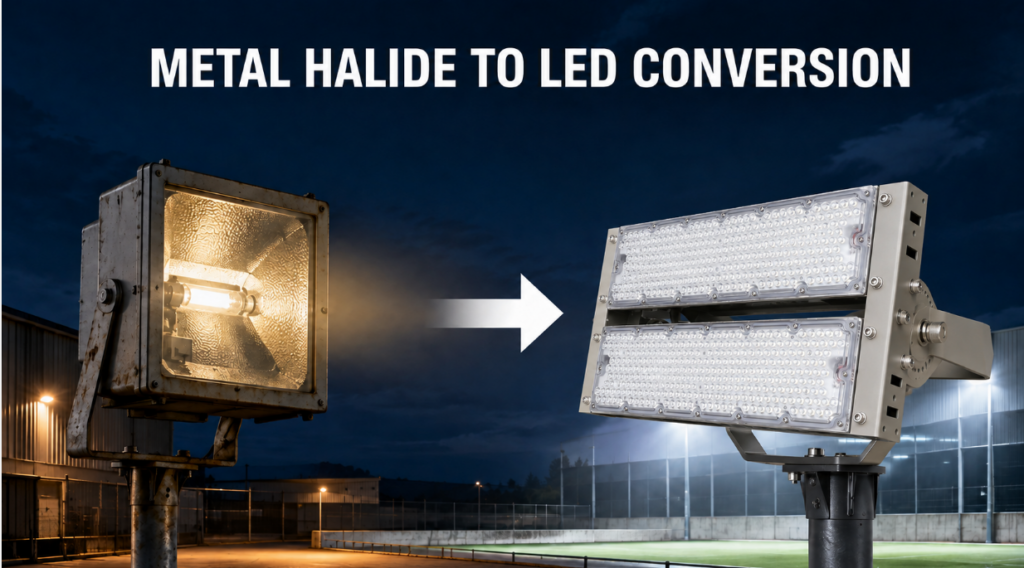
Why Commercial Projects Are Converting Metal Halide to LED
Four forces are driving large-scale MH-to-LED conversions:
- Energy regulations and electricity costs. Many regions are phasing out inefficient HID sources, and with rising commercial power rates, long-running sites carry a heavy energy burden.
- High maintenance. Metal halide relies on lamp + ballast + ignitor; when any part ages, the fixture goes down. High-mast and large-area sites also face lift-equipment and labor costs.
- Operational pain points. Parking lots running all night, warehouse yards operating 24/7, ports and industrial parks with high-mast lighting — these are exactly where MH operating costs are magnified.
- LED is now the standard replacement. As LED efficacy has matured, both new builds and retrofits default to LED floodlights.
Is it time to upgrade your specific project? It’s usually worth evaluating a conversion if any of the following apply:
- Electricity costs keep rising and lighting is a meaningful share of the load
- Maintenance visits (lamp/ballast replacement) are becoming more frequent
- On-site brightness has visibly declined compared to when the fixtures were new
- The site is planned for continued long-term operation, not near end-of-life demolition
- You need to add smart control, scheduling or dimming, which metal halide can’t support well
If two or more of these apply, the payback model later in this guide will usually justify moving ahead.
Metal Halide vs LED: The Core Technical Differences
This section explains why a lower-wattage LED can actually deliver more usable light — the foundation of the whole conversion logic.
- Efficacy (lm/W). LED floodlights deliver roughly 120–160 lm/W (premium products higher), while metal halide sits around 35–80 lm/W — and that’s the bare lamp figure; after reflector and housing losses, the system efficacy is lower still.
- Energy structure. Metal halide converts roughly 70–80% of input power into heat rather than light, so it needs higher wattage to hit the same illuminance. LED converts most of its power directly into light, with far less heat.
- Ballast loss. Metal halide requires a ballast to strike and regulate the lamp, which itself consumes an additional 10–15% of system wattage — a “400W” fixture may actually draw 450–460W from the grid. LED is direct-drive with no ballast, so there’s no equivalent loss.
- Light distribution (key). Metal halide is 360° omnidirectional and depends on reflectors to push light back toward the target — a process that typically loses 30–40% of the output. LED is directional, sending light straight to the area that needs it, so usable lux on the ground is equal or higher even at lower lumens.
- Mercury and disposal. Metal halide contains mercury and requires special end-of-life handling; LED is mercury-free, easing ESG/compliance requirements and disposal costs.
Bottom line: don’t compare lamp wattage — compare lm/W × light utilization → delivered lux.
Metal Halide vs LED Floodlight: Key Performance Comparison
| Metric | Metal Halide (MH) | LED Floodlight |
|---|---|---|
| Efficacy (lm/W) | 35–80 (lower at system level) | 120–160+ |
| Color Rendering (CRI) | 65–70 | 70–95+ |
| Color Stability | Shifts over time | Stable for life |
| Typical Lifespan | 6,000–20,000 hours | 50,000+ hours |
| Lumen Maintenance | ~40–50% loss within 6–12 months | L70 @ 50,000–100,000h |
| Ballast Loss | Additional 10–15% of system wattage | None — direct-drive, no ballast required |
| Start-up Time | Several minutes warm-up | Instant on |
| Hot Restrike | 10–15 min cool-down after power interruption | Milliseconds |
| Beam / Distribution | 360° + reflector loss | Directional, high utilization |
| Maintenance Cycle | Frequent (lamp/ballast/ignitor) | Long, near maintenance-free |
| Smart Control | Limited | Supported (dimming, timer, sensor-based control) |
| Mercury Content | Contains mercury | Mercury-free |
| Rebate / Incentive Eligibility | Not eligible | DLC-listed: utility rebate eligible |
Conversion Principle: Match by Lumens & Lux, Not Watts
The one correct rule for conversion sizing:
❌ Don’t replace watt-for-watt (the most common cause of under-lighting).
✅ Do design by target lumens and target lux, taking advantage of LED’s directional output (the same lux usually needs fewer watts).
Practical path: determine the site’s target lux (per the relevant application standard) → back-calculate the required lumens → then select the LED wattage. The chart below gives common starting points, but final wattage must be confirmed by a lux-based layout.
This article covers conversion sizing specifically — for general application-based wattage selection on new-build projects (not a metal halide replacement), see our Wattage Guide.
To calculate by site, use the LED Lighting Calculator; for parking layouts see Parking Lot Lighting Design
Metal Halide to LED Conversion Chart (by Lumens)
Common starting points — confirm final wattage with a lux-based layout for your site.
| Metal Halide (MH) | Approx. Lumens | Recommended LED | Typical Application | Product Page |
|---|---|---|---|---|
| 175W MH | ~9,000–13,000 lm | 65–100W LED | Pathways / small perimeter / signage | 65W · 100W |
| 250W MH | ~13,000–18,000 lm | 100–150W LED | Small parking lots / walkways | 100W · 150W |
| 400W MH | ~20,000–28,000 lm | 150–200W LED | Parking lots / warehouse yards | 150W · 200W |
| 600W MH | ~30,000–40,000 lm | 240–300W LED | Large yards / loading areas | 300W |
| 750W MH | ~40,000–50,000 lm | 300–400W LED | Industrial parks / large areas | 300W · 400W |
| 1000W MH | ~55,000–75,000 lm | 400–500W LED | High-mast / ports / heavy-duty | 400W · 500W |
| 1500W MH | ~80,000–110,000 lm | 750–1000W LED | Stadiums / extra-high masts | 750W · 1000W |
Not sure of target lux? Use the LED Lighting Calculator to back-calculate required lumens first.
Lumen Depreciation & Lifespan: L70 vs MH’s 50% Drop
Many sites hit the same problem a few years into metal halide: the lamps still work, but the area is visibly darker.
Metal halide can lose ~20% of its lumens in the first 6 months and up to ~50% by mid-rated-life; rated life is typically 6,000–20,000 hours. In other words, even when the lamp isn’t dead, the light level may already be out of spec.
LED is measured by L70 (hours to maintain 70% of initial output), reaching 50,000–100,000 hours on quality products, with stable output over time.
For parking lots, logistics centers and industrial parks that need consistent illuminance, “no fade” is itself a safety and compliance value — not just saved lamps.
Color Quality (CRI) for Parking, Security & Sports
Color rendering and stability directly affect security-camera recognition, license-plate reading and overall visibility:
- CRI: quality LED floodlights reach 70–95+, vs 65–70 for metal halide.
- Color shift: metal halide drifts in color temperature over its life; LED stays stable.
- Where it matters: parking and perimeter security need stable, true white light for camera systems; sports and field lighting demand higher uniformity and rendering — see our Stadium LED Flood Lights Guide for dedicated sports/field projects.
Instant-On & Hot Restrike: A Real Operational Advantage
This is an underrated weakness of metal halide.
Metal halide needs several minutes to warm up to full output — and critically, after a power blip it requires a 10–15 minute cool-down before it can restrike. For continuous-operation warehouses, ports and security-critical sites, that “dark window” is a real risk.
LED turns on and off instantly, restrikes in milliseconds after an outage, and supports frequent switching plus sensor/dimming integration.
Energy & ROI: A Transparent Payback Model (Before / After Rebate)
The question procurement really asks isn’t “is LED expensive?” — it’s “how fast does it pay back?” Here is a model you can reuse (figures below are illustrative assumptions — replace with your project’s real parameters).
Annual energy & cost formulas
Annual kWh = system kW × quantity × hours/day × days/year
Annual cost = annual kWh × rate per kWh
Example (assumption): 100 × 400W MH → 100 × 180W LED (Assumes: MH draws ~460W incl. ballast loss; 12h/day; 365 days; $0.12/kWh)
| Item | Metal Halide | LED |
|---|---|---|
| System power per fixture | ~0.46 kW | 0.18 kW |
| Annual energy | ~201,480 kWh | ~78,840 kWh |
| Annual energy cost | ~$24,178 | ~$9,461 |
| Annual saving (energy only) | — | ~$14,717 (≈61%) |
Add maintenance savings on top (no periodic lamp/ballast replacement, less lift work).
Payback (example): Assume total project cost ~$30,000 (incl. install) → ~2-year payback on energy alone. With DLC rebates (assume $150/fixture × 100 = $15,000) → net cost drops to ~$15,000 → payback shortens to ~1 year.
The figures above are a worked example, not a project result — actual payback depends on your local electricity rate, operating hours, original fixture wattage, and applicable rebate program. Contact our engineering team with your current fixture details for a project-specific estimate.
To compare floodlight price ranges, see our Price Guide. For a project-specific payback calculation, use our [ROI Calculator
DLC Listing & Utility Rebates: How Incentives Shorten Payback
This is where you can differentiate from generic comparison content — and it directly affects ROI (especially for North American projects):
- DLC (DesignLights Consortium) has Standard and Premium tiers, and only DLC-listed LED fixtures qualify for utility rebates.
- Many North American utilities offer commercial LED retrofit rebates around $100–$200 per floodlight fixture (high bay can be higher); some require pre-approval.
- Rebates offset project cost directly, shortening payback from 2–3 years to roughly 1–1.5 years (see the ROI example above).
- Always confirm a product is DLC-listed and eligible under the target project’s local utility program before specifying.
Suggested authority links (insert official URLs at publish): [DesignLights Consortium QPL → designlights.org], [ENERGY STAR / U.S. DOE → energy.gov]
Three Conversion Methods (incl. Retrofit / Conversion Kit)
Choose your path based on the condition of the existing fixtures and budget.
1. Lamp / Conversion Kit Retrofit Keep the existing housing and pole; replace only the light source with an LED module or LED conversion/retrofit kit. Low cost and fast install; suitable where the housing is in good shape and the ballast can be bypassed or removed. Confirm heat dissipation and ingress protection are adequate for outdoor use.
2. Fixture Replacement Swap in a complete LED floodlight while keeping the existing pole and wiring. This is the most common and most reliable path for outdoor floodlight conversions — best optics, thermal management and IP rating, and it keeps full fixture warranty and DLC eligibility.
3. Full System Upgrade Used when fixtures are aged, wiring/poles are non-compliant, or smart control is being added — and may involve rewiring and control deployment. Adding dimming/smart control during conversion is a common way to amplify savings (scheduling, sensors and zoned dimming reduce energy further).
Most outdoor projects choose “fixture replacement” — size directly from the chart above.
For projects adding control during conversion, see Smart LED Floodlight or DALI Dimmable LED Floodlight; for protocol choice, [DALI vs 0-10V Dimming].
Common Customer Concerns During Retrofit
From our experience, customers replacing metal-halide floodlights with LED usually have three practical concerns.
1. What LED Wattage Is Required?
The first question is whether the new LED floodlight can achieve the same or better lighting result than the original metal-halide fixture.
LED replacement should not be based on wattage alone. The original fixture wattage, lumen depreciation, mounting height, beam angle, target lux and site dimensions must all be considered. A lower-wattage LED fixture may outperform an older metal-halide fixture, but the final selection should be confirmed through photometric data and lighting simulation.
The goal is not simply to make the site “much brighter.” A successful retrofit should provide sufficient illuminance, better uniformity and lower energy consumption without creating excessive glare.
2. Will Installation Be Complicated?
Traditional metal-halide floodlights often use a large box-shaped housing containing a replaceable lamp, ballast and other electrical components. Customers may worry that replacing the complete fixture with an LED floodlight will require major changes to the existing wiring and mounting structure.
In many retrofit projects, the existing pole and lighting position can be retained. The old metal-halide fixture and ballast are removed, and the new LED floodlight is connected directly to the appropriate AC supply. LED floodlights with adjustable mounting brackets can be fixed to the existing structure or to a suitable adaptor, with the bracket angle then adjusted to the required aiming direction.
Before installation, the contractor should still confirm:
- Input voltage and wiring method
- Existing cable condition
- Mounting-hole dimensions
- Bracket and adaptor compatibility
- Earthing and surge protection
- Weight and wind-load suitability
- Local electrical and installation requirements
The electrical work should be completed by a qualified installer.
3. Will Lux and Uniformity Be Adequate?
Customers are not only concerned about whether the new fixtures are bright enough. They also want to know whether the entire site will have adequate illuminance and acceptable uniformity.
For one project with eight existing lighting positions, our preliminary configuration used 400W LED floodlights installed at a height of approximately 7 metres — see our Mounting Height Guide for how mounting height is typically determined. Each mounting arm extended about 1 metre from the supporting structure. The fixtures used an adjustable bracket and could be aimed at an inclined angle. Asymmetric optics were also considered to direct more light toward the target area and reduce wasted light behind the fixture — see our Beam Angle Guide for how beam distribution is selected.
| Project Item | Configuration |
|---|---|
| Existing lighting positions | 8 |
| Proposed LED power | 400W per position |
| Installation height | Approximately 7 metres |
| Arm extension | Approximately 1 metre |
| Mounting method | Adjustable bracket |
| Optical option | Asymmetric distribution |
| Final confirmation | Lighting simulation and on-site aiming |
The adjustable bracket makes installation and final aiming relatively straightforward. This configuration should not be treated as a universal solution for every site — the final wattage, beam angle and aiming direction must be confirmed according to the site dimensions, required lux level and uniformity target.
From our engineering team: In our view, the most important part of a metal-halide retrofit is not finding an LED fixture with a roughly equivalent wattage. It is confirming that the new fixture can fit the existing mounting position, connect safely to the electrical system, and deliver the required lux and uniformity. If these three points are checked before production, the actual replacement process is usually much simpler than customers expect.
Whichever site type you’re converting, the sizing and installation principles above apply the same way — Parking Lot Flood Lights, Warehouse Flood Lights and Commercial / Outdoor Flood Lights cover the fixture options for each scenario in more depth.
Common Mistakes When Converting Metal Halide to LED
- Replacing watt-for-watt — ignores LED’s directional advantage; causes under-lighting or over-spending.
- Ignoring optics/distribution — looking only at lumens, not beam angle and uniformity; ground lux falls short.
- Ignoring DLC eligibility — specifying a product not on the QPL forfeits rebates and lengthens payback.
- Ignoring IP rating and surge protection — inadequate protection outdoors raises failure rates. For guidance on why upfront cost isn’t the full picture here, see our [Project-Grade vs Cheap LED Flood Lights — 待补:#26尚未上线,暂无真实URL] comparison of long-term TCO.
- Comparing fixture price alone, without factoring in operating cost — a cheaper unit that fails early or draws more power can cost more over 5–10 years than a higher-spec product.
Avoiding these five is the prerequisite for a strong ROI.
Frequently Asked Questions
What wattage LED replaces a 400W metal halide floodlight? A 150–200W LED floodlight (about 20,000–28,000 lumens) typically replaces a 400W MH. Because LED light is directional and more efficient, you usually need fewer watts to reach the same ground-level lux. Always confirm with a lux-based layout rather than matching watt-for-watt.
Is LED brighter than metal halide? On raw lamp lumens an LED isn’t always higher, but thanks to directional optics and higher light utilization, an LED floodlight usually delivers equal or higher usable lux on the target area — and it avoids the rapid lumen depreciation of metal halide, so it stays bright far longer.
Do I need to rewire to convert metal halide to LED? In most cases, no. A full-fixture replacement or an LED conversion/retrofit kit keeps the existing poles and wiring. Rewiring is only needed when wiring is aged, the pole is non-compliant, or you’re adding smart control or dimming.
Do I need to replace the ballast when switching to LED? Direct-wire LED replacements bypass the ballast entirely, eliminating both its energy loss and its future failure risk. Conversion/retrofit kits also typically remove or bypass the ballast — confirm this with your fixture supplier before install.
How fast do LED floodlights pay back after a metal halide conversion? Long-running commercial projects typically pay back in 1.5–3 years from energy and maintenance savings alone. Where DLC-listed fixtures qualify for utility rebates, payback can shorten to roughly 1–1.5 years.
Can I replace just the lamp with a conversion kit? Yes. An LED conversion or retrofit kit lets you keep the original housing and pole. First confirm heat dissipation, IP rating and ballast bypass suit outdoor use; otherwise a full-fixture replacement is the safer option.
Are there rebates for converting metal halide to LED? In North America and other regions, DLC-listed LED fixtures can qualify for utility rebates, commonly around $100–$200 per floodlight fixture. Eligibility and amounts depend on the local utility’s program.
Conclusion
For most commercial and industrial outdoor projects, converting metal halide to LED floodlights is now the standard choice: lower energy, less maintenance, longer life, more stable illuminance — and faster payback once DLC rebates apply. The keys to a successful conversion are sizing by lumens/lux rather than wattage, and specifying DLC-listed products.
Need a conversion plan or wattage sizing? MVS can match the right LED floodlight wattage, beam angle, IP rating and control option to your existing metal halide setup and target lux.
Browse the full range → LED Flood Lights
Select by wattage → 65W–1000W LED Flood Light
Calculate your lux first → LED Lighting Calculator
Download the spec template → LED Flood Light Specification Template