By Lighting Engineering Team, MVS Lighting — outdoor lighting manufacturer with 5 production lines and 15+ years of experience in stadium and large-area sports lighting projects, providing professional LED flood light selection and lighting simulation solutions for global applications. Last updated: 2026-11
Home > LED Flood Lights > Stadium LED Flood Lights Guide
Stadium LED floodlight selection mainly depends on field size, target illuminance, mounting height, pole position, beam angle, and broadcast requirements. Small training fields typically start at 300–500W per fixture, while large stadiums and high-mast projects use 1000W-class fixtures, often several per pole position. Higher mounting heights generally call for higher light output and narrower beam angles.
You can’t select a stadium floodlight by wattage alone. Take the same 1000W fixture:
- 15° suits long-distance projection
- 30° suits medium-distance coverage
- 60° suits shorter-range, wide-area lighting
This guide walks you through the stadium selection sequence: field type → lighting requirement → mounting height → wattage → beam angle → fixture check. Browse the fixtures themselves in the LED Floodlight Series.
Stadium lighting is one category of commercial outdoor lighting. For the broader selection framework across parking lots, industrial yards, and sports venues, see the Complete LED Flood Light Guide.
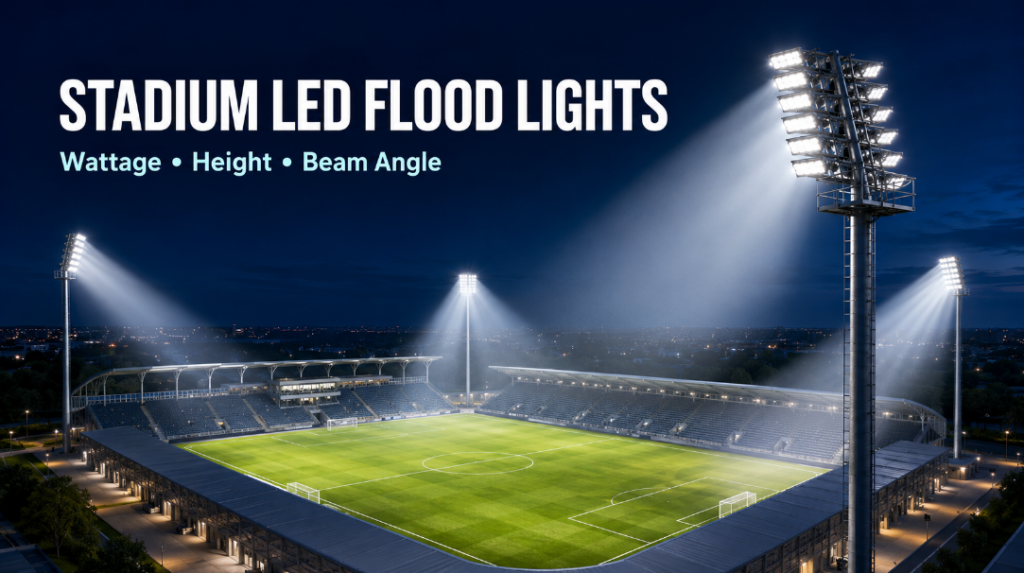
![Stadium LED flood lights showing different mounting heights and beam angles across a football field]
Table of Contents
- Quick Answer — Stadium Floodlight Selection
- What Sets a Stadium Floodlight Apart
- Choose by Stadium Type
- Wattage and Mounting Height
- Choose the Right Beam Angle
- How Many Floodlights Does a Stadium Need?
- Why Lighting Simulation Is Essential
- Stadium-Specific Checks
- What to Send a Supplier
- A Real Stadium Project
- Final Selection Checklist
- FAQ
Quick Answer — Stadium Floodlight Selection
| Stadium Type | Mounting Height | Starting Wattage (per fixture) | Beam Angle | Main Priority |
|---|---|---|---|---|
| Small Training Field | 8–15 m | 300–500W | 30°–60° | Cost & basic uniformity |
| School Sports Field | 12–20 m | 400–800W | 20°–40° | Uniformity |
| Community Stadium | 15–25 m | 600–1000W | 15°–40° | Coverage & glare |
| Professional Stadium | 25–50 m | 1000W, several fixtures per position | 10°–30° | High output & precision |
| Broadcast Stadium | 30–60 m | Project-specific | Multiple optics | Vertical lux & flicker |
These are preliminary selection ranges, not final design values. Final fixture quantity and optical distribution must be confirmed through a lighting simulation based on field dimensions, pole positions, and target illuminance.
For the general logic behind each parameter, see the Wattage Guide, the Beam Angle Guide, and the Mounting Height Guide. For competition-level lux and uniformity requirements, see Sports Field Lighting Standards.
What Sets a Stadium Floodlight Apart
A general-purpose outdoor floodlight and a fixture suited for stadium projects differ in four ways:
- Output that holds up. What matters is actual lumen output, efficacy (lm/W), and lumen maintenance under high operating temperatures — not simply “the higher the wattage, the brighter.”
- Beam options in combination. A large stadium rarely uses one beam angle across the whole installation; different pole positions and target zones call for different optics.
- Glare control. Glare affects player sightlines, spectator comfort, and nearby residential areas, and is largely determined by aiming and optical design.
- Flicker performance. Flicker-free output matters for slow-motion capture and HDTV broadcast and depends heavily on driver quality. Training fields and broadcast-grade stadiums have very different flicker requirements.
Choose by Stadium Type
Training and recreational fields. Cost-sensitive, lower mounting heights, no broadcast requirement, predominantly medium-to-wide beam angles.
School and community stadiums. Priorities: uniformity, glare control, spill light onto neighboring areas, and maintenance cost.
Professional stadiums. High-mast installations, long-distance projection, multiple optical combinations, and stricter uniformity and glare requirements.
Broadcast and competition stadiums. Priorities: horizontal illuminance, vertical illuminance, flicker performance, camera-direction alignment, and system redundancy. Competition-level lux and uniformity targets are covered in Sports Field Lighting Standards.
Wattage and Mounting Height
A common question from buyers: what wattage fits which pole height? Use the Quick Answer table above as a starting range — as a rule, higher poles call for higher output and narrower beams.
Mounting height alone cannot determine wattage. At the same 30-meter height, field size, pole position, target lux, and beam angle can all vary — and so will the final result. For the full height-to-wattage logic, see the Mounting Height Guide.
Choose the Right Beam Angle
- Narrow beam, 10°–20° — high-mast installations, long-distance projection, center-field zones.
- Medium beam, 20°–40° — mid-distance coverage across primary competition areas.
- Wide beam, 40°–60° — lower mounting positions, close-range zones, supplementary lighting.
Large stadiums typically use a combination of beam angles rather than a single distribution across the entire installation. For how beam angle is calculated and chosen in general, see the Beam Angle Guide.
How Many Floodlights Does a Stadium Need?
Fixture quantity depends on field dimensions, target lux, fixture lumen output, mounting height, pole positions, beam angles, coefficient of utilization (CU), and maintenance factor (MF).
As a starting point, total lumens required can be roughly estimated as target lux × field area ÷ utilization factor — but this preliminary calculation only estimates quantity; it cannot determine the final layout. For the general counting method, see How Many Flood Lights Do I Need.
Why Lighting Simulation Is Essential
Without a lighting simulation, buyers can’t accurately determine fixture quantity, average lux, minimum lux, uniformity, hot spots, dark zones, glare risk, or the aiming angle for each individual fixture.
Two stadium projects using the same 1000W floodlights can produce completely different real-world results, depending entirely on layout, aiming, and pole positioning — not just fixture specification.
Stadium-Specific Checks
Beyond the general specification checks in the LED Flood Light Specification Template, stadium projects should confirm:
- Flicker performance for broadcast-grade projects
- Dimming (DALI / 0–10V) if the venue needs scene or event modes — see DALI vs 0-10V
- IP rating and surge protection matched to the site’s exposure and pole height — see the IP Rating Guide and Surge Protection Guide
- Photometric files (IES/LDT) so the simulation reflects the actual fixture
What to Send a Supplier
For an accurate quote and layout recommendation: field dimensions, sport type, target lux, pole quantity and positions, mounting height, voltage, project country, broadcast requirement (if any), and any existing drawings. If specifications aren’t complete yet, start with field dimensions, pole positions, and target illuminance — our engineering team can help fill in the rest. The full ordering process is in How to Order LED Flood Lights.
A Real Stadium Project
Multi-purpose stadium, Zhejiang, China. The venue — a football field, running track, and spectator areas — required high-power lighting on high poles around the site. MVS supplied 82 × 500W fixtures for general field and track coverage and 54 × 1000W fixtures for high-mast, long-distance illumination.
The core design challenge wasn’t brightness — it was aiming. Floodlights on the same pole often need to point in different directions to cover their assigned zone, so the rotation and adjustment range of the mounting bracket mattered as much as fixture output. The mixed-power approach matched each fixture to its pole’s job instead of using a single wattage everywhere.
Full details: Stadium & Football Field Case Studies.
Final Selection Checklist
- ☐ Stadium type confirmed
- ☐ Required lighting level defined
- ☐ Mounting height and pole positions checked
- ☐ Preliminary wattage range selected
- ☐ Beam angles matched
- ☐ Lighting simulation run
- ☐ Final fixture specification confirmed
Get a Stadium Lighting Proposal
Send us your field dimensions, pole layout, mounting height, and target lux level. Our lighting team can prepare a fixture recommendation and lighting simulation for your stadium project. [Request a Stadium Lighting Proposal →]
FAQ
What wattage LED floodlights are used for stadiums? Stadium floodlights typically range from 300W for small training fields to 1000W per fixture for large, high-mast stadiums, with several fixtures grouped per pole position where more output is needed.
How high should stadium floodlights be mounted? Mounting height typically ranges from 8–15 m for training fields up to 30–60 m for large broadcast-grade stadiums, depending on field size and pole position.
What beam angle is best for stadium lighting? Most large stadiums use a combination of narrow (10°–20°), medium (20°–40°), and wide (40°–60°) beam angles rather than a single distribution type.
How many floodlights does a stadium need? It depends on field size, target lux, fixture lumen output, and mounting height — a lighting simulation is required to confirm the final number.
Are 1000W LED floodlights suitable for stadiums? Yes. 1000W fixtures are commonly used for medium-to-large stadiums, typically paired with narrower beam angles for higher mounting heights.