
A vague specification is the single easiest way for a lower-quality bid to slip through a tender process looking identical to a genuinely compliant one. Two suppliers can both claim “IP66” and “meets project lux requirements” — the difference between a real commitment and a marketing claim usually isn’t visible until the fixture is already installed.
This guide covers what a genuinely enforceable floodlight specification should include, and gives you a downloadable template you can adapt for your own tender or bid document.
🖼️ specification document checklist for LED floodlight tender
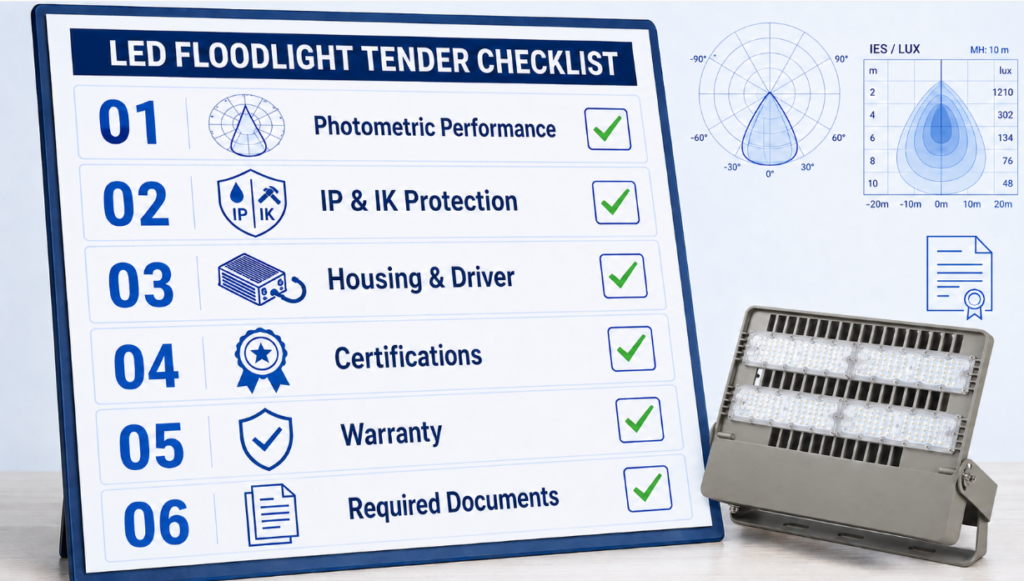
For the full floodlight selection framework, see our Complete LED Flood Light Guide. This is one step in the broader purchasing journey — see our Buyer’s Guide for the full picture.
Why a Vague Spec Invites Bid Substitution
Tender documents that specify “150W LED floodlight, IP66, 5-year warranty” and nothing more leave enormous room for interpretation. Two bidders can both check every box on that list — one with a tested, documented product, and one with an unverified claim — and on paper they look identical to whoever is comparing quotes.
The gap shows up later: a driver that wasn’t actually the branded component implied, an IP rating with no test report behind it, or a warranty with no written coverage scope. A specification that requires documentation, not just a number, closes that gap before the order is placed, not after the fixture fails.
What Should Be in a Floodlight Specification Template
Photometric parameters
- Wattage and luminous flux (lumens), not wattage alone — see our Wattage Guide
- Luminous efficacy (lm/W)
- Beam angle and light distribution type — see our Beam Angle Guide
- CRI (minimum acceptable value)
- CCT — see our Color Temperature Guide
- Target Average Lux and Minimum Uniformity Ratio — see our Lux Levels Guide
Protection ratings
- IP rating, with test report required — see our IP Rating Guide
- IK (impact resistance) rating, if applicable
- Surge protection (SPD) rating in kV/kA — see our Surge Protection Guide
Mechanical structure
- Housing material and construction (e.g., die-cast aluminum, wall thickness)
- Fixture weight
- Mounting method and bracket adjustment range — see our Mounting Height Guide
Electrical parameters
- Input voltage range
- Driver brand (named, not “equivalent”)
- Dimming/control compatibility, if required — see our DALI vs 0-10V Guide
Certification requirements
- Certifications required for your specific destination market — see our Buying from China Guide for market-specific certification requirements
- Test reports required as supporting documentation (LM-79/LM-80, IES files), not just certification claims
Warranty and documentation
- Warranty duration and what it explicitly covers
- Required documentation at delivery (spec sheet, test reports, IES files)
Not Every Field Matters Equally for Every Project
The list above is comprehensive on purpose — but a comprehensive checklist and a well-written specification aren’t the same thing. Filling in every field with equal weight regardless of your project type usually means the fields that actually decide bid quality get buried under ones that don’t matter much for your situation.
A rough guide to where the emphasis should shift by application:
| Application | Focus On | Often Less Critical |
|---|---|---|
| Parking lot / general area | Target lux & uniformity, IP rating | IK rating, RGB/DMX, dimming |
| Sports field / stadium | Uniformity ratio, glare control, bracket aiming range | CCT flexibility, RGB |
| Industrial yard / coastal | IP66+, surge (SPD) rating, housing corrosion resistance | CRI, dimming |
| Security / camera-monitored | CRI, CCT (cool white), vertical illuminance | RGB, dimming |
| Architectural / decorative | CCT, RGB/DMX control, housing finish | Surge rating (unless high-exposure site) |
This is a starting point, not a rule — a coastal parking lot should treat both of its relevant rows as important, for example. When a field genuinely doesn’t apply to your project, mark it “N/A” in the spec rather than leaving it out entirely — that tells the bidder it was considered, not overlooked.
How to Use This Template in a Real Tender
- Require documentation alongside every claimed spec — a number with no supporting test report is a claim, not a verified spec
- Start from the priority guide above rather than treating every field as equally critical for your specific project
- Name the driver brand explicitly rather than accepting “equivalent” substitutions, which is one of the most common places quality gets quietly downgraded after the bid is won
- Specify the exact certification your destination market requires, not a generic “CE/UL as applicable” — see our Buying from China Guide if you’re sourcing internationally
- Request a sample against the written spec before finalizing a bulk order, not after
For a broader framework on vetting the supplier behind the bid — not just the spec sheet — see our Manufacturer Checklist.
Download the Specification Template
The downloadable template includes the same priority guide above as its opening page, followed by the full checklist in a ready-to-adapt format for your own tender or bid document.
[Download the LED Flood Light Specification Template →]
Frequently Asked Questions
Why isn’t “IP66” enough on its own in a specification? Because it’s a claim, not a verified fact, until it’s backed by a test report. A specification that requires the report — not just the rating — closes the gap that lets an unverified claim pass as equivalent to a tested one.
Should I name a specific driver brand in my specification? Yes, if driver reliability matters to your project. Allowing “equivalent” substitutions is one of the most common ways a bid quietly downgrades component quality after being awarded.
What certifications should I require in my specification? It depends entirely on your destination market — requirements differ meaningfully between regions. See our Buying from China Guide for market-specific certification requirements before finalizing your spec.
Should I require a sample before awarding a bulk contract? Yes, for any commercial-scale tender — a sample verified against the written specification is the check that confirms the bid matches what’s actually delivered.
Is this template only for tenders, or useful for smaller purchases too? It scales down fine — even a small commercial order benefits from a written spec with documentation requirements, though the formality of a full tender document may not be necessary.
Do I need to fill in every field for my project? No — the priority guide in this article and at the start of the downloadable template shows which categories matter most by application. Fields that genuinely don’t apply to your project should be marked “N/A” rather than left blank, so the supplier knows it was a deliberate decision.
Conclusion
A specification that only lists numbers leaves room for substitution; a specification that requires documentation behind every claim doesn’t. Use the categories in this guide — photometric, protection, mechanical, electrical, certification, and warranty — to build a tender document that actually protects the project, not just one that looks complete.
Need help preparing a project-specific specification? [Contact our engineering team →] — we can help confirm what’s realistic and verifiable for your project before you finalize the tender.
Browse our LED Floodlight Series.