
Home > LED Flood Lights > Commercial LED Flood Lights Guide
By Lighting Engineering Team, MVS Lighting — outdoor lighting manufacturer with 5 production lines and 15+ years of experience in commercial and industrial lighting projects, providing professional LED flood light solutions for global applications. Last updated: July 2026
Introduction
Choosing the best commercial LED flood lights is not simply about selecting the highest wattage or the brightest fixture. For commercial outdoor projects, the right flood light must match the application requirements, installation environment, mounting height, lighting level, beam distribution, and long-term operating conditions.
Modern commercial projects use a wide range of LED flood light specifications, from compact 30W fixtures to high-power 1000W models. Explore our LED Floodlight Series to compare different wattages, beam angles, and commercial lighting solutions before selecting the right fixture for your project.
A professional commercial lighting solution should provide reliable illumination, energy efficiency, low maintenance costs, and consistent performance throughout its service life.
Whether you are designing lighting for a parking lot, industrial facility, warehouse, stadium, commercial building, or large outdoor space, selecting the correct LED flood light specification is essential for achieving the required lighting performance and project reliability.
This guide explains how to choose commercial LED flood lights, what specifications matter most, and how different applications require different lighting solutions.
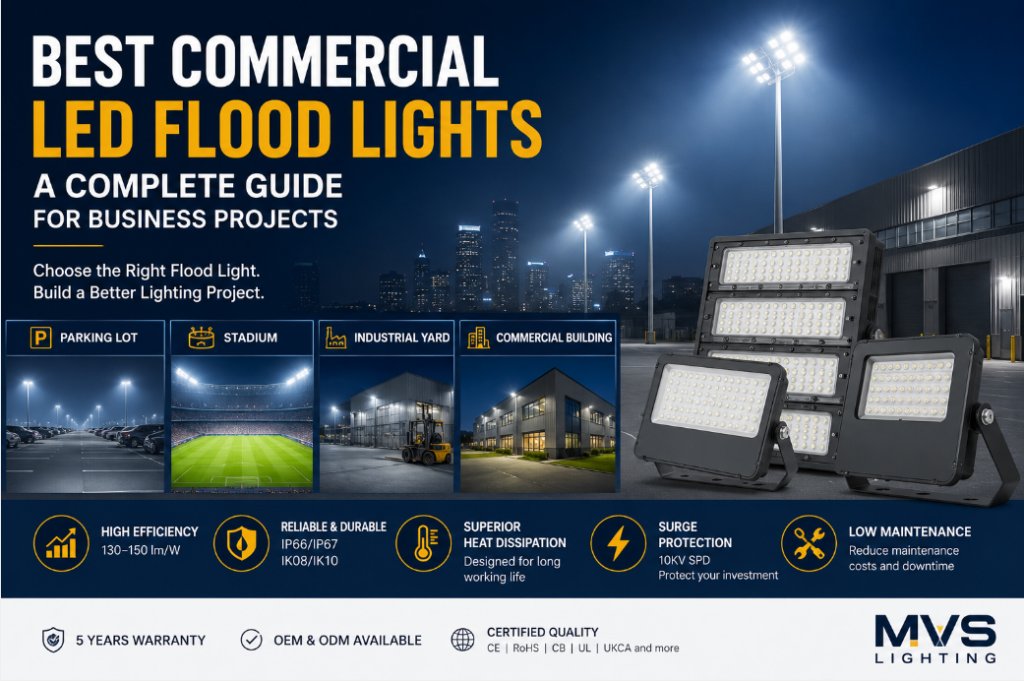
Find the Right Commercial Lighting Guide
Not sure where to start? Choose the guide that best matches your commercial lighting project.
| If your project is… | Read this guide |
|---|---|
| Compare all LED flood light models (30W–1000W) | LED Floodlight Series → |
| Parking lots and vehicle areas | Best LED Flood Lights for Parking Lots → |
| Sports fields and stadiums | LED Stadium Flood Lighting Guide → |
| Industrial yards and heavy-duty work areas | Industrial Yard LED Flood Lights Guide → |
What Are Commercial LED Flood Lights?
Commercial LED flood lights are high-performance outdoor lighting fixtures designed for business, industrial, and public infrastructure applications where reliable and powerful illumination is required.
Compared with basic residential flood lights, commercial-grade LED flood lights are engineered for:
- Larger coverage areas
- Longer operating hours
- Higher reliability requirements
- More demanding outdoor environments
- Professional lighting standards
Typical commercial applications include:
- Parking lots
- Industrial yards
- Warehouses
- Sports facilities
- Commercial buildings
- Construction sites
- Security areas
- Public infrastructure projects
A commercial flood light is not defined only by its power rating. A reliable commercial fixture should combine efficient LED technology, quality drivers, optimized optical design, strong thermal management, and suitable protection ratings.
For large-scale projects, the goal is not simply to produce more light, but to deliver the right amount of light exactly where it is needed.
What Makes the Best Commercial LED Flood Lights?
The best commercial LED flood lights should provide a balance between lighting performance, reliability, and total project value.
When evaluating flood lights for commercial projects, professional buyers usually focus on several key factors.
1. High Lighting Efficiency
Efficiency directly affects long-term operating costs.
Modern commercial LED flood lights typically achieve:
- 130–150 lm/W efficiency
- High lumen output with lower power consumption
- Reduced electricity costs compared with traditional lighting technologies
For projects operating many hours every day, such as warehouses, industrial yards, and security lighting systems, higher efficiency can significantly reduce lifetime operating expenses.
However, efficiency should not be evaluated alone. A fixture with high lm/W but poor thermal design may experience faster lumen depreciation and reduced service life.
2. Reliable Thermal Management
Heat management is one of the most important factors affecting LED lifespan.
Commercial-grade flood lights usually use:
- Die-cast aluminum housing
- Optimized heat sink design
- Large cooling surface area
- Professional LED module arrangement
Effective thermal management helps maintain:
- Stable lumen output
- Longer LED lifespan
- Better driver reliability
- Consistent performance in outdoor environments
For high-power models such as 500W, 750W, and 1000W LED flood lights, thermal design becomes especially important.
3. Professional Optical Design
A good commercial flood light should control light distribution instead of simply producing maximum brightness.
The optical system determines:
- Lighting coverage
- Uniformity
- Glare control
- Installation distance
- Energy utilization
Different projects require different beam angles:
| Beam Angle | Typical Application |
|---|---|
| 15°–30° | Long-distance illumination and high mounting positions |
| 40°–60° | Sports fields and industrial areas |
| 80°–120° | Parking lots and large open areas |
Selecting the wrong beam angle may create:
- Dark areas
- Excessive glare
- Uneven lighting
- Wasted energy
4. Suitable Protection Ratings
Outdoor commercial lighting systems must withstand weather conditions and environmental challenges.
Important protection ratings include:
IP Rating
Common requirements:
- IP65: Suitable for general outdoor applications
- IP66: Recommended for demanding outdoor environments
- IP67: Used for projects requiring higher protection
IK Rating
Impact protection is important for:
- Industrial facilities
- Public areas
- Sports venues
Commercial projects often require:
- IK08
- IK09
- IK10
Higher protection levels help improve fixture durability in challenging environments.
5. Quality LED Drivers and Components
The LED driver is one of the most important components affecting reliability.
Professional commercial flood lights often use recognized driver brands, including:
- Philips Xitanium
- Mean Well
- Inventronics
- MOSO
- SOSEN
- Lifud
A quality driver helps provide:
- Stable current output
- Better efficiency
- Lower failure rates
- Longer operating life
For large projects, component reliability directly affects maintenance costs and downtime.
Manufacturer’s Insight
From our experience working with distributors, contractors, and commercial lighting projects, one of the most common purchasing mistakes is focusing only on wattage and the lowest purchase price.
Many buyers initially compare 300W, 500W, or 1000W flood lights only by price, assuming that fixtures with the same wattage deliver the same performance. In reality, factors such as optical design, thermal management, driver quality, and component reliability have a much greater impact on long-term performance.
A lower-priced flood light may reduce the initial purchasing cost, but it often leads to higher maintenance expenses, more frequent failures, and additional labor costs during its service life. For distributors and contractors, product failures also affect customer satisfaction and can damage their reputation in the local market. In many cases, the cost of replacing failed fixtures is far higher than the savings made on the original purchase.
For commercial projects, the goal should not be buying the cheapest flood light—it should be choosing the most reliable lighting solution with the lowest total cost of ownership.A reliable product helps you keep your customers. A failed product may cost far more than the price difference between two suppliers.
Best Commercial LED Flood Lights by Application
Different commercial projects have different lighting requirements.
There is no single flood light model that is suitable for every application. The correct solution depends on the area size, mounting height, lighting standard, and environmental conditions.
The following table provides a quick selection guide.
| Application | Recommended Flood Light Type | Main Requirements |
|---|---|---|
| Parking Lot | Wide beam or asymmetric LED flood light | Uniform lighting, reduced glare |
| Warehouse Area | High lumen flood light | Large coverage, efficient operation |
| Industrial Yard | High-power flood light | Long-distance illumination, durability |
| Stadium | Professional sports flood light | Glare control, high uniformity |
| Building Facade | Narrow beam flood light | Architectural lighting effects |
| Security Area | Adjustable flood light | Reliable nighttime illumination |
Commercial LED Flood Lights for Parking Lots
Parking lot lighting requires more than simply increasing brightness.
A professional parking lot lighting system should achieve:
- Uniform illumination
- Comfortable visibility
- Reduced glare
- Efficient coverage between poles
Common solutions include:
- 100W–300W LED flood lights
- Wide beam distribution
- Asymmetric optics
- Pole-mounted installation
The fixture selection should consider:
- Pole height
- Pole spacing
- Required lux level
- Traffic flow
- Camera requirements
For detailed parking lot design considerations, see our guide:
LED Flood Lights for Parking Lots
Commercial LED Flood Lights for Warehouse and Industrial Areas
Warehouses, industrial facilities, and outdoor working areas usually require powerful and reliable lighting systems that can operate for long hours under demanding conditions.
The best commercial LED flood lights for these applications should provide:
- High lumen output
- Wide area coverage
- Stable performance
- Low maintenance requirements
- Strong environmental protection
Typical specifications include:
| Project Requirement | Recommended Solution |
|---|---|
| Large outdoor yard | 300W–1000W LED flood lights |
| High mounting height | Narrow or medium beam optics |
| Continuous operation | High-efficiency LED and reliable driver |
| Harsh environment | IP66/IP67 protection |
Industrial applications often involve:
- Heavy equipment operation
- Vehicle movement
- Dust and moisture exposure
- Long working hours
Therefore, reliability becomes more important than simply choosing the lowest-cost lighting fixture.
A professional industrial lighting design should consider:
- Required lux level
- Lighting uniformity
- Installation height
- Beam distribution
- Maintenance accessibility
For large industrial areas, an optimized lighting layout can reduce the number of fixtures required while maintaining proper illumination.
Commercial LED Flood Lights for Stadiums and Sports Facilities
Sports lighting requires a higher level of optical control compared with general outdoor lighting.
A stadium or sports facility requires:
- High uniformity
- Controlled glare
- Accurate beam positioning
- Flicker-free performance for cameras and broadcasting
Commercial sports flood lights typically use:
- Narrow beam optics
- High-power LED modules
- Advanced aiming systems
- Professional lighting simulation
Common applications include:
- Football fields
- Tennis courts
- Basketball courts
- Training grounds
- Multi-purpose sports venues
For sports facilities, selecting a fixture only based on wattage is not sufficient.
The lighting design must consider:
- Playing area size
- Competition level
- Camera requirements
- Viewing comfort
- Mounting structure
For detailed sports lighting requirements, refer to our:
LED Sports Field Lighting Guide
Commercial LED Flood Lights for Building Facade and Architectural Projects
Commercial buildings often use LED flood lights to improve appearance, visibility, and nighttime identity.
Facade lighting focuses on:
- Light direction
- Beam control
- Color temperature
- Visual effects
Typical requirements include:
| Requirement | Recommended Solution |
|---|---|
| Highlight architectural details | Narrow beam flood lights |
| Illuminate large walls | Medium beam optics |
| Create uniform appearance | Multiple fixture layout |
| Reduce light pollution | Accurate aiming |
Common applications include:
- Office buildings
- Shopping centers
- Hotels
- Public buildings
- Cultural landmarks
Unlike industrial lighting, facade projects focus more on visual quality and design flexibility.
How to Choose the Right Commercial LED Flood Lights
Selecting the correct commercial LED flood light requires evaluating several project factors.
A professional selection process should include the following steps
1. Define the Application Requirement
The first step is identifying the purpose of the lighting system.
Ask:
- What area needs illumination?
- Is it for safety, operation, security, or appearance?
- How many hours will the lights operate daily?
- Are there specific lighting standards?
Different applications require different solutions.
For example:
A parking lot needs uniform lighting.
An industrial yard needs long-distance coverage.
A stadium needs glare control.
A facade project needs visual effects.
2. Calculate Required Lighting Level
Brightness should be measured by lighting performance, not only wattage.
Important factors include:
- Lux level
- Area size
- Mounting height
- Uniformity requirement
- Reflective conditions
A common mistake is selecting flood lights only according to power.
For example:
A 500W flood light may not perform well if:
- The beam angle is incorrect
- The installation height is unsuitable
- The light distribution does not match the area
Professional projects usually require lighting calculations or simulation before installation
3. Select the Correct Wattage
Commercial LED flood light wattage depends on:
- Coverage area
- Mounting height
- Required illumination
- Beam angle
Typical reference:
| Application | Typical Wattage Range |
|---|---|
| Small commercial area | 50W–150W |
| Parking lot | 100W–300W |
| Warehouse yard | 200W–500W |
| Industrial facility | 300W–1000W |
| Large sports venue | High-power professional fixtures |
Higher wattage does not always mean better performance.
The goal is achieving the required lighting level with the most efficient design.
For detailed wattage selection, see:
LED Flood Light Wattage Guide
4. Choose the Correct Beam Angle
Beam angle determines how light spreads across the target area.
The correct beam angle depends mainly on:
- Mounting height
- Distance between poles
- Area shape
- Lighting objective
General selection:
| Beam Angle | Suitable Applications |
|---|---|
| 15°–30° | High poles, long-distance lighting |
| 40°–60° | Industrial areas, sports applications |
| 80°–120° | Parking lots, open areas |
A wider beam is not always better.
For example:
A very wide beam installed on a high pole may create insufficient brightness at ground level.
A narrow beam in a parking lot may create uneven lighting.
The correct combination of wattage and beam angle is essential for professional results.
For more information:
LED Flood Light Beam Angle Guide
5. Consider Mounting Height and Installation Layout
Installation height directly affects lighting performance.
Important design factors include:
- Pole height
- Fixture quantity
- Pole spacing
- Aiming angle
- Light distribution
Common installation situations:
| Mounting Height | Typical Application |
|---|---|
| 5–8 m | Parking areas and small commercial spaces |
| 8–15 m | Industrial yards and warehouses |
| 15 m+ | Large areas and sports facilities |
Professional projects should avoid simply adding more fixtures.
A proper lighting layout can achieve:
- Better uniformity
- Lower energy consumption
- Reduced glare
- Easier maintenance
For installation guidance:
How High to Mount Flood Lights?
Commercial LED Flood Light Specifications Checklist
Before purchasing commercial LED flood lights, professional buyers should review the following specifications.
Optical Performance
Check:
- Lumen output
- Lighting efficiency
- Beam angle
- Color temperature
- CRI
- Uniformity performance
Electrical Performance
Important parameters:
- Input voltage
- Power factor
- Driver brand
- Dimming options
- Surge protection
Common commercial requirements:
- PF ≥0.95
- 0–10V dimming
- DALI control option
- 6kV–10kV surge protection
Mechanical Protection
Confirm:
- IP rating
- IK rating
- Housing material
- Operating temperature range
Recommended:
- Die-cast aluminum housing
- IP66 waterproof design
- IK08 or higher impact protection
Commercial Grade LED Flood Lights vs Standard Outdoor Flood Lights
When comparing commercial LED flood lights with standard outdoor flood lights, the main difference is not only brightness.
The biggest difference is the level of engineering, reliability, and project suitability.
Commercial-grade flood lights are designed for long-term professional applications, while standard models are usually developed for smaller areas with lower operating requirements.
| Comparison | Commercial LED Flood Lights | Standard Outdoor Flood Lights |
|---|---|---|
| Application | Business and infrastructure projects | Residential and small areas |
| Operating Hours | Long daily operation | Shorter operation time |
| LED Efficiency | Higher lm/W performance | Average efficiency |
| Thermal Design | Optimized heat dissipation | Basic cooling structure |
| Driver Quality | Professional-grade drivers | Entry-level components |
| Optical Control | Multiple beam options | Limited distribution |
| Protection Level | IP66/IP67 options | Usually basic protection |
| Maintenance Cost | Lower long-term cost | Higher replacement frequency |
| Customization | OEM and project customization | Limited options |
For commercial projects, choosing a professional-grade fixture can reduce future maintenance problems and improve the overall return on investment.
A lower initial purchase price does not always mean lower project cost.
The total cost should include:
- Energy consumption
- Maintenance frequency
- Replacement cost
- Downtime risk
- Expected service life
Why Choose a Professional Commercial LED Flood Light Manufacturer?
For large commercial projects, selecting the right manufacturer is as important as selecting the right fixture.
A reliable LED flood light manufacturer should provide more than products.
Professional suppliers should be able to support:
Lighting Solution Support
A qualified manufacturer can help evaluate:
- Project application
- Installation environment
- Required lighting level
- Fixture quantity
- Beam angle selection
For complex projects, lighting simulation can help verify the design before installation
Stable Production Capability
Commercial projects often require:
- Consistent product quality
- Reliable delivery schedules
- Large quantity production
- Long-term supply capability
A manufacturer with established production systems can better support:
- Bulk orders
- Distributor requirements
- Project-based purchasing
Product Customization
Different markets and projects may require different specifications.
Professional manufacturers can provide customization options such as:
- Wattage range
- Beam angle
- Driver brand
- LED chip selection
- Housing design
- Color temperature
- Cable and connector options
- Branding and packaging
This is especially important for distributors and contractors who need products matching their local market requirements.
Certification and Quality Documentation
Commercial lighting projects often require compliance documents.
Common requirements include:
- CE
- RoHS
- CB
- UL / ETL
- UKCA
- Regional certifications
A professional supplier should provide complete technical documentation to support project approval and procurement procedures.
Commercial LED Flood Light Project Checklist
Before placing an order, professional buyers should confirm the following information.
Project Information
☑ Application type
☑ Installation location
☑ Indoor or outdoor environment
☑ Operating hours per day
Lighting Requirements
☑ Required lux level
☑ Coverage area
☑ Mounting height
☑ Pole spacing
☑ Uniformity requirement
Product Specifications
☑ Wattage selection
☑ Lumen output
☑ Beam angle
☑ Color temperature
☑ CRI requirement
☑ IP rating
☑ IK rating
☑ Surge protection
Supplier Requirements
☑ Manufacturer experience
☑ Production capacity
☑ Certification documents
☑ Warranty terms
☑ Lead time
☑ After-sales support
Providing these details before purchasing helps avoid incorrect product selection and reduces project risks.
Frequently Asked Questions
What wattage LED flood light is best for commercial projects?
The suitable wattage depends on the application, installation height, area size, and required lighting level.
Small commercial areas may use 50W–150W models, while large industrial or outdoor projects may require 300W–1000W high-power flood lights.
The correct choice should be based on lighting calculations rather than wattage alone.
Are IP66 LED flood lights suitable for outdoor commercial use?
Yes.
IP66 LED flood lights are widely used for outdoor commercial applications because they provide strong protection against dust and water exposure.
For demanding environments such as industrial areas, ports, or heavy outdoor installations, higher protection levels and stronger mechanical designs may be considered.
How many LED flood lights do I need for a commercial project?
The required quantity depends on:
- Area size
- Mounting height
- Fixture wattage
- Beam angle
- Target lux level
- Lighting uniformity
Professional projects usually require a lighting layout or simulation to determine the optimal fixture quantity.
What beam angle is best for commercial LED flood lights?
There is no single best beam angle.
The correct choice depends on the installation conditions.
- Narrow beams are suitable for high mounting heights and long-distance lighting.
- Medium beams work well for industrial areas and sports applications.
- Wide beams are suitable for parking lots and large open spaces.
What is the difference between commercial and residential flood lights?
Commercial flood lights are designed for larger areas, longer operation times, and higher reliability requirements.
They usually provide:
- Better thermal management
- Higher efficiency
- More optical options
- Stronger protection
- Longer service life
Get a Commercial LED Flood Light Solution for Your Project
Choosing the right commercial LED flood lights requires understanding your application, environment, and lighting requirements.
At MVS Lighting, we support commercial and industrial lighting projects with:
- Professional LED flood light solutions
- Customized specifications
- Stable manufacturing capability
- Project lighting support
- OEM and wholesale services
Send us your project information:
- Application area
- Installation height
- Required lighting level
- Quantity requirement
Our engineering team can help recommend a suitable LED flood light solution for your project.