
Written by Chris Choi, Technical Sales Manager at MVS Lighting, with practical experience supporting overseas buyers on LED street lighting projects. Meet the MVS Lighting Engineering Team →
This guide is built for project buyers, contractors, and lighting distributors who are planning an LED street lighting project and need to know what to consider before requesting quotes or a lighting simulation.
It does not walk through every technical parameter in full — each section below explains why a factor matters and links to the article that covers it in depth. Use this page as your starting point, then follow the links that match your project stage.
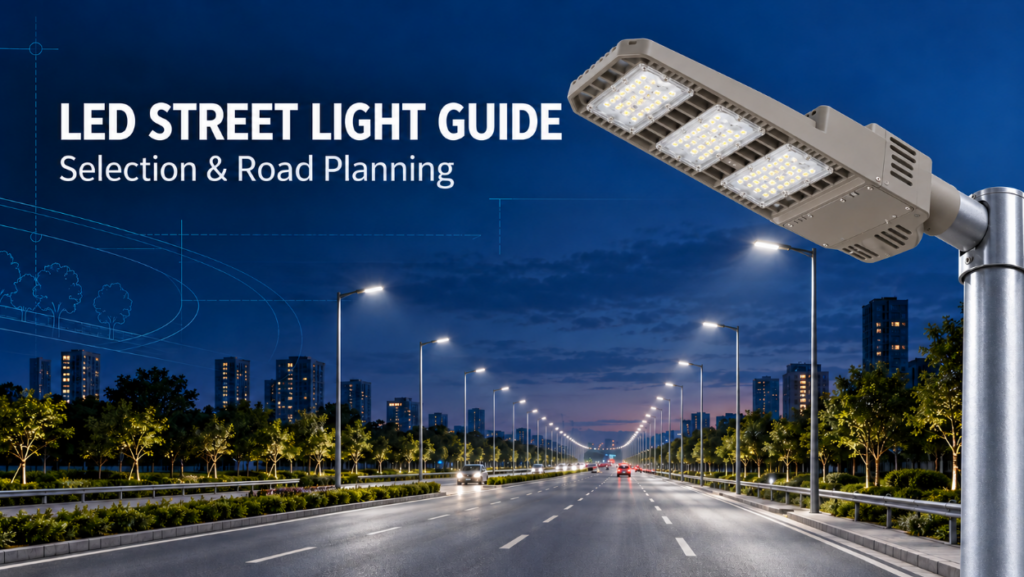
Understanding an LED Street Lighting Project
A road lighting project brings together three things: the road itself, the fixture specification, and how the fixtures are laid out along the road. None of these can be decided in isolation — the wrong pole height or wattage for a given road width usually shows up as poor uniformity or wasted energy after installation, not before. The outcome you are aiming for — even light distribution, no dark patches, no excessive glare, a fixture that lasts through its warranty period — depends on getting road conditions, fixture specification, installation layout and lighting targets aligned from the start.
Selecting a street light is not a single decision. It follows a sequence: road type, pole, optics, efficacy, protection, and control. The full decision framework is covered in our LED street light selection guide. This page is organized in the order a project is normally planned.
Start with the Road and Application
Road Width, Traffic and Environment
Road width, traffic speed, and the surrounding environment set the baseline for pole height, spacing, and light distribution. A residential collector road and a coastal industrial access road will call for different fixture configurations even at similar wattages.
Different Road Lighting Applications
The application changes what “correct” looks like. A residential street lighting project prioritizes low glare and resident comfort; a highway LED street light project prioritizes uniformity and high-speed visibility; an industrial park road lighting project prioritizes continuous, reliable coverage for logistics traffic. If none of these match your project type, browse LED street lighting applications by project type for the full list of scenario-specific guides.
Review the Main Street Light Specifications
Wattage, Lumens and Efficiency
Wattage and lumen output need to match the road, not the other way around. Our wattage and lumen guide explains how to select a range based on road width, pole height, and target lighting level. If you’re replacing existing HPS fixtures, the HPS-to-LED conversion guide covers equivalent wattage and verification steps. For a direct comparison between two common wattage tiers, see 100W vs 150W LED street lights. For projects that need to confirm input voltage and power supply compatibility with the local grid, see our power supply and voltage compatibility guide.
Light Distribution and Color Temperature
Light distribution type determines how light is thrown across the road surface, and color temperature affects visibility and how the lighting is perceived by residents and drivers. Both are explained in the street light distribution types guide and the street light color temperature guide.
Protection, Surge and Control Options
Outdoor road fixtures need to handle moisture, dust, and voltage surges over years of exposure, and increasingly need to support dimming or automatic control. See the IP and IK protection guide and the surge protection guide for what to specify. For control options, see photocell and dusk-to-dawn control and motion sensor street lights.
Connect the Fixture to the Road Layout
Pole Height and Pole Spacing
Pole height and pole spacing work together, not separately — a taller pole allows wider spacing, but only within limits set by the fixture’s light distribution. See the pole height guide and pole spacing guide for how to approach each, or use the pole spacing and quantity calculator for a quick first estimate.
Layout, Lux and Uniformity
How fixtures are arranged along the road — single-sided, staggered, or opposite — affects lux levels and uniformity as much as the fixture specification itself. See street light layout types, lux and luminance levels, and how many street lights a project needs.
Verify the Plan Before Installation
Before finalizing an order, the full layout should be checked against your project’s lighting targets. Our road lighting design guide walks through this verification process, including how to request a lighting simulation.
Check Standards and Long-Term Reliability
Road Lighting Requirements
Most road lighting projects need to meet a recognized lighting standard. Our EN 13201 road lighting standards guide explains the classification system used on most international projects. Glare and unwanted light spill are covered separately in our glare and light pollution control guide.
Product Reliability and Maintenance
A street light’s real cost shows up over its service life, not at the point of purchase. See our LED street light lifespan and maintenance guide for what affects failure rates and how to evaluate a fixture’s long-term reliability, and our price guide for how purchase price compares across project sizes.
Certifications Buyers Should Verify
Before ordering, buyers should confirm that a supplier’s certifications match the project’s destination market and compliance requirements. Our complete guide to street light certifications and standards covers the certification systems most commonly requested on international projects.
See It in a Real Project
Reading about pole height or wattage ranges is one thing — seeing how those decisions played out on an actual project is another. Our street lighting project case studies document real installations, including the fixture configuration, layout, and results. <!– Case study link (#29) reserved — the map slug is still a template (/[road]-led-street-light-case-study/); add the real URL once the first case study is live –>
Move from Technical Planning to Purchasing
Prepare the Basic Project Information
Once you have a sense of the road conditions, fixture specification, and layout, you’re ready to move from planning to purchasing. Having the following ready will speed up your first conversation with a supplier: road width, pole height, pole spacing, required lighting level, and project quantity.
Continue to the B2B Buying Guide
Purchasing an LED street lighting project — from requesting quotes to evaluating suppliers to placing an order — is covered separately in our LED street lights buyer’s guide for B2B projects.
Common Questions About LED Street Lighting Projects
What pole height do I need for my road? It depends on road width, fixture wattage, and light distribution together, not on pole height alone. The pole height guide above explains how to approach it.
How many street lights do I need per kilometer? This depends on pole spacing, layout type, and your target lighting level. The street light quantity guide and the pole spacing guide above cover how to estimate it.
What wattage replaces my existing HPS lighting? The equivalent LED wattage depends on your current HPS wattage and target lighting result. The HPS-to-LED conversion guide above covers how to verify it for your project.
What certifications should I check before ordering? Certification requirements vary by destination market. The certifications and standards guide above covers the systems most commonly requested.
Do you offer a free lighting simulation? Yes. Share the project details listed below, or read the road lighting design guide above for what a simulation covers.
Find LED Street Lights for Your Project
Ready to move forward? View the LED Street Light Series or request a free DIALux lighting simulation for your project.
To get started, share the following with our team:
- Road width
- Pole height
- Pole spacing
- Required lighting level
- Project quantity
View the LED Street Light Series Request a Free DIALux Lighting Simulation