
Written by Chris Choi, Technical Sales Manager at MVS Lighting, with practical experience supporting overseas buyers on LED street lighting projects.
Project specs that reference “M3” or “C2” without explanation are one of the more common sources of confusion we see from procurement teams and installers working on European or internationally-specified projects. Copy the class from a similar-looking project down the road and you risk two outcomes: over-specifying (paying for performance the road doesn’t need) or under-specifying (failing acceptance testing). EN 13201 exists to prevent both, by tying the lighting class directly to what the road is actually used for. For the complete road lighting planning framework this standard fits into, see the LED Street Light Guide.
What Is EN 13201?
EN 13201 is the European standard framework for road lighting, published in several parts covering classification methodology, calculation methods, measurement procedures, and performance requirements. You don’t need to work through every part to use it correctly on a project — the part that matters day-to-day is the classification system, which assigns every road a lighting class based on its function, traffic volume, and complexity.
The Three Lighting Classes: M, C & P
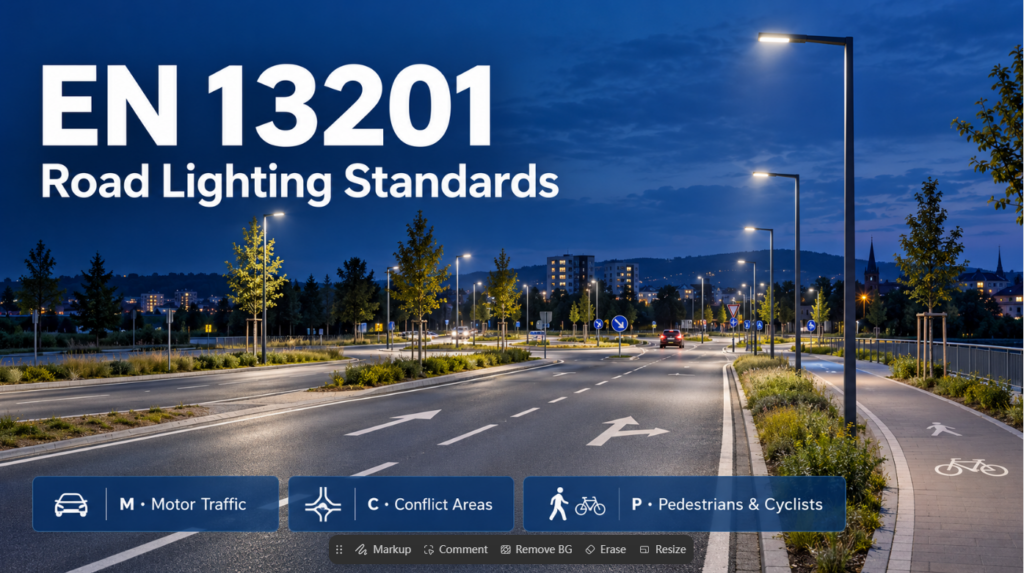
EN 13201 splits lighting requirements into three class families, and picking the right one starts with identifying what the road segment is actually for.
M classes (M1–M6) apply to roads where motorized traffic is the primary user — this is the class family most road lighting projects fall under. The classes run from M1 (highest performance requirement) to M6 (lowest), with the right class determined by traffic speed, volume, and road complexity. A high-speed arterial road with heavy traffic needs a low M-number (M1 or M2); a low-speed local access road can typically use M5 or M6. Choosing a lower M-number than the road actually needs means paying for luminance and uniformity performance the road doesn’t require.
C classes apply to conflict areas — intersections, roundabouts, and other zones where vehicles, cyclists, and pedestrians mix and visual complexity is higher than a straight road segment. These areas typically need illuminance-based rather than luminance-based criteria, since there isn’t a single consistent viewing direction the way there is on a straight road.
P classes apply to pedestrian-priority areas — sidewalks, footpaths, and cycle paths where the pedestrian and cyclist experience, rather than driver visibility, is the primary design concern. For residential and community-focused projects where this class family is central, see our Residential Street Lighting Design guide.
The logic across all three families is the same: class selection follows road function, not a general sense of “how important” the road feels. Over-specifying wastes budget on performance nobody needs; under-specifying risks a failed acceptance inspection.
Core Performance Indicators Behind Each Class
Each class translates into specific numeric targets across a small set of core indicators — this is where EN 13201 actually gets enforced during design review and acceptance testing.
Luminance and illuminance requirements scale with class — a higher-performance class like M1 sets a higher minimum luminance target than M5.
Uniformity — both overall uniformity (U0) and longitudinal uniformity (U1) — is specified alongside the luminance target, since a road can technically hit its average luminance number while still having enough variation to cause the “zebra crossing” effect drivers find fatiguing. For the full breakdown of luminance, illuminance and uniformity targets by road type, see our Street Light Lux and Luminance Levels guide.
Threshold Increment (TI), the glare metric, is also class-dependent — higher-performance classes generally carry stricter TI limits, since glare tolerance on a fast, high-traffic road is lower than on a quiet local street.
We won’t reproduce the full numeric table for every class combination here — the values matter enough to a project’s outcome that they should always be verified against the current published standard rather than a summarized table, and the practical application of these numbers is covered in the design workflow linked below.
How EN 13201 Compares to Other Regional Standards
If you’re working on a project outside Europe, it’s worth knowing upfront that EN 13201 isn’t the only classification system in use — North American projects typically reference IES RP-8-21 instead, which uses a different classification logic and different terminology for equivalent concepts. If you’re specifying a project that needs to reconcile the two systems, or bidding on international work where the reference standard isn’t immediately obvious, confirm which standard the project documentation actually calls for before designing to either one.
Applying EN 13201 in Project Design
Classification is the starting point, not the finish line. Once a road segment’s M, C, or P class is determined, that class sets the luminance, uniformity, and TI targets that the rest of the design has to hit — which then drives fixture selection, pole height, pole spacing, and distribution type. It’s also worth noting that road surface condition — dry versus wet, and the road’s reflection characteristics — affects whether a design actually delivers its calculated performance in practice, so this should be factored in alongside the class target rather than treated as a separate afterthought. For the complete workflow from road classification through to a verified design, see our Road Lighting Design Guide.
FAQ
What is the difference between M and C lighting classes? M classes apply to roads where motorized traffic is the primary user, using luminance-based criteria for a consistent driving viewpoint. C classes apply to conflict areas like intersections and roundabouts, using illuminance-based criteria since there’s no single consistent viewing direction.
Do I need to follow EN 13201 outside Europe? Not by default — it’s a European standard, so projects outside Europe typically follow their own regional standard (IES RP-8-21 in North America, for example). That said, some international projects and multinational specifiers reference EN 13201 regardless of location, so it’s worth confirming which standard the project documentation actually calls for before designing to either one.
How do I know which M-class my road needs? The class is determined by traffic speed, volume, and road complexity rather than by road name or general importance. A full classification determination should reference the current published standard directly; as a general pattern, high-speed arterial roads with heavy traffic fall toward M1–M2, while low-speed local roads typically fall toward M5–M6.
Request a Lighting Class Verification
Send MVS Lighting your road type, traffic conditions, project location and applicable regional standard. Our team can help confirm the appropriate lighting class and recommend fixtures suited to the resulting performance targets.
[Request a Lighting Class Verification] View LED Street Light Series