
By Lighting Engineering Team, MVS Lighting — outdoor lighting manufacturer with 5 production lines and 15+ years experience
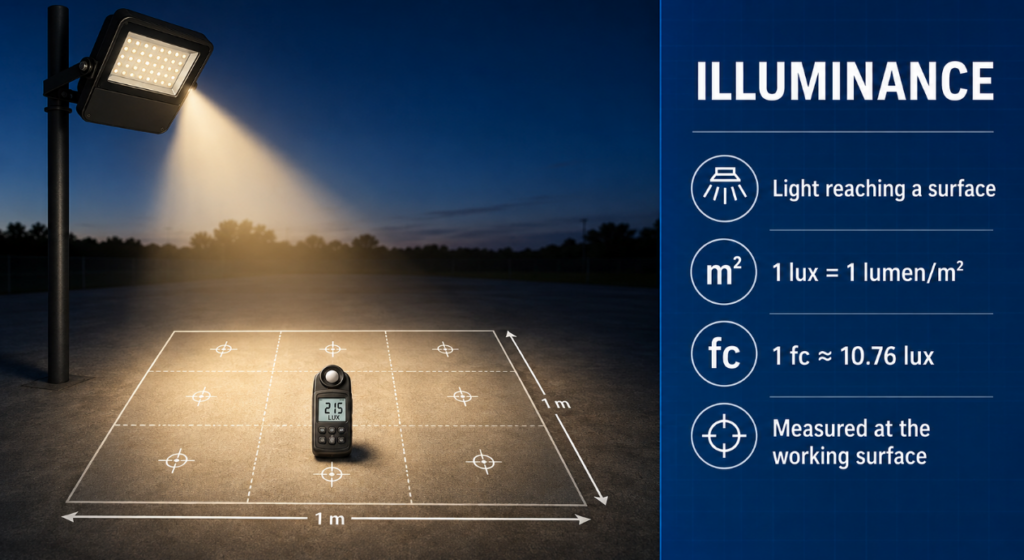
Lux is the unit of illuminance — it measures how much light actually lands on a surface, equal to one lumen spread over one square metre (lux = lumens ÷ m²). It’s the number that decides whether a lighting project passes inspection, which is why lux — not wattage — should drive your design.
Two things are worth knowing up front:
- 1 fc ≈ 10.76 lux (the US uses foot-candles, most of the world uses lux).
- Two fixtures with the same wattage can deliver very different lux on the ground, depending on mounting height, beam angle and layout.
This guide explains what lux is, how it converts to foot-candles, the quality factors lux alone won’t show you, and how to estimate the lux your project needs. For the exact levels and standards of a specific application, follow the dedicated guide linked in each section.
For the full floodlight selection framework, see our Complete LED Flood Light Guide or How to Choose the Right LED Flood Light.
Need help getting your project right? [Talk to our lighting team — free →]
What Is Lux?
In practical terms, lux is what gets measured on site at handover. A reading is taken across the area and compared to the target on the specification — if it falls short, the installation fails, no matter how many watts were installed. That is why lux, the light that actually reaches the surface, is the figure that matters.
Lux vs Lumen vs Watt
These three are constantly confused, so it’s worth separating them clearly:
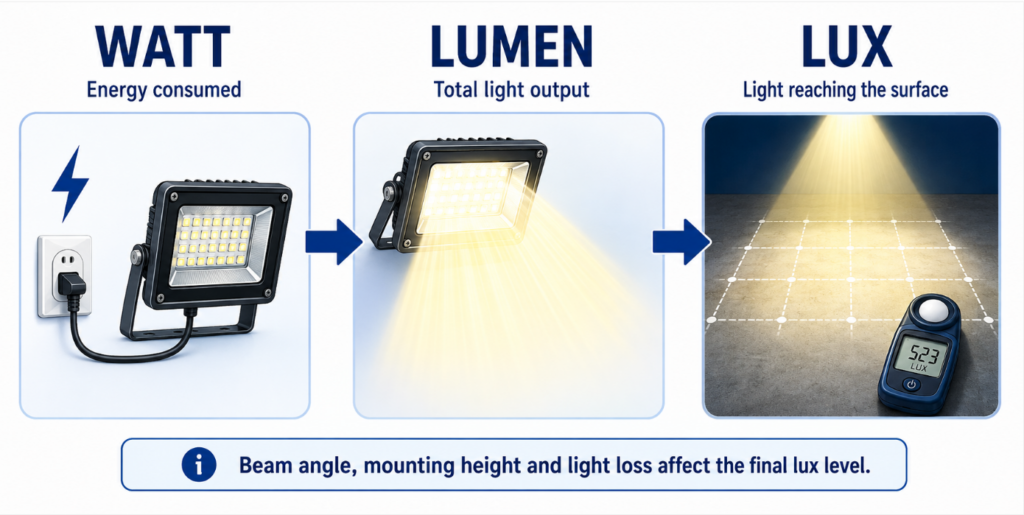
- Watt — the energy the fixture consumes.
- Lumen — the total light output the fixture produces.
- Lux — the light that actually reaches your surface (lumens per m²).
The chain runs one way: watts produce lumens, and lumens — once spread over your area and reduced by losses — produce lux. A buyer who shops on watts alone has no idea how much light will reach the ground. For how wattage relates to output, see our Wattage Guide.
Lux vs Foot-Candle
If your project is in the US, your drawings and specifications are almost certainly written in foot-candles (fc), not lux. Most of the rest of the world uses lux. Both measure the same thing — light per unit area — just on different scales:
1 fc ≈ 10.76 lux · lux = fc × 10.76 · fc = lux ÷ 10.76
| Foot-candles (fc) | Lux |
|---|---|
| 1 fc | ~10.76 lux |
| 3 fc | ~32 lux |
| 5 fc | ~54 lux |
| 10 fc | ~108 lux |
| 50 fc | ~538 lux |
So a US parking lot specified at 3 fc is the same as roughly 32 lux on an international datasheet. Keep both units in mind whenever you compare a US specification with a manufacturer’s lux figures — mixing them up is one of the most common spec errors.
Why Lux Matters More Than Watts
Wattage measures consumption, not result. Raise the mounting height, widen the beam angle, or aim a fixture poorly, and the same wattage delivers far less usable lux. That is why projects are accepted or rejected on measured lux, never on watts.
Two project variables decide how much of a fixture’s output becomes usable lux on the ground:
- Mounting height — higher poles cover more area but spread light thinner, lowering local lux. See our Mounting Height Guide.
- Beam angle — wide beams spread light evenly; narrow beams concentrate it. See our Beam Angle Guide.
What Lux Alone Doesn’t Tell You
Hitting an average lux target is necessary but not sufficient. Three quality factors decide whether the installation actually performs. This section defines them; for the required values in a specific sport or venue class, see our Sports Lighting Standards guide.
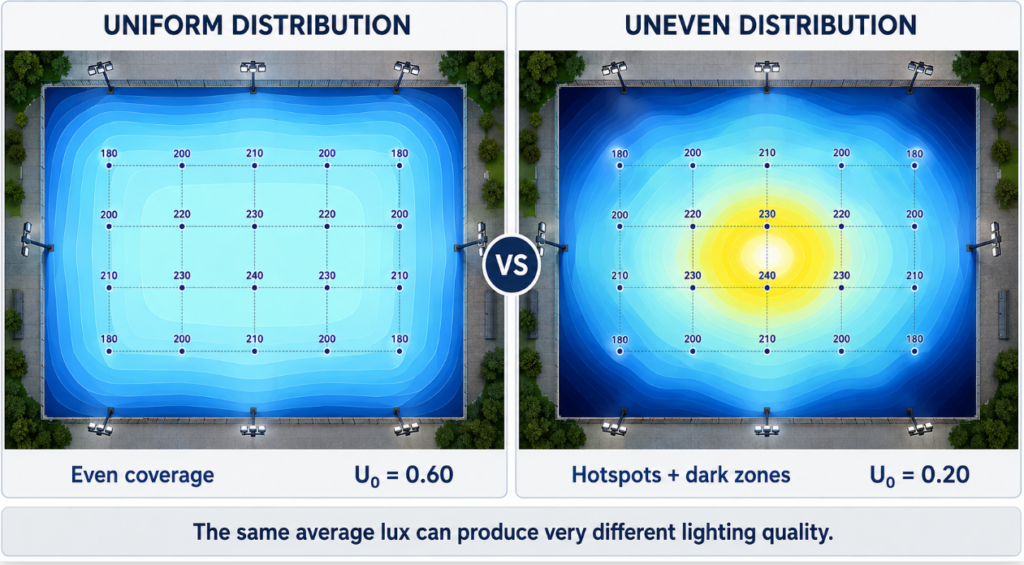
Uniformity (U0 and U1) Uniformity describes how evenly the light is spread: U0 = minimum lux ÷ average lux; U1 = minimum lux ÷ maximum lux. A site can show a high average lux while still having dark corners and bright hotspots. The required uniformity depends on the application and class.
Glare (Glare Rating, GR) Badly aimed or uneven lighting creates glare that blinds users and hides obstacles. The metric is the Glare Rating (GR). Good optics and correct aiming control glare; raw lumens do not.
Maintained Lux (Maintenance Factor) Lux falls over time as LEDs depreciate and lenses collect dust. A sound design works to maintained lux by applying a maintenance factor (MF / LLF) — typically in the 0.7–0.8 range — rather than to the bare initial figure.
Key takeaway: a poorly uniform high-lux system can perform worse than an evenly lit lower-lux one. Average lux is only one number among several.
Lux Spec Mistakes We See in Real RFQs
Most lux guides stop at definitions and formulas. In practice, the majority of quoting delays and post-installation disputes we see trace back to how the lux target was communicated in the first place — not to the calculation itself.
- “50 lux” with no area or fixture count attached. Lux is a ratio (lumens per m²), not a fixed property of a fixture. A buyer asking “how many lumens for 50 lux” without specifying the area is asking an incomplete question — the same fixture delivers a different lux reading depending on how much ground it’s covering.
- Initial lux quoted as if it were maintained lux. A spec that says “50 lux” without stating whether that’s day-one output or output after depreciation leads to systems that pass inspection at handover and fall out of spec within a few years. Always confirm which figure a spec sheet — yours or a competitor’s — is actually quoting.
- A generic CU value applied regardless of site conditions. Coefficient of utilisation depends on reflectance, obstructions and fixture optics at the actual site — not a fixed industry constant. Using a textbook 0.7 on a site with high obstruction or low-reflectance surfaces routinely under-delivers against the calculated target.
- A target described as “as bright as the old fixture” instead of a lux number. This is common in retrofit enquiries and forces a back-conversion before any sizing can start — see our Metal Halide to LED Conversion Guide if that’s your situation.
None of these are calculation errors — they’re communication gaps between what’s written on a spec sheet and what the number actually means. Confirming area, maintained vs. initial, and site conditions before sizing a project avoids the majority of rework we see after the fact.
Recommended Lux by Application
LED flood lights are an outdoor and large-area solution. The table below gives typical starting ranges for the applications they cover, to orient you; for the exact levels, classes and standards of each, follow the dedicated guide.
| Application | Typical Lux (Range) | fc | Full Guide |
|---|---|---|---|
| Parking lot | 10–50 | ~1–5 | Parking Lot Lighting Design |
| Outdoor / general area | 30–100 | ~3–10 | How to Choose |
| Sports & stadiums (by class) | varies by class | — | Sports Lighting Standards |
| Basketball court | varies by level | — | Basketball Court Lighting |
How to Estimate the Lux You Need
A quick estimate uses the lumen method. The correct formula accounts for losses — do not simply multiply target lux by area.
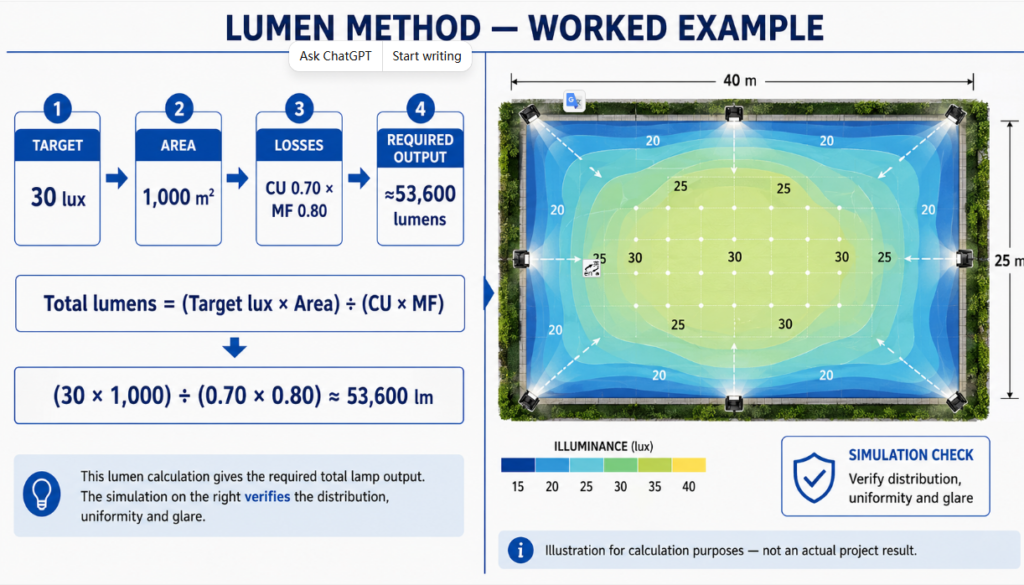
Total lumens required = (Target lux × Area) ÷ (CU × MF)
Where:
- CU = coefficient of utilisation (how much light reaches the surface; typically 0.6–0.8)
- MF = maintenance factor (typically 0.7–0.8)
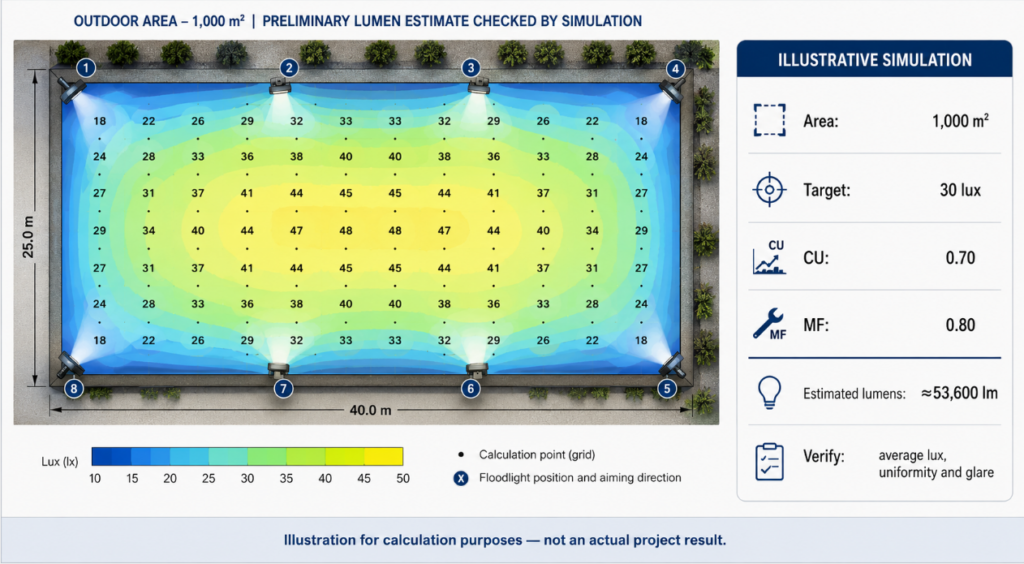
Worked example — 1,000 m² area, target 30 lux:
Total lumens = (30 × 1,000) ÷ (0.7 × 0.8) = 30,000 ÷ 0.56 ≈ 53,600 lumens
A naïve “30 × 1,000 = 30,000 lumens” estimate falls short because it ignores utilisation and maintenance losses.
Once you have the total lumens, the next step is to work out how many fixtures that means for your specific wattage and layout. Use our [Flood Light Quantity Calculator — 待补:#13尚未上线,暂无真实URL] for that step — it accounts for fixture output and spacing.
For any real project, confirm the result in Dialux or AGi32 — a hand calculation gets the range; only a simulation reveals the actual distribution, uniformity and glare.
Why Professional Lighting Simulation Matters
Two designs can hit the same average lux and still perform completely differently — fixture count, beam angle, aiming and mounting height all reshape the result. A simulation reveals hotspots, dark zones and glare before installation, when fixing them costs nothing. It also turns a vague enquiry into a precise, buildable layout.
Send us your dimensions and target lux, and we’ll return a layout you can build to.
[Get a free DIALux lighting simulation for your project →]
Frequently Asked Questions
What is lux in lighting? Lux is the unit of illuminance — the light landing on a surface, equal to one lumen per square metre. It’s the figure measured to confirm a project meets its lighting target.
Lux vs foot-candle — what’s the difference? Both measure illuminance. The US uses foot-candles, most of the world uses lux. The conversion is 1 fc ≈ 10.76 lux.
How do I calculate the lux my project needs? Use the lumen method: total lumens = (target lux × area) ÷ (CU × MF), where CU ≈ 0.6–0.8 and MF ≈ 0.7–0.8. Then divide by your fixture output to size the installation, or run a simulation.
Is lux better than watts for choosing flood lights? Yes — lux measures the light that actually reaches the surface, while watts only measure power draw. The same wattage can deliver very different lux depending on height, beam angle and layout.
Is the lux number on a spec sheet the day-one figure or the maintained figure? Always confirm this before comparing two quotes. A spec sheet that doesn’t state whether its lux figure is initial or maintained is one of the most common sources of mismatched expectations between buyer and supplier.