
By Lighting Engineering Team, MVS Lighting — outdoor lighting manufacturer with 5 production lines and 15+ years experience
High-quality LED floodlights can run reliably for 10–15 years or more, with some industrial-grade products rated up to 50,000–100,000 hours. But not every LED floodlight actually reaches that number in the field. Some fixtures show visible lumen depreciation, driver failure, or water ingress damage within 3–5 years, while others keep running steadily for over a decade in parking lots, sports fields, and industrial yards.
What actually determines a floodlight’s real-world lifespan isn’t the number printed on the box — it’s driver quality, thermal design, ingress protection, and overall build quality working together.
🖼️ cross-section of an LED floodlight showing driver, heat sink and LED array
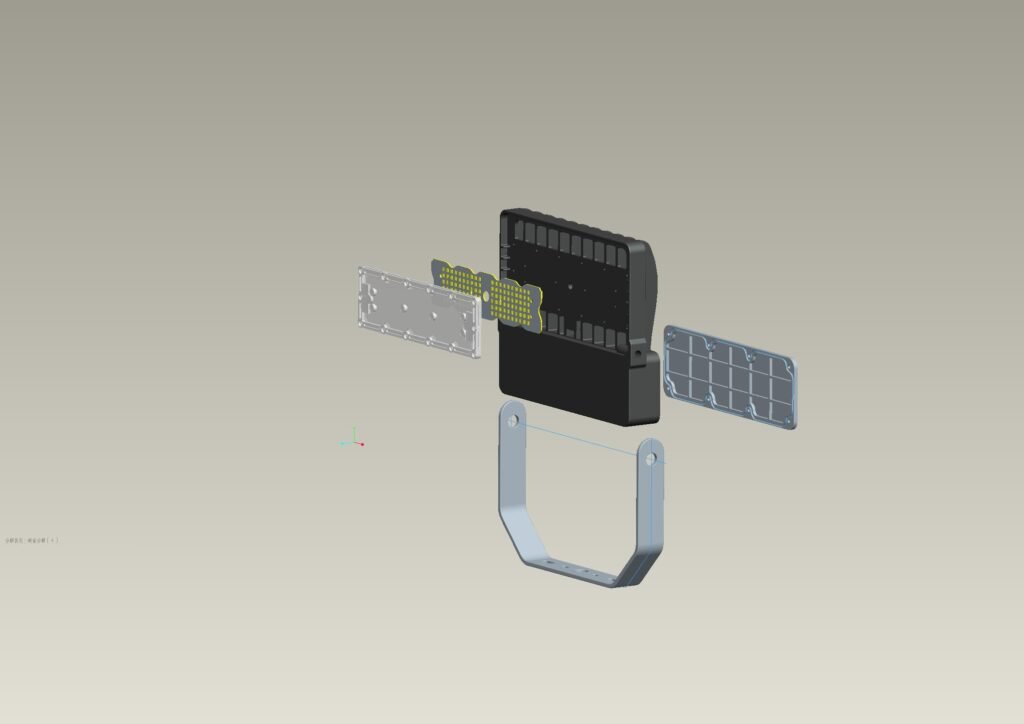
For contractors, lighting distributors, and procurement teams, understanding what actually drives long-term reliability matters more than the rated-hours figure alone.
For the full floodlight selection framework, see our Complete LED Flood Light Guide. This is one step in the broader purchasing journey — see our Buyer’s Guide for the full picture.
Why Do Some LED Floodlights Fail Earlier Than Expected?
Driver Failure Is Often the First Problem
The driver is one of the most common failure points in an LED floodlight — often before the LED chips themselves show any real degradation. A low-quality driver can fail early from overheating, voltage fluctuation, or component aging, even while the LEDs it’s powering are still functioning normally.
Poor Heat Dissipation Reduces Lifespan
Heat is one of the biggest threats to LED lifespan. Higher-quality LED floodlights typically use die-cast aluminum housings, large-surface-area heat sink fins, and separated thermal chambers to keep the driver and LED array running at manageable temperatures. Poor thermal design accelerates lumen depreciation and shortens driver life, even on fixtures with good LED chips.
Moisture and Dust Can Shorten Real-World Lifespan
Outdoor exposure to rain, humidity, and dust also affects long-term reliability — ingress protection is a real contributor to failure rates, not a separate concern from lifespan. The right IP rating depends on your specific site conditions, not a single universal number; see our [IP Rating Guide — 待补:#14尚未上线,暂无真实URL] for how to match IP rating to your project.
Power Surges Cause Unexpected Failures
Many fixtures don’t fail from wearing out — they fail after a lightning strike or voltage transient damages the driver outright. Surge exposure and the right SPD rating for your site are covered in our Surge Protection Guide.
What Matters More Than a 50,000-Hour Lifespan Claim?
| Check This | Why It Matters |
|---|---|
| Driver brand | Determines overall system stability |
| Heat sink design | Determines thermal management capability |
| Surge protection | Reduces risk from lightning and voltage transients |
| IP rating | Determines outdoor reliability |
| Housing material | Affects heat dissipation and corrosion resistance |
| Warranty | Reflects the manufacturer’s own confidence in the product |
| Certifications | Verifies claims through third-party testing |
What Does 50,000 Hours Really Mean?
A rated-hours figure only becomes meaningful once you translate it into actual years of operation, based on how many hours per day the fixture runs:
| Operating Hours / Day | Theoretical Lifespan |
|---|---|
| 4 hours | ~34 years |
| 8 hours | ~17 years |
| 12 hours | ~11 years |
| 24 hours | ~5.7 years |
A 50,000-hour rating sounds impressive on a spec sheet, but a fixture running 24/7 (common in some industrial or security applications) reaches that figure in well under six years — worth factoring in before assuming “50,000 hours” automatically means “decades.”
LED Floodlights vs Metal Halide vs Halogen
| Lighting Technology | Average Lifespan |
|---|---|
| LED Floodlight | 50,000–100,000 hours |
| Metal Halide | 6,000–20,000 hours |
| Halogen | 2,000–4,000 hours |
For the full comparison of why this gap exists — and what it means for a metal halide retrofit — see our Metal Halide to LED Conversion Guide.
How to Choose the Right LED Floodlight for Your Project
Lifespan expectations vary by application, since operating hours, environmental exposure, and duty cycle differ significantly by use case:
- Parking Lot Lighting — see our Parking Lot Lighting Design Guide
- Sports Field Lighting — see our Sports Lighting Standards Guide
- Industrial Yard Lighting — see our Industrial Yard Flood Lights Guide
- Basketball Court Lighting — see our Basketball Court Lighting Guide
How to Select a Floodlight That Can Really Last 10+ Years
Look for a combination of these factors together — no single spec on its own guarantees long-term reliability:
- A recognized branded driver, not an unbranded or unverifiable one
- Die-cast aluminum housing with real thermal engineering behind it, not just a heavy-looking shell
- An IP rating confirmed against your actual site exposure, not just the highest number available
- Surge protection sized to your project’s real risk level, not a generic default
- High efficacy (130–150 lm/W range on quality products) — a sign of a well-engineered LED array, not just a marketing number
- Dimming/control compatibility (DALI or 0-10V) if your project needs it
- A warranty of 5+ years — a meaningful signal of how much confidence the manufacturer has in their own product
Lifespan Spec Mistakes We See in Real RFQs
- Rated hours quoted with no L70 context. A “50,000 hour” rating means little without knowing it’s measured to L70 (70% of initial lumen output) — ask what maintained-lumen threshold the rating is based on, not just the raw hour figure.
- Daily operating hours not factored into the expectation. As the table above shows, a fixture running 24/7 reaches its rated hours in a fraction of the time a fixture running 8 hours a day would — buyers sometimes assume “50,000 hours” means the same number of years regardless of use case.
- A branded driver treated as a guarantee on its own. A good driver reduces risk, but poor thermal design around it can still shorten real-world life — driver quality and heat dissipation need to be evaluated together, not as substitutes for each other.
- IP and surge ratings copied from a different project’s spec sheet. The right rating depends on your specific site’s exposure — reusing a number from an unrelated project can mean over-paying for protection you don’t need, or under-specifying for conditions you do have.
Recommended Long-Life LED Floodlights for Commercial Projects
The combination of driver quality, thermal design, and protection ratings above applies across project types, including:
Parking Lot Lighting · Sports Field Lighting · Industrial Yard Lighting · Port Lighting · Billboard Lighting · Facade Lighting
Frequently Asked Questions
How long do LED floodlights actually last? Quality LED floodlights are commonly rated for 50,000–100,000 hours to L70, but real-world lifespan depends heavily on driver quality, thermal design, IP rating, and how many hours per day the fixture actually operates.
What usually fails first in an LED floodlight — the LED chips or the driver? The driver is typically the first point of failure, often well before the LED chips themselves show meaningful degradation, especially in fixtures with lower-quality drivers or poor thermal management.
Does a 50,000-hour rating mean the fixture will last 50 years? No — it depends on daily operating hours. A fixture running 8 hours a day reaches 50,000 hours in about 17 years; one running 24/7 reaches it in under 6 years.
Is a higher IP rating always better for lifespan? Not necessarily cost-effective — the right IP rating should match your site’s actual exposure. See our IP Rating Guide for how to choose the right level rather than defaulting to the highest number.
Does surge protection affect lifespan, or is that a separate spec? It’s directly connected — many “premature failures” are actually surge damage, not lumen depreciation or normal wear. See our Surge Protection Guide for how to size SPD protection to your project.
Conclusion
A long rated-hours figure on a spec sheet is a starting point, not a guarantee. Real-world lifespan comes down to driver quality, thermal design, IP rating matched to real exposure, and surge protection sized to real risk — evaluated together, not as a single headline number.
Wondering whether it’s actually worth paying more for a longer-lasting fixture? See our [Project-Grade vs Cheap LED Flood Lights —] guide for the real 10-year cost comparison.
Browse our LED Floodlight Series.