
By Lighting Engineering Team, MVS Lighting — outdoor lighting manufacturer with 5 production lines and 15+ years experience
Every outdoor LED floodlight spec sheet lists an IP rating, but the number alone doesn’t tell you whether a fixture is actually right for your site. IP65, IP66, and IP67 are the three ratings you’ll see most often on commercial floodlights — and the difference between them comes down almost entirely to water, not dust.
This guide explains what the IP rating numbers actually mean, what changes in practice between IP65/66/67 for floodlight applications, and how to match the right rating to your project without overpaying for protection you don’t need.
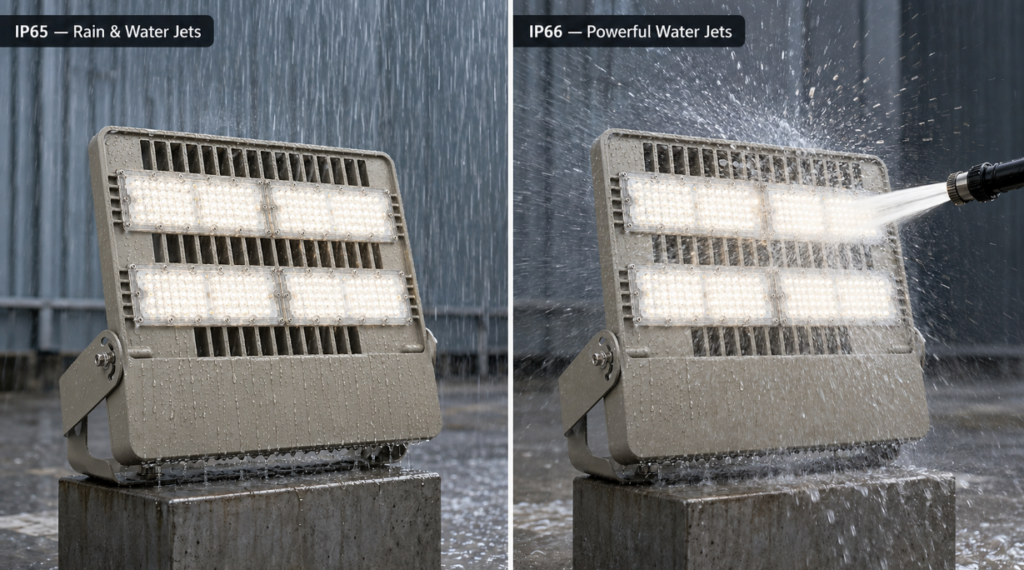
🖼️ IP65 floodlight in rain vs IP66 floodlight under high-pressure water jet
For the full floodlight selection framework, see our Complete LED Flood Light Guide or How to Choose the Right LED Flood Light. This is one step in the broader purchasing journey — see our Buyer’s Guide for the full picture.
How to Read an IP Rating
IP stands for Ingress Protection, defined under IEC 60529. The rating is two digits: the first covers protection against solid objects and dust, the second covers protection against moisture.
First digit — solid particle protection (0–6):
| Digit | Protection |
|---|---|
| 0 | No protection |
| 1 | Objects larger than 50mm |
| 2 | Objects larger than 12.5mm |
| 3 | Objects larger than 2.5mm |
| 4 | Objects larger than 1mm |
| 5 | Dust-protected — limited ingress, doesn’t affect operation |
| 6 | Dust-tight — no ingress at all |
Second digit — moisture protection (0–9):
| Digit | Protection |
|---|---|
| 0 | No protection |
| 1 | Vertically falling drops |
| 2 | Falling drops up to 15° from vertical |
| 3 | Sprays up to 60° from vertical |
| 4 | Splashing from any direction |
| 5 | Low-pressure water jets from any direction |
| 6 | Powerful water jets from any direction |
| 7 | Temporary immersion up to 1m |
| 8 | Continuous immersion beyond 1m |
| 9 | High-pressure, high-temperature jets |
IP65 vs IP66 vs IP67: What Actually Changes for Floodlights
Here’s the part most spec sheets don’t make clear: IP65, IP66, and IP67 all carry the same first digit (6) — complete dust protection. There is no practical dust-protection difference between them. The entire difference between these three ratings is in the second digit, i.e. water.
- IP65 — protected against low-pressure water jets from any direction. This covers ordinary rain, snow, and splashing, but not high-pressure washdown or hosing. It’s a reasonable baseline for most general outdoor floodlight applications — building facades, parking lots, sports areas.
- IP66 — protected against powerful, high-pressure water jets from any direction. This is the step up for sites with washdown cleaning, storm-driven rain, coastal wind-blown spray, or heavy industrial exposure.
- IP67 — dust-tight and rated for temporary immersion up to 1 meter for 30 minutes. This matters for ground-level, recessed, or flood-prone installations — it’s generally not necessary for a pole- or wall-mounted floodlight that will never realistically sit underwater, even briefly.
In practice: IP65 covers most standard commercial floodlight projects. IP66 is the more common choice for coastal, industrial, or storm-exposed sites — several manufacturers position it as the best balance of protection and cost for commercial outdoor lighting. IP67 is worth paying for only if there’s a genuine submersion or flood risk at the installation point — paying for it on an elevated pole-mounted fixture that will never see standing water is protection you don’t need.
Recommended IP Rating by Application
| Application | Typical IP Rating | Full Guide |
|---|---|---|
| General parking lots, building facades | IP65 | Parking Lot Lighting Design |
| Sports fields & stadiums | IP65–IP66 | Sports Lighting Standards |
| Coastal, industrial yards, washdown environments | IP66 | Industrial Yard Flood Lights |
| Ground-level, recessed, or flood-prone installations | IP67 | No dedicated guide yet — confirm submersion risk on-site before specifying |
IP Rating ≠ Surge Protection
IP rating protects against dust and water ingress. It has nothing to do with protection against voltage transients or lightning-induced surges — that’s a separate spec entirely. See our Surge Protection Guide for SPD ratings.
IP Rating ≠ Lifespan Guarantee
A high IP rating keeps water and dust out, but it doesn’t guarantee long-term lumen output or driver longevity on its own — a well-sealed fixture with a poor driver will still fail early. See our [Why Some LED Flood Lights Last 10 Years ] guide for what actually drives long-term lifespan.
What to Check Before You Buy
- Confirm the rating is tested, not just claimed. Ask for the actual IP test report, not just a datasheet mention.
- Check cable entry and gasket quality, not just the housing. A housing rated IP66 is only as good as its cable glands and seals — a poorly sealed cable entry point defeats the rating at the weakest point.
- Don’t assume IP rating covers corrosion resistance. For coastal or chemical-exposure sites, IP rating and corrosion resistance are separate specs — ask about housing material and anti-corrosion coating specifically, not just the IP number.
- Match the rating to real exposure, not the highest available option. Paying for IP67 on a fixture that will never be near standing water is money better spent elsewhere in the spec.
IP Spec Mistakes We See in Real RFQs
- Requesting IP68 “to be safe” on a pole-mounted floodlight. Immersion protection is irrelevant for a fixture that will never sit in water — this usually just adds cost without adding real protection for the application.
- Confirming the IP number without checking cable entry quality. A fixture can carry a correct IP66 rating on its housing and still leak at a poorly installed cable gland — the rating describes the tested unit, not necessarily every field installation.
- Assuming IP66 automatically means corrosion-resistant. Coastal and industrial-chemical buyers sometimes stop at the IP number and skip asking about housing material or coating — IP rating and corrosion resistance are tested and specified separately.
- Specifying IP65 for a site that actually gets pressure-washed. IP65 is not rated for high-pressure jets; sites with routine washdown cleaning need IP66 at minimum, or the rating gets exceeded during normal maintenance, not just extreme weather.
Frequently Asked Questions
What IP rating do I need for outdoor LED flood lights? IP65 is a reasonable baseline for most general outdoor projects. IP66 is recommended for coastal, industrial, or storm-exposed sites. IP67 is only necessary if there’s a genuine risk of temporary submersion.
What’s the actual difference between IP65 and IP66? Both offer complete dust protection. The difference is water: IP65 handles low-pressure water jets (rain, splashing), while IP66 handles high-pressure jets (washdown, storm-driven rain, hosing).
Is IP67 better than IP66 for outdoor floodlights? Not necessarily “better” — different. IP67 adds temporary submersion resistance, which matters for ground-level or flood-prone installations but is unnecessary for a typical pole- or wall-mounted floodlight.
Does a higher IP rating mean a longer-lasting fixture? Not on its own. IP rating protects against dust and water ingress specifically — driver quality, thermal design, and lumen maintenance are separate factors that determine overall lifespan.
Can I use an IP65 floodlight in a coastal area? IP65 protects against rain and splashing, but coastal environments usually also involve wind-driven spray and salt exposure — IP66 plus confirmed corrosion-resistant housing is the more reliable spec for that environment.
Conclusion
IP65, IP66, and IP67 all offer identical dust protection — the real decision is about water exposure at your specific site, not picking the highest number available. IP65 covers most standard projects, IP66 is the practical choice for coastal or industrial exposure, and IP67 is worth its added cost only where genuine submersion risk exists.
Need help matching IP rating to your project? [Talk to our lighting team — free →]