
By Lighting Engineering Team, MVS Lighting — outdoor lighting manufacturer with 5 production lines and 15+ years experience
LED floodlights are more exposed to voltage surges than almost any other fixture type on a commercial site. They’re outdoor, often pole- or high-mast-mounted, and wired over long runs back to the electrical panel — wiring that effectively acts as an antenna, picking up induced voltage from nearby lightning strikes or utility-side switching events. A single unprotected surge can take out a driver or LED array outright.
This guide covers what a Surge Protection Device (SPD) actually does, how to read its kV/kA rating, and which level of protection fits your project.
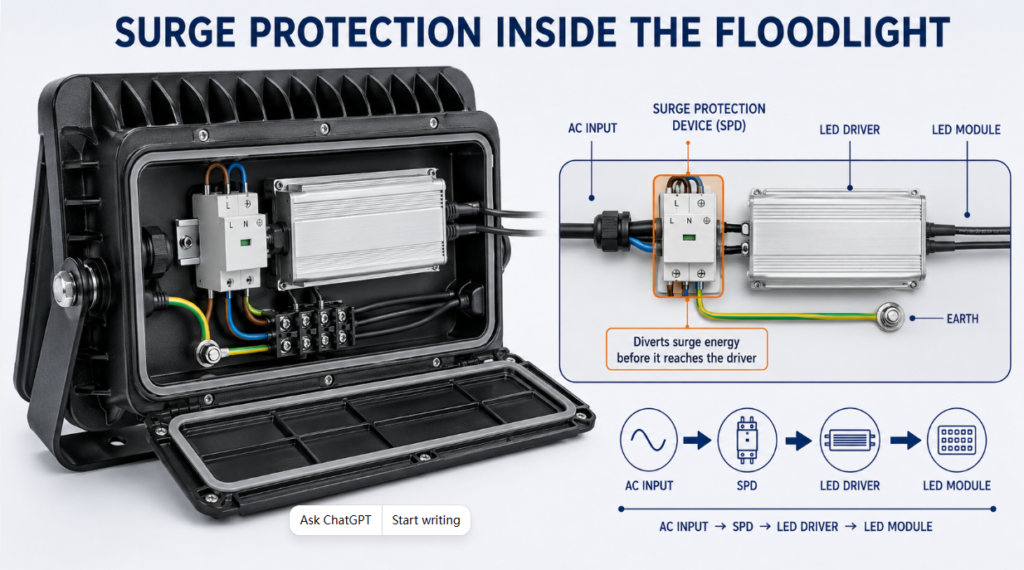
🖼️ surge protection device installed at LED floodlight driver compartment
For the full floodlight selection framework, see our Complete LED Flood Light Guide or How to Choose the Right LED Flood Light.
What Is a Surge Protection Device (SPD)?
An SPD is installed between the power supply and the LED fixture — either integrated at the driver/fixture level, or upstream at the electrical panel serving multiple fixtures. When incoming voltage exceeds a set threshold, the SPD activates within nanoseconds, clamping the voltage to a safe level and diverting the excess energy to ground. Once the transient passes, the SPD resets and stands ready for the next event.
LED drivers are particularly sensitive to these transients compared to older HID or incandescent gear — a voltage spike that an old metal-halide ballast might shrug off can damage an LED driver’s circuitry outright. Parking lots, sports fields, wall packs, and any pole-mounted fixture with a long wiring run are the highest-exposure cases.
Understanding SPD Types (Type 1 / 2 / 3)
SPDs are classified by where they sit in the electrical system and how much surge energy they’re built to absorb:
- Type 1 (Class I) — installed at the service entrance or main panel. Built for the highest-energy events, including direct or near-direct lightning strikes. Ratings in this class can run up to 40kA.
- Type 2 (Class II) — installed at a distribution board or sub-panel, protecting a group of circuits from surges that pass the first stage of protection.
- Type 3 (Class III) — installed at the device or fixture level, as the final layer of protection closest to the LED driver itself. This is where most fixture-integrated floodlight SPDs sit.
For most commercial floodlight projects, fixture-level (Type 3) protection is the baseline; panel-level (Type 1/2) protection is layered on top for high-exposure sites. Note that fixture-level LED lighting SPD modules are typically certified to IEC/EN 61643-11, the standard specific to LED lighting surge protection components — not to be confused with the broader building-level SPD standards.
SPD Ratings Explained: kV, kA, and Why Both Matter
A surge protector’s rating isn’t a single number — it’s a combination of two figures, and buyers who only ask for “10kV” are only getting half the spec:
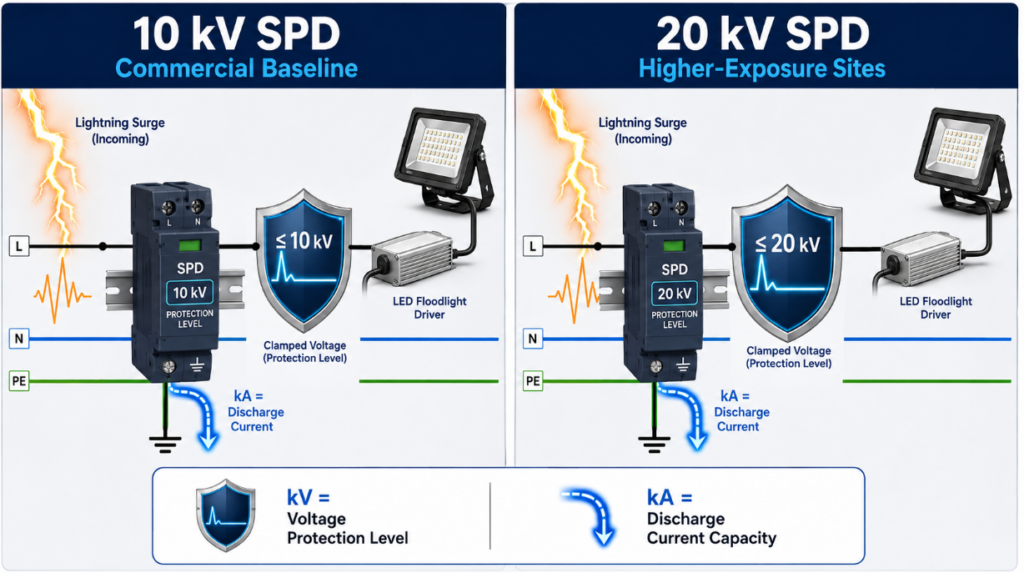
- kV (kilovolts) — the voltage the SPD can clamp down to a safe level before it lets a surge through.
- kA (kiloamps) — the maximum discharge current the SPD can absorb and shunt to ground without failing, usually specified against a standard 8/20μs test waveform (an industry-standard way of simulating a lightning-induced surge pulse).
10kV / 10kA is a common commercial baseline for fixture-level floodlight protection. Higher-exposure sites — lightning-prone regions, high-mast installations, large sports or stadium projects — often step up to 20kV, or pair a higher-kA fixture-level SPD with additional Type 1/2 protection upstream at the panel.
🖼️ SPD rating comparison — 10kV vs 20kV clamping and discharge current
Recommended SPD Rating by Application
| Application | Typical SPD Rating | Full Guide |
|---|---|---|
| General commercial / parking lot | 6kV–10kV | Parking Lot Lighting Design |
| Sports fields & stadiums (high-mast) | 10kV–20kV | Sports Lighting Standards |
| Industrial yards & high-lightning-exposure regions | 10kV–20kV, layered with panel-level Type 1/2 | Industrial Yard Flood Lights |
Regardless of application, the SPD rating should be confirmed against local lightning frequency data and the length of the wiring run — not just copied from a generic spec sheet.
Surge Protection ≠ IP Rating
SPD ratings and IP ratings solve two unrelated problems — a fixture can have an excellent SPD and still fail from water ingress if its IP rating is inadequate, or vice versa. See our [IP Rating Guide — 待#14发布后补链接] for dust and moisture protection.
Surge Protection ≠ Guaranteed Lifespan
An SPD protects against sudden voltage events; it doesn’t extend a fixture’s baseline lumen-depreciation lifespan on its own, and it doesn’t make up for a poor driver or thermal design. See our [Why Some LED Flood Lights Last 10 Years] guide for what actually drives long-term lifespan.
What to Check Before You Buy
- Confirm both numbers, not just kV. Ask for the kA rating alongside the kV rating, and check what test waveform (typically 8/20μs) it’s rated against.
- Ask for the certification, not just the claim. IEC/EN 61643-11 certification (for fixture-level LED lighting SPD modules) should come with a test report, not just a datasheet mention.
- Check the disconnect behavior. Some SPDs are parallel-connected and fail safe, keeping the fixture powered after the SPD itself reaches end-of-life; others are series-connected and disconnect power to protect the luminaire. Confirm which behavior your project needs.
- Confirm grounding quality on-site. An SPD is only as effective as the grounding path it diverts energy into — a well-rated SPD on a poor ground connection will underperform its spec.
Surge Spec Mistakes We See in Real RFQs
- “10kV” requested with no kA number. As covered above, kV alone doesn’t describe the SPD’s actual surge-absorbing capacity — always confirm both figures.
- Assuming the SPD is a one-time install with no further attention. SPDs degrade with each surge event they absorb and have a working life of their own — most include a status indicator, and a failed indicator means the SPD may no longer be protecting the fixture. Skipping periodic checks is a common gap on long-running sites.
- Treating a fixture-level SPD as sufficient for a high-lightning-exposure site. On sites with real lightning exposure — high-mast, open sports fields, coastal or inland-storm-prone regions — fixture-level protection alone is often not enough; layered protection with a panel-level Type 1 or 2 device is the more realistic spec.
- Not accounting for grounding in the surge protection budget. Buyers sometimes spec a high-kA SPD while overlooking that the on-site grounding infrastructure is what actually determines whether that rating is realized in practice.
Frequently Asked Questions
What SPD rating do I need for outdoor LED flood lights? 10kV/10kA is a common commercial baseline. Higher-exposure sites — high-mast, lightning-prone regions, large sports facilities — often need 20kV or layered panel-level protection in addition to fixture-level SPD.
What’s the difference between Type 1, 2, and 3 SPDs? Type 1 sits at the service entrance and handles the highest-energy events (up to 40kA); Type 2 sits at a distribution panel; Type 3 sits at the device or fixture level, closest to the LED driver. Most floodlight-integrated SPDs are Type 3.
Does a higher kV rating always mean better protection? Not on its own — the kA (discharge current) rating matters just as much as the kV (clamping voltage) rating. A supplier quoting only a kV number without a kA figure hasn’t given you the full spec.
Do I still need surge protection if my site rarely gets lightning? Yes — utility-side switching events and equipment on the same grid can also cause damaging transients, independent of lightning frequency. SPD is standard practice for outdoor commercial lighting regardless of local storm frequency, though the required rating may be lower.
Does surge protection replace the need for a good IP rating or quality driver? No. SPD protects against voltage transients specifically — it doesn’t address water/dust ingress (IP rating) or general lumen-depreciation lifespan, which depend on separate factors.
Conclusion
Surge protection is not a single number to check off a spec sheet — it’s a combination of voltage rating, discharge current rating, SPD type/placement, and site grounding quality, matched to your project’s actual exposure level. For most commercial floodlight projects, 10kV/10kA fixture-level protection is a reasonable baseline; higher-exposure sites need more.
Need help specifying the right SPD level for your project? [Talk to our lighting team — free →]