
By Lighting Engineering Team, MVS Lighting — outdoor lighting manufacturer with 5 production lines and 15+ years experience
Choose 200W for medium-height installations where lower energy use and more flexible fixture spacing matter. Choose 300W for higher mounting positions, larger open areas, or projects where fewer fixtures are preferred.
However, wattage alone does not determine the result. Beam angle, lumen output, mounting height, target lux, fixture quantity and installation structure must also be considered.
For the complete wattage selection logic, see our LED Flood Light Wattage Guide.
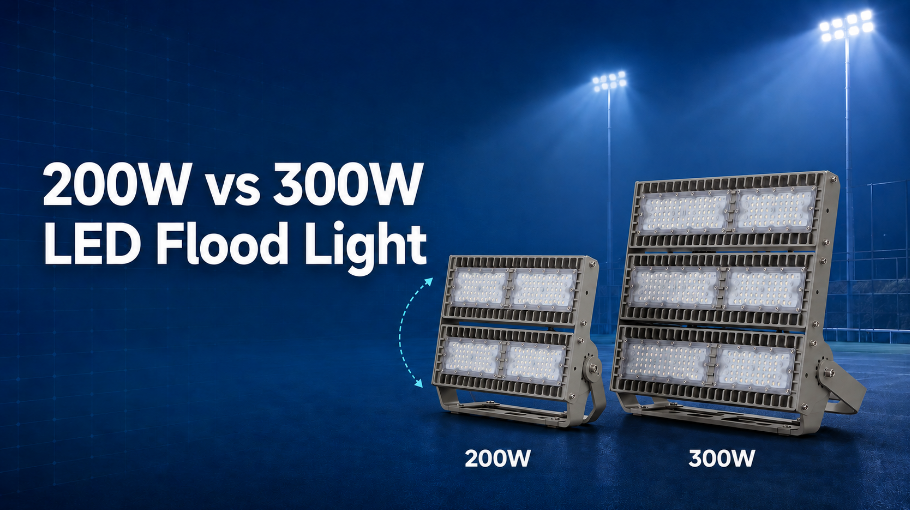
200W vs 300W at a Glance
| Factor | 200W LED Flood Light | 300W LED Flood Light |
|---|---|---|
| Power | 200W | 300W |
| Typical Lumen Output | Approximately 24,000–26,000 lm | Approximately 39,000 lm |
| Best For | Medium to large areas | Large open areas |
| Typical Mounting Height | 8–12 m | 8–12 m, typically toward the upper end |
| Coverage Approach | More flexible fixture distribution | Higher output per installation point |
| Fixture Quantity | Usually more | Potentially fewer |
| Energy Use | Lower per fixture | Higher per fixture |
| Initial Cost | Lower | Higher |
| Best Project Type | Distributed fixture layout | High-mast or large-area layout |
The main difference is not simply that 300W is brighter. The real decision is whether your project benefits more from additional fixtures with flexible coverage or fewer fixtures with higher individual output.
What Is the Real Difference?
Lumen Output and Brightness
A 200W LED floodlight typically outputs around 24,000–26,000 lumens, while a 300W unit outputs around 39,000 lumens. This means the 300W model provides approximately 50% more total light output within this product range.
However, actual results still depend on fixture efficacy, optical design and operating conditions. Both wattages in this range achieve approximately 120–130 lm/W, but this will not necessarily be the same across every product line or manufacturer.
Compare lumens rather than wattage alone. Two fixtures with the same wattage can produce meaningfully different light output depending on their efficacy.
Coverage Area
A 300W fixture does not automatically cover a larger area. Beam angle changes the lighting result.
A narrow beam projects light farther but covers a smaller footprint, while a wide beam covers more area but reduces centre-point intensity.
Both the 200W and 300W fixtures in this product range are available with 30°, 60°, 90° and 120° beam angles, along with wide-angle distribution options. This means optical selection is not determined by wattage alone.
For NEMA classifications, coverage calculations and application selection, see our LED Floodlight Beam Angle Guide.
Mounting Height
Both 200W and 300W fixtures are commonly used within an 8–12 metre mounting range.
Within this overlapping range, 300W is more frequently used toward the upper end, especially at 10–12 metres or when the project requires more output from each installation point.
A 200W fixture is more commonly used toward the lower or middle part of this range, or where closer fixture spacing provides better uniformity.
There is no fixed rule that one wattage must always correspond to one mounting height. For the complete height-selection method, see our LED Floodlight Mounting Height Guide.
Energy Consumption
Consider a simple comparison between ten 200W fixtures and ten 300W fixtures operating for ten hours per day.
200W system:
200W × 10 fixtures = 2,000W system load
20 kWh per day
Approximately 7,300 kWh per year
300W system:
300W × 10 fixtures = 3,000W system load
30 kWh per day
Approximately 10,950 kWh per year
This comparison is only valid when fixture quantity and daily operating time remain the same. A project that uses fewer 300W fixtures may produce a different total energy result.
Actual input power can also vary slightly from the rated wattage because of driver tolerance and operating conditions. For precise energy budgeting, use the measured input power or the value stated in the final product datasheet.
When Should You Choose 200W?
Choose a 200W LED flood light when:
- The mounting height falls within the medium range.
- The area has an irregular shape.
- You need greater flexibility in fixture placement.
- Uniformity matters more than maximum single-fixture output.
- The existing circuit or power budget is limited.
- You want to reduce the procurement cost per fixture.
- The lighting design needs to avoid excessively bright hot spots.
- Individual modules need to be installed, removed or adjusted separately.
Common applications include medium-sized parking areas, industrial yards, building perimeters, loading areas and general outdoor commercial areas.
When Should You Choose 300W?
Choose a 300W LED flood light when:
- The poles are mounted higher.
- A longer throw distance is required.
- The open area is larger.
- The number of available installation points is limited.
- You want to reduce the total fixture quantity.
- High-position maintenance costs are a concern.
- The existing structure cannot easily support additional mounting points.
- Higher output is required from each individual fixture.
Common applications include large industrial yards, ports, logistics areas, large parking areas, sports facilities and high-mast installations.
The advantage of 300W is not simply that brighter is always better. Its practical advantage is that certain projects may achieve the required lighting result with fewer installation points.
More 200W or Fewer 300W Fixtures?
This is the comparison that matters for many commercial projects: should the design use more 200W fixtures or fewer 300W fixtures?
| Project Factor | More 200W Fixtures | Fewer 300W Fixtures |
|---|---|---|
| Uniformity | Usually easier to control | More dependent on layout |
| Fixture Cost | More units required | Fewer units required |
| Installation Cost | More mounting points | Fewer mounting points |
| Wiring | Potentially more complex | Potentially simpler |
| Energy Use | Depends on total system wattage | Depends on total system wattage |
| Maintenance | More fixtures to service | Fewer fixtures to service |
| Design Flexibility | Higher | Lower |
| Dark-Area Risk | Easier to control | Layout becomes more critical |
| Individual Fixture Weight | Lighter individual modules | Heavier individual fixtures |
| Angle Adjustment | Each module can be adjusted separately | Fewer but heavier units to adjust |
Modular Installation and Weight
Fixture weight matters when multiple floodlights are installed on the same mounting structure.
A 200W floodlight can be used as an individual lighting module. Each unit can be installed, removed, replaced and aimed separately. Two 200W modules can also be mounted on a customized rear bracket to create a combined 400W lighting assembly.
This modular design is useful when different lighting directions are required from the same mounting position. If the project changes later, the individual modules can be removed or reconfigured without replacing the complete lighting assembly.
A 300W floodlight provides more output from one fixture, but its housing is generally heavier. When several 300W fixtures are combined on the same bracket, the pole, bracket and mounting structure must support greater total weight. Installation, removal and angle adjustment may also become more difficult.
For projects requiring flexible aiming or future reconfiguration, smaller 200W modules may therefore be easier to manage.
The correct comparison is the complete lighting system, rather than 200W and 300W as isolated fixtures.
200W vs 300W by Application
| Application | Usually Start With | Reason |
|---|---|---|
| Medium Parking Area | 200W | Better layout flexibility |
| Large Parking Area | 200W or 300W | Depends on pole height and spacing |
| Industrial Yard | 200W or 300W | Depends on area and target lux |
| Logistics Area | 300W | Higher output for larger open areas |
| Sports Field | Modular 200W or 300W | Depends on mounting structure and aiming requirements |
| Building Perimeter | 200W | 300W may be unnecessary |
| High-Mast Area | 300W | Higher output per mounting point |
These are starting points rather than final specifications. Without site dimensions, pole positions and a lighting simulation, no wattage recommendation should be treated as a fixed engineering conclusion.
Is 300W Actually More Expensive?
A single 300W fixture costs more and consumes more power than a single 200W fixture. However, a complete 300W-based lighting system is not automatically more expensive than a 200W-based system.
Four cost factors should be considered:
- Fixture purchase cost
- Installation cost
- Wiring and mounting cost
- Long-term energy cost
Consider the following system comparison:
Plan A: 10 × 200W = 2,000W total connected load
Plan B: 7 × 300W = 2,100W total connected load
The two plans have a similar total connected load, but Plan B requires three fewer fixtures. This may reduce mounting points, wiring work and the number of fixtures requiring future maintenance.
However, Plan A may provide greater flexibility and make lighting uniformity easier to control.
The correct cost comparison should therefore include total fixture quantity, connected load, installation requirements and long-term operating costs—not only the price of one fixture.
For current factory pricing and wholesale budgeting factors, see our LED Floodlight Price Guide.
Do Not Choose by Wattage Alone
Before selecting 200W or 300W, check the following factors.
Actual Lumen Output
Different products can achieve different efficacy at the same wattage. Always compare the declared lumen output and lm/W rather than relying on wattage alone.
Beam Angle
Different optical distributions produce completely different coverage, throw distance and centre-point intensity.
Mounting Height
Mounting height directly affects ground-level illuminance, coverage area and the appropriate aiming angle.
Target Lux
Parking lots, industrial yards, logistics areas and sports fields require different illumination levels.
Lighting Layout
The final result depends on fixture quantity, installation position, pole spacing and aiming direction—not simply the wattage printed on the product label.
Mounting Structure
Check the available bracket space, fixture weight, structural strength, wind load and whether individual modules need to be adjusted separately.
A Simple Decision Guide
Choose 200W when the project has:
- Medium mounting height
- More available mounting points
- An irregular lighting area
- Higher uniformity requirements
- Flexible fixture placement
- Modular installation requirements
Choose 300W when the project has:
- Higher mounting positions
- A larger open area
- Fewer available mounting points
- A longer required throw distance
- Sufficient structural load capacity
- A need for higher output from each fixture
Run a lighting simulation when the project has a specific lux target, irregular dimensions, high poles or a large fixture quantity.
Practical Project Example
Modular 200W Floodlights in Guangzhou
Around four to five years ago, MVS supplied a modular LED floodlight solution for the lighting renovation of a small 7-a-side football field in Guangzhou, Guangdong Province, China. The existing lighting poles were approximately 15 metres high.
For this project, two 200W LED floodlights were installed on a customized rear bracket to form each 400W lighting assembly. The fixtures used a 60° beam angle, and each 200W module could be aimed separately according to the required lighting direction.
This modular structure made each fixture easier to install, remove and reposition. It also provided greater aiming flexibility than a combined mounting structure based on heavier individual modules.
Based on the available project information, the completed football field achieved approximately 380 lux in the reported measurements. The customer was satisfied with the final lighting result.
Although this was a relatively small project, it demonstrates an important practical advantage of 200W modules: they can be used independently or combined to create a higher-power lighting assembly.
For projects requiring flexible aiming, convenient installation or future reconfiguration, modular 200W floodlights can be more manageable than combining heavier 300W units.
Final Recommendation
Choose 200W when your project requires flexible fixture placement, lower power per fixture, easier modular installation and greater control over lighting distribution.
Choose 300W when the project has higher mounting positions, larger open areas or limited installation points that require more output from each fixture.
For a commercial project, compare the complete lighting system—not just the wattage of one fixture. Fixture quantity, total power, beam angle, mounting structure, installation cost and target lux should all be evaluated together.
You can compare available wattages, optical distributions and project configurations in our LED floodlight series.
Not sure whether your project requires 200W or 300W? Send us your area dimensions, mounting height, pole positions and target lux. Our lighting team can compare both options before quotation.
Compare 200W and 300W for My Project
Frequently Asked Questions
Is a 300W LED flood light 50% brighter?
Not necessarily in every product range. Based on the typical figures used in this comparison, a 300W fixture producing approximately 39,000 lumens delivers around 50% more light output than a 200W fixture producing approximately 24,000–26,000 lumens.
However, actual efficacy varies between products, so the declared lumen output should always be verified.
How high can a 200W flood light be mounted?
A 200W floodlight is commonly used at mounting heights between 8 and 12 metres, typically toward the lower or middle part of that range.
Higher installation positions may be possible when multiple 200W modules are combined, but the final result depends on total output, beam angle, fixture quantity and target lux.
When should I choose 300W instead of 200W?
Choose 300W when the project has higher mounting positions, larger open areas or a limited number of installation points where fewer fixtures with higher individual output are preferred.
Can fewer 300W lights replace more 200W lights?
In some projects, yes. However, this depends on the lighting layout and target uniformity.
A design using fewer fixtures becomes more dependent on correct positioning and optical distribution, so the result should be verified through a lighting simulation.
Which is more energy-efficient?
Neither wattage is automatically more energy-efficient. Efficiency should be compared using lm/W.
The total energy consumption of a project depends on fixture quantity, actual input power and daily operating hours—not only the wattage of one fixture.