
Home > LED Flood Lights > Stadium LED Flood Lights Guide
By Lighting Engineering Team, MVS Lighting — outdoor lighting manufacturer with 5 production lines and 15+ years of experience in stadium and large-area sports lighting projects, providing professional LED flood light selection and lighting simulation solutions for global applications. Last updated: July 2026.
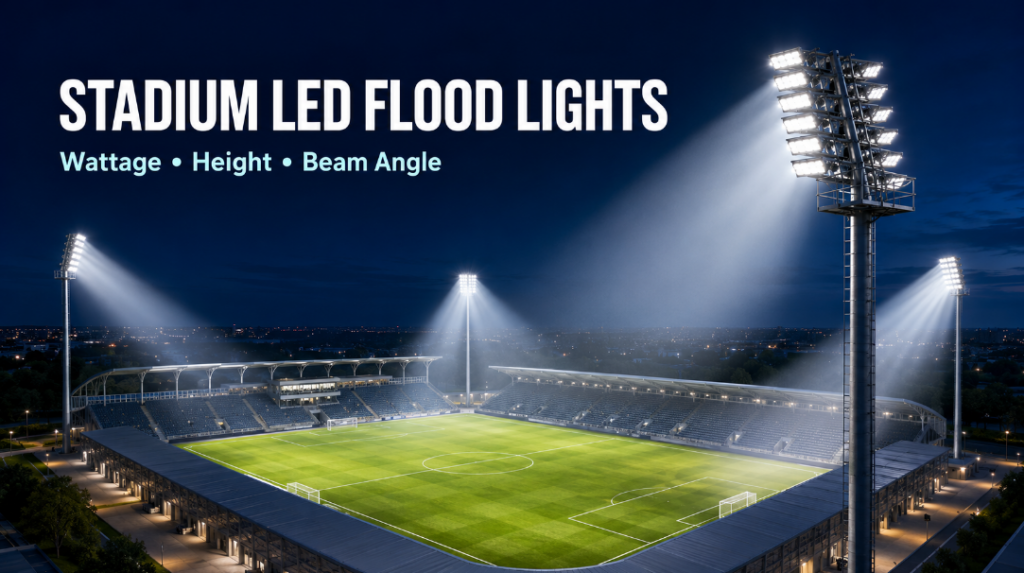
Stadium LED floodlight selection mainly depends on field size, target illuminance, mounting height, pole position, beam angle, and broadcast requirements. Small training fields typically start at 300–500W, while large stadiums and high-mast projects usually require 600–1500W professional-grade stadium floodlights. Higher mounting heights generally call for higher light output and narrower beam angles.
MVS offers a range of commercial LED floodlights suitable for training fields, community sports grounds, and high-mast stadium projects, with multiple wattages and optical distributions available.
You can’t select a stadium floodlight by wattage alone. Take the same 1000W fixture:
- 15° suits long-distance projection
- 30° suits medium-distance coverage
- 60° suits shorter-range, wide-area lighting
This guide walks you through the full selection sequence: field type → lighting requirement → mounting height → wattage → beam angle → fixture specification.
Stadium lighting is only one category of commercial outdoor lighting. For a broader comparison of floodlights used in parking lots, industrial facilities, commercial buildings, and sports venues, see our guide to the best commercial LED flood lights. For the complete technical selection process, see our LED Floodlight Buying Guide.
Quick Answer — Stadium Floodlight Selection
| Stadium Type | Mounting Height | Typical Wattage | Beam Angle | Main Priority |
|---|---|---|---|---|
| Small Training Field | 8–15 m | 300–500W | 30°–60° | Cost & basic uniformity |
| School Sports Field | 12–20 m | 400–800W | 20°–40° | Uniformity |
| Community Stadium | 15–25 m | 600–1000W | 15°–40° | Coverage & glare |
| Professional Stadium | 25–50 m | 1000–1500W | 10°–30° | High output & precision |
| Broadcast Stadium | 30–60 m | Project-specific | Multiple optics | Vertical lux & flicker |
These are preliminary selection ranges, not final design values. Final fixture quantity and optical distribution must be confirmed through a lighting simulation based on field dimensions, pole positions, and target illuminance.
For wattage questions, see our Wattage Guide. For beam angle questions, see our Beam Angle Guide. For mounting height questions, see our Mounting Height Guide. For competition-level lux and uniformity standards, see our upcoming Sports Field Lighting Standards guide.
What Makes a Good Stadium Floodlight?
A general-purpose outdoor floodlight and a fixture genuinely suited for stadium projects differ in several important ways.
High Lumen Output
Wattage alone doesn’t tell the full story. What matters is actual fixture lumen output, luminous efficacy (lm/W), lumen maintenance over time, and output stability under high operating temperatures — not simply “the higher the wattage, the brighter.”
Precise Beam Control
Stadiums require narrow, medium, and wide beam options — often in combination. A large stadium project typically doesn’t rely on a single beam angle across the entire installation; different pole positions and target zones call for different optics.
Low Glare
Glare control affects player sightlines, spectator comfort, and nearby residential areas — largely determined by fixture aiming and optical design. (Detailed glare rating calculations are covered in our upcoming Sports Field Lighting Standards guide.)
Flicker-Free Performance
Flicker-free output matters for slow-motion camera capture and HDTV broadcast, and depends heavily on driver quality. Training fields and broadcast-grade stadiums have very different flicker performance requirements.
Outdoor Durability
Key specifications include IP66, IK08/IK09 impact resistance, 10kV or 20kV surge protection, corrosion resistance, and thermal management. See our IP Rating Guide and Surge Protection Guide.
Choose by Stadium Type
Training and Recreational Fields
Cost-sensitive, lower mounting heights, no broadcast requirement, predominantly medium-to-wide beam angles.
School and Community Stadiums
Priorities: uniformity, glare control, spill light onto neighboring areas, and maintenance cost.
Professional Stadiums
High-mast installations, long-distance projection, multiple optical combinations, and stricter uniformity and glare requirements.
Broadcast and Competition Stadiums
Priorities: horizontal illuminance, vertical illuminance, flicker performance, camera-direction alignment, and system redundancy.
For specific competition-level lux and uniformity requirements — including FIFA’s international broadcast target of approximately 2000 lux with a uniformity ratio of 0.8 or better — see our upcoming Sports Field Lighting Standards guide.
Choose Wattage by Mounting Height
A common question from buyers: what wattage fits which pole height?
| Mounting Height | Starting Wattage Range | Typical Application |
|---|---|---|
| 8–12 m | 200–400W | Small fields |
| 12–20 m | 400–800W | School/community |
| 20–30 m | 600–1200W | Medium stadiums |
| 30–50 m | 1000–1500W | Large stadiums |
Mounting height alone cannot determine wattage. At the same 30-meter height, field size, pole position, target lux, and beam angle can all vary — and so will the final result.
Choose the Right Beam Angle
Narrow Beam: 10°–20° — suited for high-mast installations, long-distance projection, and center-field zones.
Medium Beam: 20°–40° — suited for mid-distance coverage across primary competition areas.
Wide Beam: 40°–60° — suited for lower mounting positions, close-range zones, and supplementary lighting.
Large stadiums typically use a combination of beam angles rather than a single distribution across the entire installation.
How Many Floodlights Does a Stadium Need?
Fixture quantity depends on field dimensions, target lux, fixture lumen output, mounting height, pole positions, beam angles, coefficient of utilization (CU), and maintenance factor (MF).
As a starting point, total lumens required can be roughly estimated as target lux × field area ÷ utilization factor — but this preliminary calculation only estimates quantity; it cannot determine final fixture layout.
See our Fixture Quantity Guide and our upcoming Sports Field Lighting Standards guide for competition-specific requirements.
Why Lighting Simulation Is Essential
Without a lighting simulation, buyers can’t accurately determine fixture quantity, average lux, minimum lux, uniformity, hot spots, dark zones, glare risk, or the aiming angle for each individual fixture.
Two stadium projects using the same 1000W floodlights can produce completely different real-world results, depending entirely on layout, aiming, and pole positioning — not just fixture specification.
(A real DIALux simulation image would be placed here once available from a completed project.)
Stadium Floodlight Specification Checklist
| Specification | What to Check |
|---|---|
| Power | Based on mounting height and project scale |
| Luminous Efficacy | Actual fixture lm/W |
| Beam Angle | Multiple optical options available |
| IP Rating | IP66 recommended |
| Impact Protection | IK08 or above |
| Surge Protection | 10kV / 20kV |
| Driver | Reliable brand |
| Flicker | Verify for broadcast-grade projects |
| Dimming | DALI / 0–10V if required |
| Housing | Thermal and corrosion resistance |
| Warranty | 5 years |
| Photometric File | IES/LDT available |
What Information Should You Send a Supplier?
To get an accurate quote and layout recommendation, provide:
- Field dimensions
- Sport type
- Required lux level
- Pole quantity
- Pole positions
- Mounting height
- Voltage
- Project country
- Broadcast requirement (if any)
- Existing layout or drawings
If complete specifications aren’t available yet, you can start with just field dimensions, pole positions, and target illuminance — our engineering team can help fill in the rest.
Real Stadium Lighting Project
Confidential Large Outdoor Sports Venue
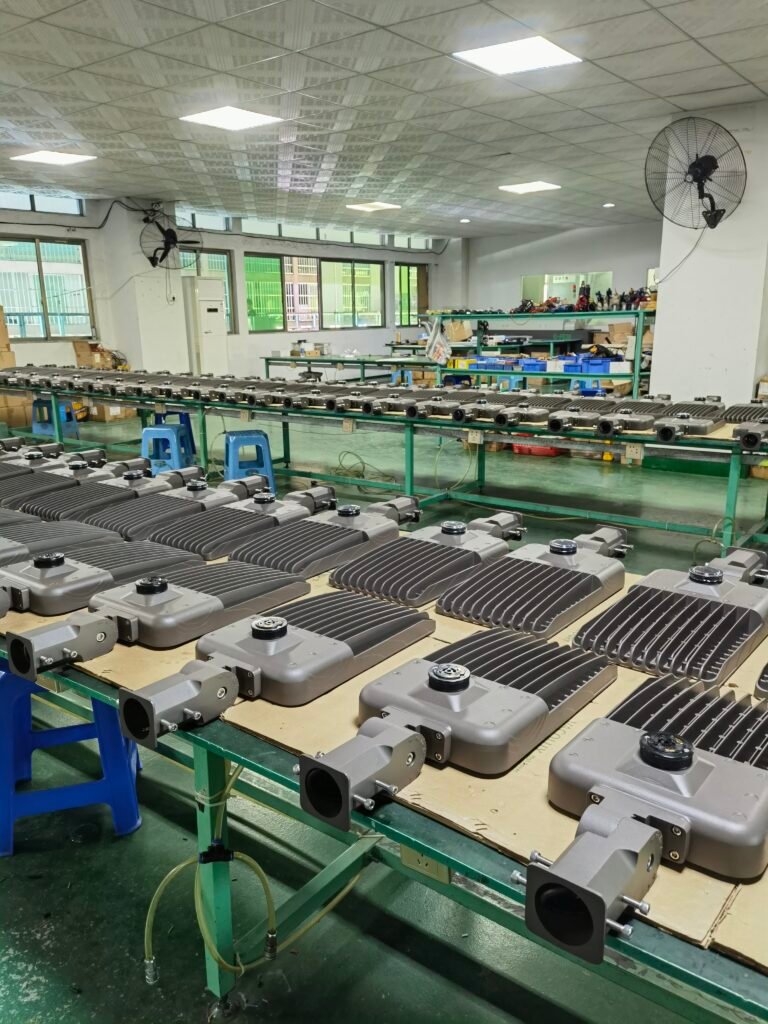
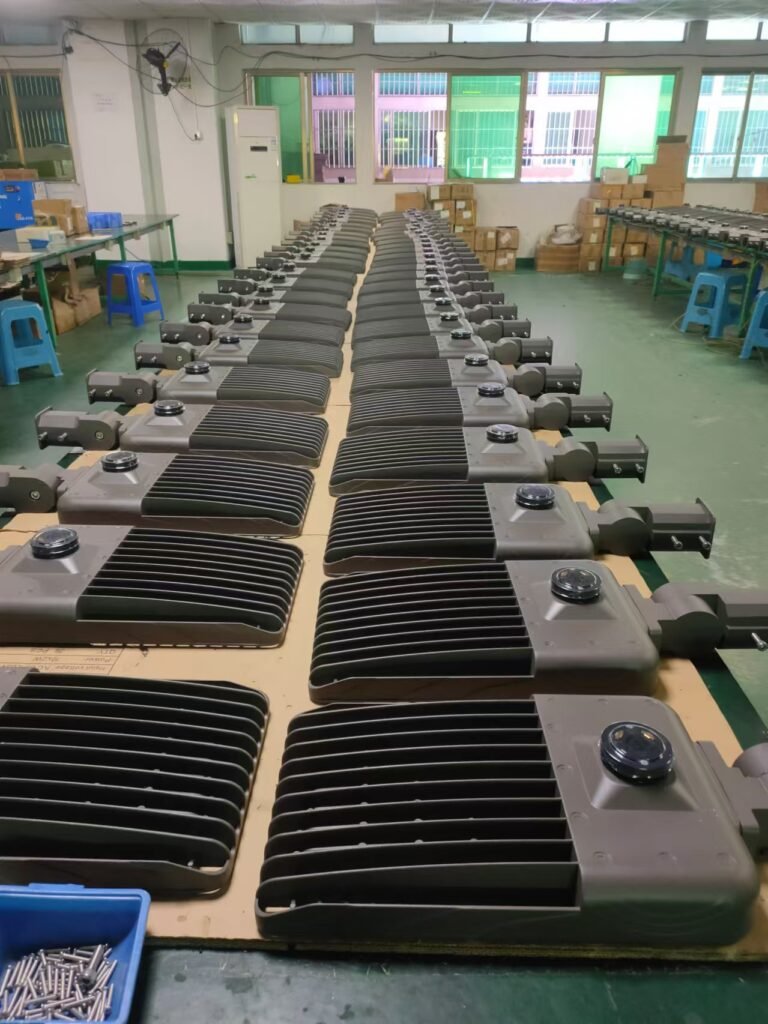
In May 2025, MVS Lighting supplied high-power LED floodlights for a large outdoor equestrian and sports venue. At the customer’s request, the project name, location, and identifying details remain confidential.
The project required reliable illumination across a large outdoor activity area, with particular attention to long-distance projection, beam control, outdoor durability, and stable operation.
Project Requirements
- Large outdoor equestrian and sports area
- Long-distance light projection
- High mounting positions
- Controlled beam distribution
- Reliable performance in outdoor conditions
- Reduced dark zones and wasted spill light
Lighting Solution
- Fixture type: Professional LED stadium floodlights
- Power: 【100W】
- Quantity: 【1100pcs】
- Beam angle: 【80*150°】
- Color temperature: 【4000k】
- Protection rating: 【IP65】
- Surge protection: 【10kV】
- Installation method: High-mast mounting
Why This Configuration Was Selected
Because the lighting points were positioned at relatively high mounting positions and needed to cover a large outdoor area, the project required high-output floodlights with controlled optical distributions.
The final fixture configuration was evaluated according to the projection distance, coverage area, mounting conditions, and required lighting performance. This project demonstrates why stadium floodlights should not be selected by wattage alone: beam angle, mounting height, pole position, and aiming direction all influence the final result.
Production and Quality Control
Before shipment, the floodlights underwent assembly inspection, electrical testing, aging tests, and final quality checks. The fixtures were then securely packed and delivered according to the project schedule.
To protect the customer’s commercial privacy, identifying information and detailed project documentation are not published. Relevant product specifications and project references may be provided to qualified buyers where permitted.
Final Selection Checklist
- Confirm the stadium type
- Define the required lighting level
- Check mounting height and pole positions
- Select the preliminary wattage range
- Match the beam angles
- Run a lighting simulation
- Confirm the final fixture specification
Get a Stadium Lighting Proposal
Send us your field dimensions, pole layout, mounting height, and target lux level. Our lighting team can prepare a fixture recommendation and lighting simulation for your stadium project.
Frequently Asked Questions
What wattage LED floodlights are used for stadiums? Stadium floodlights typically range from 300W for small training fields to 1000–1500W for large, high-mast professional stadiums.
How high should stadium floodlights be mounted? Mounting height typically ranges from 8–15m for training fields up to 30–60m for large broadcast-grade stadiums, depending on field size and pole position.
What beam angle is best for stadium lighting? Most large stadiums use a combination of narrow (10°–20°), medium (20°–40°), and wide (40°–60°) beam angles rather than a single distribution type.
How many floodlights does a stadium need? Fixture quantity depends on field size, target lux, fixture lumen output, and mounting height — a lighting simulation is required to confirm the final number.
Are 1000W LED floodlights suitable for stadiums? Yes, 1000W fixtures are commonly used for medium-to-large stadiums, typically paired with narrower beam angles for higher mounting heights.