
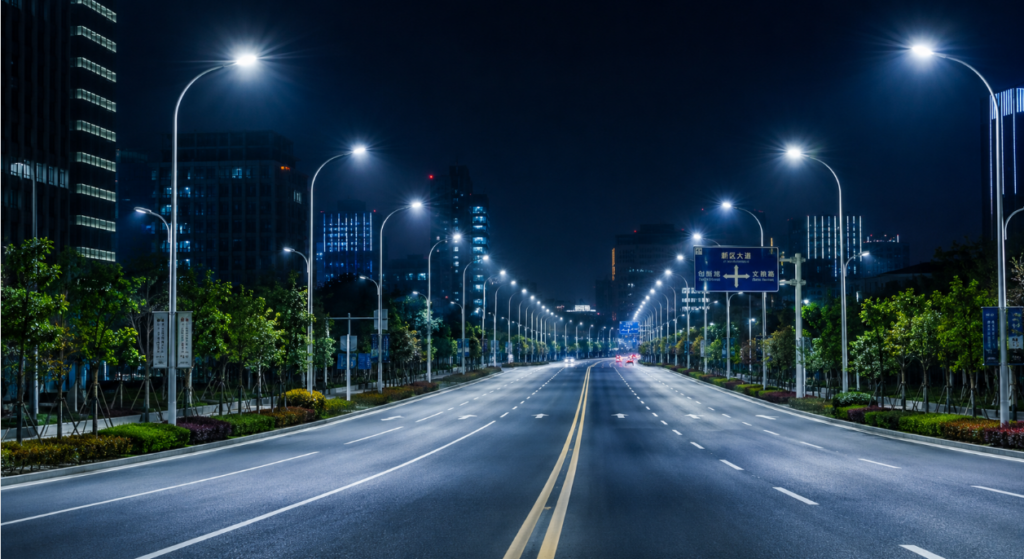
For municipal roads, industrial parks, commercial streets, and port projects, professional LED road lighting selection is not only about lamp wattage or initial price.
A reliable long-term road lighting project usually requires careful consideration of:
- Anti-glare performance
- IP protection rating
- Lumen maintenance
- Pole layout design
- Driver stability
- Smart lighting control systems
Many road lighting projects operate normally during the first few years after installation, but gradually begin to experience problems after 3–5 years, such as:
- Reduced road illumination
- Driver glare complaints
- Water ingress and corrosion
- Large-scale driver failures
- Increasing maintenance costs
In many cases, these problems are not caused by the LED chips themselves, but by improper product selection during the early planning stage and failure to consider the actual road environment and long-term operational requirements.
This guide explains how to choose LED road lighting solutions for different applications and how to reduce long-term maintenance and operational risks from a practical engineering perspective.
Why Many Road Lighting Projects Start Having Problems After 3–5 Years
Many projects appear to perform normally during the acceptance stage, but hidden problems gradually become visible after several years of operation.
Common reasons include:
- Focusing only on initial purchase price instead of long-term maintenance cost
- High initial efficacy but poor lumen maintenance
- Insufficient anti-glare design
- IP ratings that are not suitable for the actual environment
- Unstable driver performance
- Improper pole spacing calculations
For example, some industrial park projects choose lower-cost driver solutions to reduce initial procurement costs. Although the brightness level is acceptable at the beginning, continuous operation in high-temperature environments may cause rapid driver failure after several years, leading to significantly higher maintenance costs.
In port or coastal city projects, insufficient corrosion resistance and inadequate IP protection may result in moisture penetration, salt spray corrosion, and internal wiring oxidation.
For long-term road lighting projects, the initial purchase price is only part of the total cost. Maintenance, replacement, downtime, and labor expenses often become the major long-term operational burden.
How to Choose LED Road Lighting Solutions for Different Road Applications
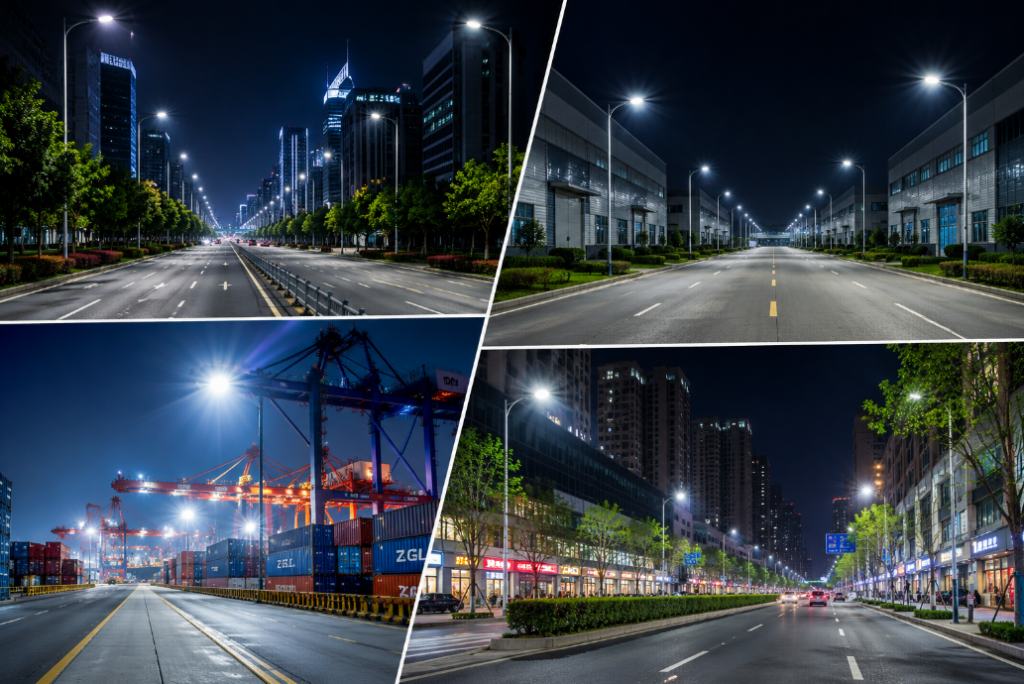
Different road environments require different color temperatures, IP ratings, efficacy levels, and control systems.
Below are some common selection recommendations:
| Application | Recommended CCT | Recommended IP | Suggested Efficacy | Recommended Control |
|---|---|---|---|---|
| Municipal Main Roads | 4000K | IP66 | ≥160lm/W | DALI Recommended |
| Port & Dock Roads | 4000K | IP67 | ≥150lm/W | Optional Smart Control |
| Industrial Parks | 5000K | IP65 | ≥155lm/W | Optional |
| Commercial Roads | 4000K | IP66 | ≥160lm/W | Recommended |
| Highway Service Roads | 4000K | IP66 | ≥165lm/W | Smart Dimming Recommended |
For example:
- Port projects focus more on anti-corrosion and moisture resistance
- Commercial roads focus more on visual comfort and uniformity
- Industrial parks focus more on high brightness and maintenance cost reduction
- Highway roads focus more on anti-glare performance and driving safety
There is no single road lighting solution suitable for all applications.
Different road environments also require different lighting standards.
For example:
- Highways require stronger anti-glare performance and better driving visibility
- Commercial roads focus more on comfort and uniformity
- Industrial parks focus more on high brightness and long-term maintenance
- Port roads focus more on corrosion and moisture resistance
Therefore, road lighting projects should be designed according to:
- Road classification
- Traffic flow
- Pedestrian density
- Installation environment
Why Anti-Glare Performance Affects Road Safety and Project Acceptance
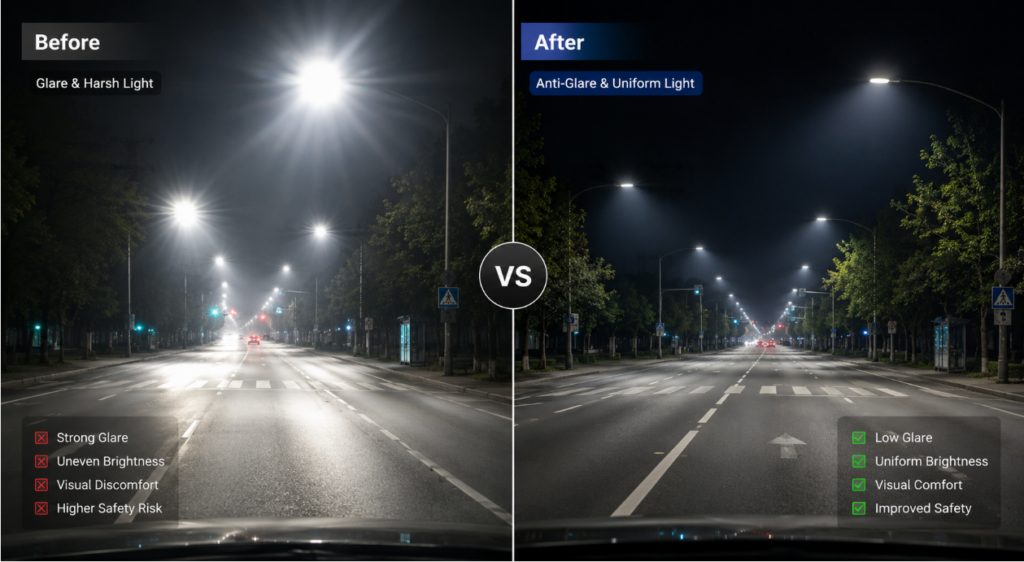
Many road lighting projects still cause visual discomfort even when brightness levels are sufficient.
Common reasons include:
- High-angle glare
- Improper light distribution
- Incorrect installation angles
- Overly concentrated lighting zones
Anti-glare performance is especially important for:
- Highways
- Urban expressways
- Port transportation roads
- Commercial main roads
Poor glare control may result in:
- Visual fatigue
- Temporary blind spots
- Night driving discomfort
Professional roadway lighting projects often follow
roadway lighting standards
to evaluate glare control, roadway safety, and lighting uniformity.
Professional road lighting projects usually evaluate:
- TI (Threshold Increment)
- GR (Glare Rating)
- Light distribution curves
- Pole height and installation angle
Professional road lighting design is not only about increasing brightness, but also improving driving comfort and roadway safety.
The real goal of professional road lighting is not simply higher brightness, but better nighttime visibility and road uniformity.
Even when overall brightness levels are sufficient, strong brightness contrast and uneven lighting distribution may still create visual fatigue and delayed driver reaction.
Compared with simply increasing wattage, professional road lighting focuses more on:
- Uniformity
- Optical distribution
- Pole spacing
- Anti-glare design
What IP Protection Rating Should Be Used for Port, Municipal, and Industrial Roads
Many buyers directly request:
“We need IP66.”
However, different road environments require different protection standards.
Below are some common recommendations:
| Environment | Recommended IP Rating | Main Reason |
|---|---|---|
| Ports & Docks | IP67 | Salt spray and high humidity |
| Industrial Parks | IP65 | Dust environment |
| Rainy Urban Roads | IP66 | Long-term outdoor waterproofing |
| High-Temperature Areas | IP66 | Stable long-term operation |
For example:
Port projects require not only waterproofing, but also consideration of:
- Salt spray corrosion
- Metal oxidation
- Long-term humidity exposure
Industrial parks usually contain more dust, requiring better:
- Sealing performance
- Thermal management
- Long-term stability
A proper IP selection should always consider:
- Project environment
- Climate conditions
- Installation location
- Maintenance frequency
How Efficacy and Lumen Maintenance Affect 10-Year Project Cost
Many buyers only focus on:
“How many lm/W?”
However, for long-term road lighting projects, more important factors include:
- Lumen maintenance
- Driver lifespan
- Long-term lighting stability
Some high-efficacy products may provide strong initial brightness but experience rapid lumen depreciation after several years, leading to:
- Reduced road illumination
- Failure to meet project standards
- Premature replacement costs
For road lighting projects, electricity cost is only part of the total expense.
Long-term costs also include:
- High-altitude maintenance
- Labor replacement costs
- Downtime losses
- Operational pressure
Therefore, professional projects usually focus on:
- L70 performance
- Lumen maintenance
- Driver quality
- Thermal design
from a Total Cost of Ownership (TCO) perspective.
For long-term road lighting projects, the lowest purchase price does not always represent the lowest long-term cost.
Many real project expenses come from:
- Lumen depreciation
- Driver replacement
- Maintenance labor
- Downtime repair
- Insufficient product lifespan
As a result, more projects are shifting from:
“Initial purchase cost”
to:
“Total Cost of Ownership (TCO).”
Professional buyers also pay closer attention to
LED roadway lighting efficiency
when evaluating long-term lighting performance and maintenance costs.
In addition, lm/W alone does not fully represent real project performance.
Actual road lighting efficiency also depends on:
- Optical efficiency
- Light utilization
- Optical losses
- Lens and optical design
- Road lighting uniformity
Higher efficacy does not always guarantee better road lighting performance.
The real advantage of LED road lighting is not only higher efficacy, but also better optical control capability.
Compared with traditional HPS lighting, LED systems can:
- Reduce hot spots
- Improve road uniformity
- Reduce wasted light
- Lower high-angle glare
Why Professional Pole Layout Calculation Is Important
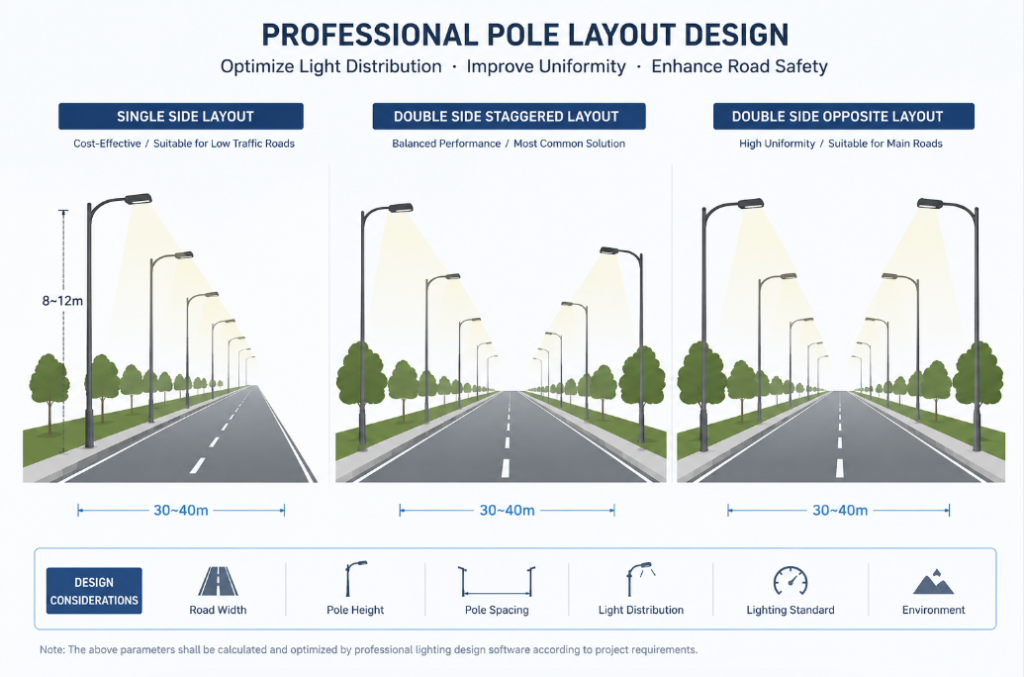
Many projects simply estimate lighting layouts based on wattage.
However, road width, pole height, optics, and pole spacing all directly affect final lighting performance.
Below are some common reference values:
| Road Width | Recommended Pole Height | Suggested Pole Spacing |
|---|---|---|
| 6–8m | 6–8m | 20–25m |
| 10–12m | 8–10m | 25–30m |
| 14m+ | 10–12m | 30–40m |
Professional projects also need to consider:
- Single-side layout
- Double-side layout
- Staggered layout
- Center-pole layout
Improper layouts may cause:
- Dark zones
- Poor uniformity
- Increased glare
Large roadway lighting projects usually rely on
Dialux lighting simulation
for professional pole spacing calculations and photometric analysis.
Therefore, professional projects often require Dialux simulation and photometric calculations.
Is Smart Road Lighting Control Worth the Investment
Not every project requires smart lighting systems.
The key question is whether smart control can reduce long-term operational costs.
Smart control systems are more suitable for:
- Municipal roads
- Port roads
- Large industrial parks
- Highway projects
Smart systems can provide:
- Scheduled dimming
- Individual lamp control
- Fault monitoring
- Remote management
- Energy-saving management
For large-scale projects with many luminaires, long-term maintenance efficiency and energy savings can become significant.
Common smart control systems include:
- LoRa
- DALI
- Zigbee
- NB-IoT
- Single lamp controllers
However, small projects may not always achieve strong ROI from complex smart systems.
Therefore, smart lighting solutions should be evaluated according to project scale and operational requirements.
Example Project 1: Smart Lighting System for a Large Coastal Port
A large coastal port project adopted a Zigbee-based smart lighting control system for roadway and operational area lighting management.
The project deployed more than 1,800 lighting nodes and supported functions such as:
- Remote individual lamp control
- Lighting status monitoring
- Fault alarm notifications
- Scheduled dimming strategies
- Energy-saving management
Because port projects usually involve:
- Large operating areas
- Complex maintenance environments
- Frequent nighttime operations
- High manual inspection costs
the smart lighting system helped improve maintenance efficiency and reduce repetitive inspection work.
For large port roads, industrial parks, and logistics transportation areas, smart roadway lighting systems can provide better operational visibility and long-term management efficiency.
Example Project 2: LoRa Smart Lighting System for a Large International Airport
A large international airport project adopted a LoRa-based smart lighting control system for apron lighting, high mast lighting, and related roadway areas.
The project deployed more than 3,000 lighting nodes and supported:
- Remote individual lamp control
- Lighting data collection
- Fault alarm notifications
- Offline dimming schedules
- Custom energy-saving strategies
Airport projects usually require:
- Centralized lighting management across large areas
- Multi-gateway synchronized control
- Long-term stable operation
- Flight-related lighting strategies
As a result, the smart lighting system improved operational efficiency and reduced maintenance pressure and manual inspection work.
For airports, high mast lighting zones, transportation hubs, and municipal roadway projects, LoRa smart lighting systems can help improve management efficiency and long-term operational stability.
Road Lighting Procurement Checklist
Before purchasing road lighting products, it is recommended to confirm:
- Lighting efficacy
- Lumen maintenance
- Driver brand
- SPD surge protection
- IK impact rating
- IP protection rating
- Optical distribution
- Smart control protocol
- CE/CB certifications
- Corrosion resistance
- Warranty period
Many long-term project problems are already created during the procurement stage.
Professional product selection can significantly reduce maintenance risk.
How MVS Supports Municipal and Commercial Road Lighting Projects
MVS can provide:
- LED road lighting selection support
- Dialux simulation
- Pole layout recommendations
- LoRa smart control solutions
- Different optical distribution options
- Coastal and high-humidity solutions
- OEM project support
- CE/CB certification support
MVS road lighting solutions are suitable for:
- Municipal roads
- Industrial parks
- Commercial roads
- Port areas
- Highway service roads
With proper product configuration and engineering support, MVS helps reduce long-term maintenance and operational costs.
FAQ
How many lux are required for road lighting?
Different road classifications require different illumination standards. Municipal roads, highways, and commercial roads usually follow different lighting requirements.
Is there a big difference between IP65 and IP66?
IP66 provides stronger waterproof capability and is more suitable for long-term outdoor and rainy environments.
What HPS wattage can a 150W LED street light replace?
In many cases, a 150W LED street light can replace a 250W–400W HPS fixture, depending on road width and installation height.
How can glare in road lighting be reduced?
Glare can be reduced through better optical distribution, proper installation angle, suitable pole height, and professional anti-glare design.
What corrosion protection is recommended for port road projects?
Port environments usually require stronger anti-corrosion treatment combined with higher IP protection levels such as IP67.
How many street lights are suitable for LoRa smart control systems?
Generally, the larger the lighting project, the more obvious the long-term ROI of smart control systems becomes.