
Written by Chris Choi, Technical Sales Manager at MVS Lighting, with practical experience supporting overseas buyers on LED street lighting projects.
Glare complaints about LED street lights almost never come down to a single cause. In most real projects, it’s a combination of unshielded optics, poor mounting angle, undersized pole height, tight pole spacing, and — in cases near residential areas — light spilling directly into windows. Understanding how these factors interact, and how the industry measures them through the BUG rating system, is the difference between a design that passes acceptance inspection and one that gets sent back for rework.
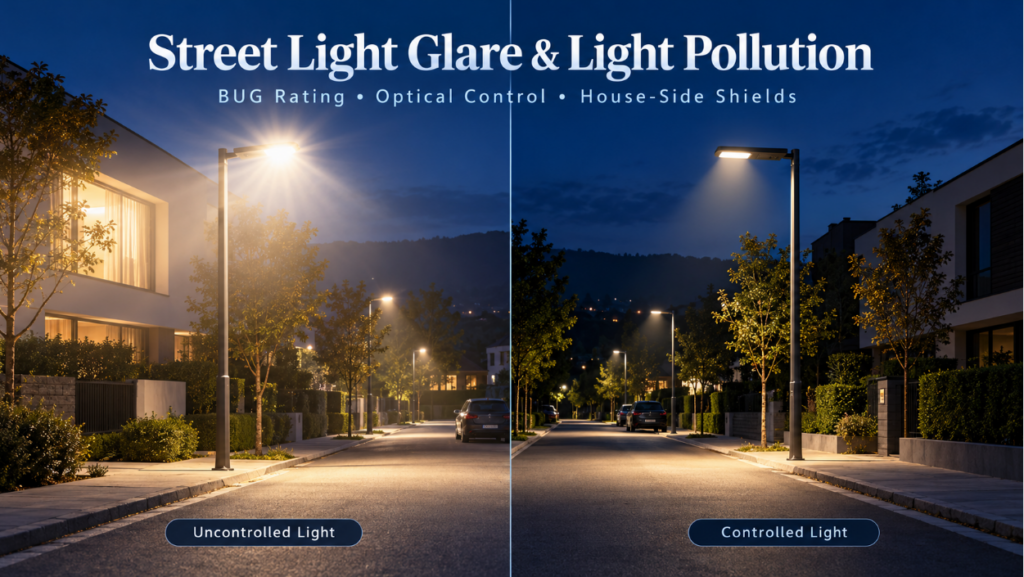
What Causes Glare in LED Street Lights
Glare in road lighting generally comes from three overlapping sources:
Unshielded or poorly optimized optics. Fixtures without proper shielding allow light to travel directly into the driver’s or resident’s line of sight instead of being directed down onto the road surface. This is the most common root cause on lower-cost fixtures where the lens or reflector hasn’t been engineered for cutoff control.
Incorrect mounting angle. Even a well-designed fixture can create glare if it’s tilted rather than mounted level. A few degrees of upward tilt is often enough to push light past the intended distribution pattern and into oncoming traffic or nearby buildings.
Pole height and spacing that don’t match the road. This is a factor project teams frequently underestimate. When poles are too short, the light source sits closer to eye level for both drivers and pedestrians, which increases perceived brightness and discomfort. Combine that with spacing that’s too tight — often the result of trying to cut down the number of poles on a project — and drivers encounter multiple close-range light sources in quick succession, which compounds the glare rather than distributing it evenly. Getting pole height and spacing right at the design stage does more to control glare than any fixture spec sheet. For the recommended ranges by road type, see our pole height guide and pole spacing calculation guide.
Color temperature also plays a role in how glare is perceived — higher CCT light tends to feel harsher even at the same lux level — but that’s a large enough topic on its own that we cover it separately in our color temperature guide.
Understanding the BUG Rating System (Backlight – Uplight – Glare)
The BUG rating system gives project teams a way to quantify glare-related performance instead of relying on subjective descriptions like “too bright” or “spills too much.” Each fixture is rated on three dimensions, typically scored 0–5:
Backlight (B) measures how much light is directed behind the fixture, away from the road it’s meant to illuminate. This is the number that matters most when a pole sits close to a property line. A high B rating is often exactly what causes the complaint every project team dreads: a resident reporting that light is shining directly into their bedroom window at night. Low B ratings mean the fixture keeps its output concentrated on the roadway rather than spilling onto adjacent land.
Uplight (U) measures light that escapes upward instead of being directed down onto the road surface. Uplight doesn’t help drivers or pedestrians see better — it only contributes to sky glow, the diffuse glow visible over developed areas at night. A U rating of 0 means the fixture emits no light above the horizontal plane at all.
Glare (G) measures the direct visual discomfort caused by looking toward the fixture, which is related to but distinct from the Threshold Increment (TI) and Glare Rating (GR) metrics used in some regional standards.
For project specifications, writing a target BUG rating — for example, B1-U0-G2 — into the tender documents gives manufacturers and installers a concrete, verifiable target instead of a vague brightness requirement.
Uplight, Backlight & Light Trespass in the Real World
The gap between a spec sheet and a completed installation shows up clearest in projects near housing. It’s a pattern that repeats across many municipal and residential-adjacent projects: a road or area is lit with fixtures chosen mainly for lumen output and energy efficiency, the lights go up, and within weeks residents are reporting that their bedrooms feel like they’re lit up all night — some describe the effect as closer to an interrogation light than a street light. The lighting is functionally correct for the road, but nobody accounted for backlight and uplight control, and the project ends up back on the punch list for rework.
This is the exact failure mode the BUG rating exists to prevent. A fixture with a poor B rating can meet every lux-level requirement for the road and still fail acceptance the moment it’s installed near a residential boundary — because the acceptance criteria in practice usually includes a simple rule: light must not shine directly into people’s homes. Once that happens, projects typically go back for shielding retrofits or full fixture replacement, both of which cost significantly more than specifying the right BUG rating up front.
Full Cutoff vs Semi-Cutoff Fixture Design
The practical fix for most backlight and uplight problems is choosing the right optical design category before installation, not after a complaint.
Full cutoff fixtures direct essentially all light downward, with zero light emitted above the horizontal plane. This is the standard choice for any road segment near housing, and it’s the fastest way to bring the U value in a BUG rating down to zero.
Semi-cutoff fixtures allow a controlled amount of light above the horizontal, which is sometimes used for decorative or heritage-style lighting where some upward glow is part of the intended aesthetic. These are a poor fit for roads adjacent to residential property.
House-side shields are a targeted add-on rather than a full fixture category — a physical shield fitted to the side of the fixture facing the property line, used specifically to cut backlight on poles positioned close to homes. This is often the most cost-effective fix when a project is already underway and a specific stretch of road is generating complaints.
Practical Checklist: Specifying Glare Control in Street Light Tenders
- Require a documented BUG rating (e.g., B1-U0-G2) for every fixture in the bid, not just lumen output and wattage
- Ask for IES TM-15 photometric reports to verify the manufacturer’s BUG rating claims
- Specify full cutoff fixtures with house-side shields for any pole within a set distance of residential property lines
- Cross-check proposed pole height and spacing against the road classification — don’t let cost-cutting on pole count compromise glare performance
- For residential streets specifically, keep color temperature at or below 3000K where local requirements allow (see our color temperature guide and residential street lighting guide)
FAQ
What is a good BUG rating for residential streets? For roads directly adjacent to housing, aim for a low B rating (B0–B1) and a U rating of 0. G rating targets vary more by road type and traffic speed, but a lower number always means less visual discomfort for drivers.
Does full cutoff reduce road visibility? No — full cutoff controls where light goes, not how much light reaches the road. A well-designed full cutoff fixture delivers the same lux levels on the road surface as an unshielded fixture of comparable output, without the wasted spill light.
Can existing poles be retrofitted with full cutoff LED heads? In most cases, yes. Pole height and spacing were usually set for the original fixture type, so a retrofit project should recheck both against the new fixture’s distribution pattern rather than assuming the existing layout is still correct.