
A note before you read further: tunnel lighting is not part of our standard product catalog. The fixtures described in this article were custom-engineered for two specific client projects — not a product line we manufacture for general sale. We’re publishing this case study because the engineering problems involved are a good showcase of our custom development capability, not as an invitation to order “tunnel lights” from our flood light catalog.
Most of our work is outdoor area lighting — parking lots, sports fields, industrial yards, ports. Tunnels are a completely different lighting problem. When a long-term client asked us to solve two tunnel lighting projects, we took it on as a custom engineering job. Here’s what we learned, and what we built.
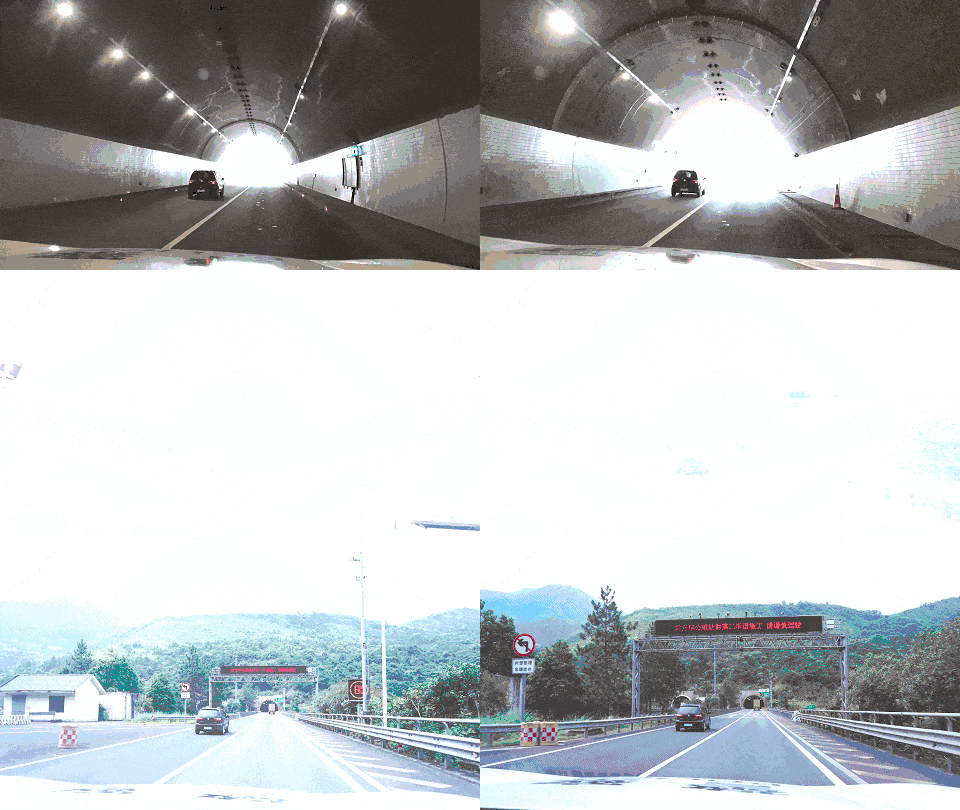
(Our zoned lighting solution helps prevent excessive glare and temporary loss of visibility when drivers exit the tunnel into bright daylight.)
The Engineering Challenge of Tunnel Lighting
Open-area flood lighting and tunnel lighting solve different problems. A parking lot or a sports field is lit against a stable, roughly uniform background — the challenge is coverage, uniformity, and glare control at a fixed brightness level. A tunnel is lit against a constantly changing background: the driver’s eyes are adapting to brightness the whole time they’re inside it. That difference drives almost every design decision.
Four visual phenomena are specific to tunnels and don’t come up in open-area lighting design at all:
- Black-hole and white-hole effect. In daytime, a driver approaching a tunnel entrance sees a dark opening against a bright sky — the “black hole.” Near the exit, the opposite happens: a bright opening against the dark interior — the “white hole.” Both create a moment where the driver’s eyes haven’t adapted yet and visibility drops sharply.
- Adaptation lag. The human eye takes a measurable amount of time to adjust from bright outdoor light to a darker interior (and back again on the way out). If the lighting design doesn’t account for this lag, drivers spend several seconds effectively driving half-blind.
- Flicker effect. Tunnel fixtures are spaced at intervals, not run continuously, so a moving vehicle passes through repeating cycles of light and shadow. This flicker is most disruptive to the human eye around a frequency of roughly 10Hz — a data point that directly informs fixture spacing and vehicle speed assumptions during design.
- Zebra effect. Poor longitudinal uniformity shows up on the road surface as alternating bright and dark bands — visually similar to the flicker effect but caused by lighting layout rather than by vehicle speed.
None of these problems exist in a parking lot or on a football field, which is exactly why tunnel lighting needs its own design approach rather than a repurposed flood light layout.
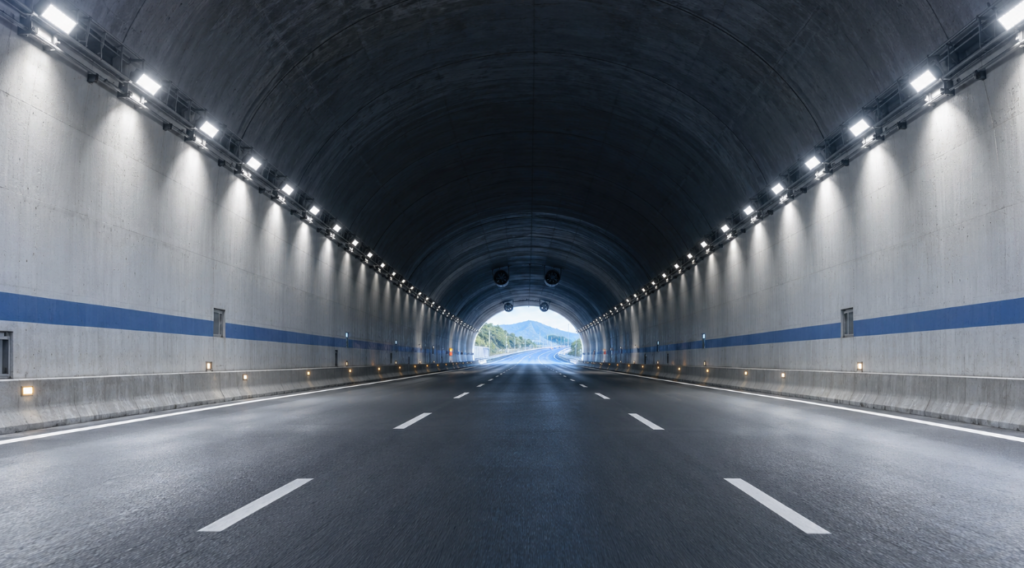
Zoned Lighting Design: Entrance, Transition, Interior, Exit
The standard response to the black-hole/white-hole problem is to split the tunnel into lighting zones, each with its own luminance target, rather than lighting the whole tunnel to one flat brightness level.
- Approach zone — the open road just before the tunnel. Not lit by the tunnel system itself, but its brightness (largely daylight-driven) sets the baseline the entrance zone has to bridge down from.
- Entrance (threshold) zone — the highest-output zone in the tunnel. Its job is to absorb the brightness drop from daylight before the driver’s eyes have had time to adapt, so it needs enough luminance to keep the “black hole” from becoming a real visibility gap.
- Transition zone — a stepped-down zone between the entrance and the interior. Luminance decreases progressively through this zone, following the pace of natural eye adaptation rather than dropping all at once.
- Interior zone — the long middle section of the tunnel. Luminance here is lowest and, importantly, needs to stay flat and uniform along the driving line — this is where zebra effect and flicker are most noticeable if the design is off.
- Exit zone — mirrors the entrance zone in reverse: luminance steps back up as the driver approaches the opening, managing the “white hole” effect on the way out.
There’s also an external zone extending roughly twice the stopping sight distance beyond each portal, which factors into how the approach and exit luminance targets are set — we won’t go deep into the calculation here, but it’s part of why entrance and exit zone design can’t be treated as a simple on/off transition.
Custom Fixture Specification
For both projects, we moved away from standard point-source LED modules and developed a surface-source lighting solution instead. The key specification points:
- Surface-source (panel-type) LED module paired with Inventronics drivers, delivering a system efficacy above 130 lm/W.
- Solid aluminum heat sink for thermal management, combined with a breather valve so the fixture housing stays dry and fog-free rather than trapping condensation — a real problem in the humid, temperature-swinging environment inside a tunnel.
- Powder-coated housing for corrosion resistance, since tunnels see constant vehicle exhaust exposure and, in many regions, de-icing salt residue.
- Fixtures configured separately for entrance, transition, interior, and exit zones, plus a basic/emergency lighting mode — matching the zoned design principle above rather than using one fixture spec throughout.
Project Results
Project 1: Yunwu Expressway — Chalin Ding Tunnel (New Installation)
This was a new-build tunnel lighting system on the Yunwu Expressway. We applied the zoned design directly:
- Entrance zone: 240W surface-source tunnel fixtures — the highest-output zone, sized to bridge the daylight-to-interior brightness gap
- Transition zone: 80W surface-source fixtures — stepped down as the driver’s eyes adapt
- Interior (basic) zone: 40W fixtures — steady, low-glare illumination through the long middle section
The installation achieved strong uniformity along the driving line with no visible glare and consistently high brightness across all zones — directly addressing the zebra-effect and flicker risks that come from poorly zoned tunnel lighting. The system also runs on a smart control platform with individual-fixture (single-lamp) control, so brightness can be tuned per zone or per fixture rather than switched as one fixed circuit — the same control philosophy behind the smart, app-controllable flood light systems we build for our standard product line.
Project 2: Yunyao Tunnel Retrofit — Guangxi (Liuzhou–Nanning Expressway)
This second project was a retrofit and head-to-head comparison, not a new build. The site — the Yunyao Tunnel on the Liuzhou–Hepu-to-Nanning expressway corridor — gave us a rare chance to benchmark our surface-source tunnel fixtures directly against a well-known domestic LED tunnel light brand under real operating conditions, in the same tunnel:
- Right bore (452m): kept the original 618 traditional LED fixtures as the control group
- Left bore (495m): retrofitted with 599 of our surface-source fixtures
- Benchmarked head-to-head on energy efficiency, illuminance, color rendering, and glare index
Results: the surface-source solution delivered 17% better energy efficiency than the comparison LED product, along with lower power draw, a longer expected service life, and lower long-term operating cost — data that directly supported the project’s carbon-neutrality goals.
Why This Matters for Our Flood Light Customers
Neither of these projects is something you can order off our shelf — they were engineered from the ground up for the specific conditions of each tunnel. But the same two capabilities are exactly what stand behind our standard flood light line: custom OEM/ODM mold and structural development when a project needs something non-standard, and the same head-to-head, real-numbers testing discipline you’ll see in our led floodlight series.
If your project has requirements our standard flood light catalog doesn’t cover, talk to us — this is the kind of engineering problem we’re set up to take on.