
Written by Chris Choi, Technical Sales Manager at MVS Lighting, working with outdoor lighting projects since 2020. MVS is a TUV/CE/CB certified manufacturer offering 5-year warranty support.
Standard-catalog floodlights work for most projects. But some buyers need something a standard SKU can’t deliver — a specific housing shape, a structure built around unusual mounting constraints, or a product carrying their own brand from the ground up. This guide covers what OEM/ODM customization for LED floodlights actually involves, and where mold development fits into that.
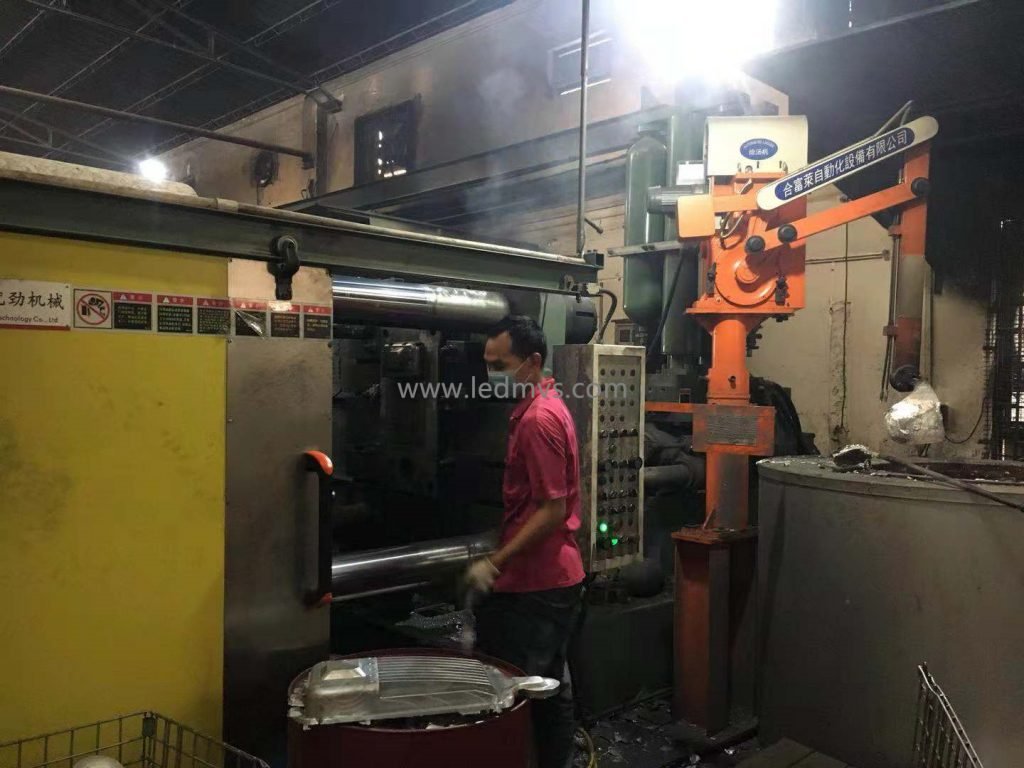
🖼️ LED floodlight mold and die-cast housing structure on the production floor
For the full floodlight selection framework, see our Complete LED Flood Light Guide. This is one step in the broader purchasing journey — see our Buyer’s Guide for the full picture.
OEM vs. ODM: What’s the Difference?
OEM (Original Equipment Manufacturer) means the product structure stays as-is, but it ships under your brand — your logo, your packaging, your labeling. The underlying housing and mold are unchanged.
ODM (Original Design Manufacturer) goes further — the product itself is designed or modified to your specification, starting from the mold and structure, not just the branding on top.
Most custom floodlight projects fall somewhere between the two: some combination of a modified structure and full private-label branding.
What We Can Customize
- Housing and mold structure — from modifying an existing mold’s mounting points or vents, to developing an entirely new housing shape
- Optical configuration — beam angle, lens type, and light distribution pattern matched to your project
- Driver selection — brand and specification matched to your target market’s certification and reliability requirements
- Branding and packaging — logo, labeling, and packaging design under your company name
New Mold Development vs. Modifying an Existing Mold
This is the decision point that shapes cost, timeline, and flexibility more than any other choice in a custom project.
Modifying an existing mold — adjusting mounting brackets, vents, or minor structural features on a housing we already produce — is faster and less expensive, and is the right fit for most OEM projects and mid-volume ODM orders. Lead time and tooling cost are a fraction of a new mold.
Developing a new mold from scratch gives you a fully custom structure with no inherited constraints, but it’s a bigger commitment. In our experience, a new mold typically takes 2–3 months from confirmed design to first production units; even on a compressed schedule, 1–2 months is usually the realistic minimum — this isn’t a step that can be rushed without risking tooling quality. This makes new-mold development the right call at higher order volumes, where the tooling cost amortizes across enough units to be worthwhile, or where an existing structure genuinely can’t meet the project’s mechanical or optical requirements. It’s also, in practice, a request we see far less often than mold modification — most projects don’t actually need it, even when a fully custom look is the initial ask.
A real example: Our stackable “D series” (MVS-FL030D through FL300D) exists because of exactly this kind of project. A domestic customer with a large order volume came to us specifically because of our product quality, but needed something our standard catalog didn’t offer — modular units that could be physically stacked together to scale wattage on demand. We developed the mold around that requirement, which is why the series starts at 30W and 80W as base units, with 150W, 200W, and 300W configurations built by stacking two, three, or four modules together. The driving use case was mountainous tunnel lighting in China, where standard single-unit fixtures weren’t flexible enough to solve inconsistent brightness along a tunnel run — stacking let the same base module scale to whatever output a given section needed. The wattage tiers and physical form of that entire series trace back to one customer’s real installation problem, not a catalog decision made in advance.
Before committing to a new mold, it’s worth confirming with your supplier whether a modified existing structure could meet 80% of the requirement at a fraction of the cost and lead time — a new mold is the right call for some projects, and an unnecessary expense for others.
High-Power Mold Structure Considerations
Mold and structural requirements aren’t the same across the wattage range. As output climbs — broadly, into the 300W+ range — housing design has to work harder:
- Heat dissipation surface area becomes a structural design problem, not just a material choice — fin geometry and internal cavity design directly affect how well the housing sheds heat at higher power density
- Wall thickness and internal cavity structure need to support both thermal performance and the physical weight of larger driver and LED array components
- Mounting bracket strength has to account for the larger physical size and weight of high-power housings, particularly for pole or high-mast installations
A mold structure that works well for a 100W fixture doesn’t necessarily scale cleanly to 400W or 750W — this is a structural engineering question specific to the wattage class, not just a resized version of the same design.
What We Need From You to Start a Custom Project
- Reference images, sketches, or existing product samples showing the target structure or design direction
- Target specification (wattage, optics, IP/surge rating, certifications required)
- Estimated order volume — this shapes whether mold modification or new development makes sense
- Timeline requirements
- Branding assets, if OEM/private-label packaging is part of the scope
Where This Fits in Your Buying Process
This guide covers customization capability specifically — a few adjacent questions are covered elsewhere:
- Evaluating us (or any supplier) as a manufacturer? See our Manufacturer Checklist
- Importing into your specific market? See our Buying LED Flood Lights from China guide
- Ready to place an order? See our How to Order Guide
Custom Mold Spec Mistakes We See in Real RFQs
- Requesting a fully custom exterior on a budget that only supports mold modification. A genuinely new housing shape needs new-mold tooling cost and lead time — if the budget or timeline only supports a modification, it’s worth adjusting the design ambition rather than the cost expectation.
- Committing to a new mold before order volume is confirmed. New tooling cost only makes sense once it’s amortized across enough units — deciding to develop a new mold before quantity is settled risks a per-unit cost that doesn’t work once the real numbers come in.
- Private-label certification requested without confirming whose name goes on it. Certification documentation needs to be issued under a specific company name — confirm this upfront, not after testing is already underway.
- High-power customization treated the same as low-power. As covered above, mold structure for 300W+ fixtures involves real thermal and mechanical engineering differences — a design that works at 100W doesn’t automatically scale to a high-power version.
Frequently Asked Questions
What’s the difference between OEM and ODM for LED floodlights? OEM means the existing product ships under your brand with no structural change. ODM means the product structure itself is customized or newly developed, beyond just branding.
Do I need a new mold, or can an existing one be modified? It depends on how different your target structure is from what already exists, and your order volume. Modifying an existing mold is faster and cheaper and covers most OEM and mid-volume ODM projects; a new mold makes sense for a fully custom structure at higher volumes.
How does order volume affect the mold development decision? New mold tooling is a fixed cost that needs to be spread across enough units to make sense per-piece — at lower volumes, that fixed cost can outweigh the benefit of a fully custom structure.
Is customization different for high-power floodlights? Yes — housings for 300W and above need real structural engineering around heat dissipation, wall thickness, and mounting strength, not just a scaled-up version of a lower-power design.
Can you handle private-label certification for our brand? Yes — this is covered under our supplier relationship generally; see our Manufacturer Checklist for how certification and documentation support works.
Conclusion
Custom LED floodlight development ranges from a simple branding change on an existing product to a fully new mold built around your exact requirements — and the right level of customization depends on your structural needs, order volume, and timeline, not just what’s technically possible. Confirming whether your project genuinely needs a new mold, or whether an existing structure can be adapted, is usually the first real decision to make.
Have a custom project in mind? [Send us your reference images and target specification →] for a feasibility and cost discussion.
Browse our LED Floodlight Series.