
By Lighting Engineering Team, MVS Lighting — outdoor lighting manufacturer with 5 production lines and 15+ years experience
There is no fixed number of floodlights for every project. The correct quantity depends on the area size, target lux, mounting height, beam angle, and how strict the uniformity requirement is. That said, most commercial projects can get a reasonable starting estimate from a simple lumen calculation, before a detailed DIALux simulation confirms the final layout.
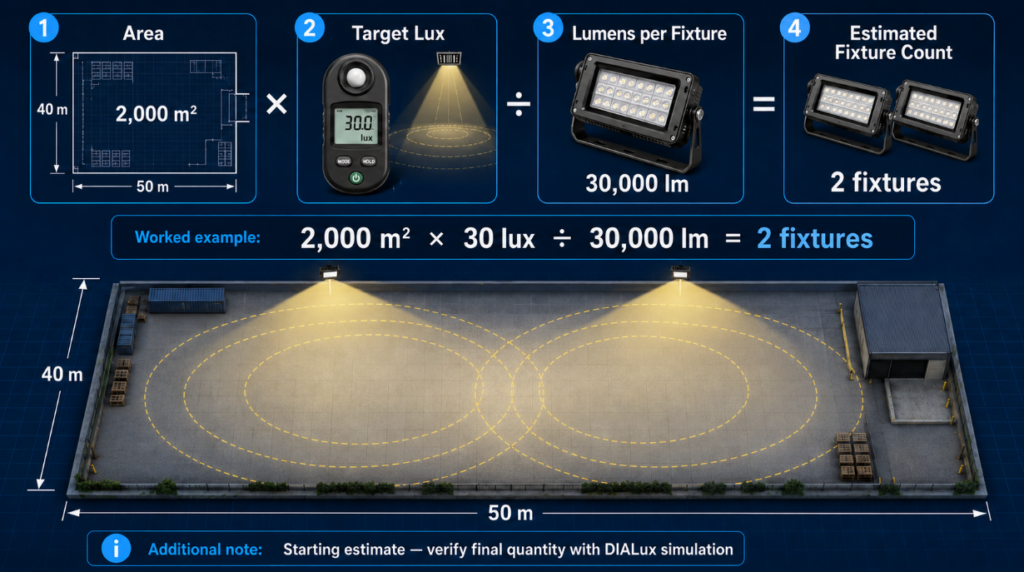
🖼️ worked example diagram — area × lux ÷ fixture lumens = fixture count
For the full floodlight selection framework, see our Complete LED Flood Light Guide.
Quick Reference Table for Common Projects
If you need a fast estimate, this table gives a reasonable starting point:
| Application | Area | Typical Quantity | Recommended Power |
|---|---|---|---|
| Small parking lot | 500 m² | 2–4 pcs | 100W–150W |
| Medium parking lot | 1,000 m² | 4–8 pcs | 150W–200W |
| Warehouse yard | 2,000 m² | 6–12 pcs | 200W–300W |
| Basketball court | 420 m² | 4–8 pcs | 200W–300W |
| Tennis court | 670 m² | 6–12 pcs | 150W–200W |
| Commercial plaza | 1,000–2,000 m² | 6–14 pcs | 200W–300W |
Important: these figures are for preliminary planning only. Actual requirements depend on target lux, mounting height, and beam angle — see the calculation below for a project-specific estimate.
The Formula: Total Lumens = Area × Lux
Before you can size the fixture count, you need to know how many total lumens the site requires. The formula is straightforward:
Total Lumens Required = Area × Target Lux
This is a more reliable starting point than guessing by wattage, because different LED floodlights have different efficacy (lm/W) — two fixtures with the same wattage can output very different lumens.
Step 1 — Calculate the Area
Area = Length × Width
| Area Type | Length | Width | Total Area |
|---|---|---|---|
| Small parking lot | 20m | 30m | 600 m² |
| Warehouse yard | 40m | 50m | 2,000 m² |
| Basketball court | 28m | 15m | 420 m² |
The larger the area, the more total lumens the project will need.
Step 2 — Determine Your Target Lux
Target lux depends entirely on the application — a parking lot and a sports court of the same size can require several times more light for the sports court. This guide doesn’t repeat those application-specific figures here; see our [Lux Levels Guide] for target lux by application, then bring that number back to this calculation.
Step 3 — Calculate Total Lumens Required
Example — Parking Lot
- Area: 1,000 m²
- Target lux: 50 lux
- Calculation: 1,000 × 50 = 50,000 lumens
This project requires approximately 50,000 lumens of usable light on the ground.
Step 4 — Convert Lumens into Fixture Quantity
Once you know the total lumen requirement, divide it by the lumen output of the fixture you’re considering.
| Power | Typical Lumens |
|---|---|
| 100W | 13,000–15,000 lm |
| 150W | 20,000–22,500 lm |
| 200W | 26,000–30,000 lm |
| 300W | 39,000–45,000 lm |
| 500W | 65,000–75,000 lm |
Formula:
Number of Floodlights = Total Lumens ÷ Lumens per Fixture
Example:
- Required: 50,000 lumens
- Selected fixture: 150W LED floodlight (≈21,000 lumens)
- Calculation: 50,000 ÷ 21,000 ≈ 2.4
- Recommended quantity: 3 floodlights
In most projects, round up rather than down — this helps maintain uniformity rather than leaving the site right at the edge of the calculated minimum.
Other Inputs That Affect the Final Number
Two other variables shift the result beyond the basic lumen calculation — each has its own dedicated guide, so this section covers only how they affect quantity, not the full selection logic.
Mounting height. Higher mounting positions spread light over a larger area but reduce ground-level illuminance for the same output, which can mean more fixtures or higher wattage per fixture are needed to hit the same target lux. See our Mounting Height Guide for how mounting height is selected — this guide doesn’t repeat a separate adjustment table here, since the exact adjustment depends on the specific height/beam-angle/target-lux combination, not a fixed percentage.
Beam angle. A narrow beam concentrates light with higher intensity but covers less ground area, while a wide beam spreads coverage further but may need additional fixtures to hit the same average lux. See our Beam Angle Guide.
Uniformity requirements. Brightness alone isn’t enough — commercial and industrial projects also need even light distribution. In many projects, additional fixtures are added not because more brightness is needed, but because uniformity requires it. Poor uniformity creates dark spots, safety risk, and inconsistent camera visibility.
Quantity Spec Mistakes We See in Real RFQs
- Quantity requested with area only, no target lux. “How many fixtures for 1,000 m²?” has no single answer without a lux target — the same area can need very different quantities depending on whether it’s a general parking lot or a security-critical zone.
- A quick-reference number applied without checking mounting height. The reference table above is a starting point for typical heights — a site with an unusually high or low mounting height can need meaningfully more or fewer fixtures than the table suggests.
- “Bright enough” treated as the only goal. A layout that hits the average lux target with poor uniformity can still fail in the field — dark corners and safety complaints are one of the most common post-installation issues we see, even when the average lux number looked correct on paper.
- Rounding down instead of up. A calculated result of 2.4 fixtures rounded down to 2 leaves a site right at the edge of its minimum requirement — rounding up is the safer default for maintaining uniformity.
Worked Examples
Example 1 — 500 m² Parking Lot Requirements: 30–50 lux, 6m pole height, 90° beam angle Recommendation: 4 × 100W LED floodlights — provides balanced coverage and minimizes dark areas.
Example 2 — 2,000 m² Warehouse Yard Requirements: 50 lux, 8m pole height Recommendation: 8–10 × 200W LED floodlights — a DIALux simulation is recommended to optimize pole spacing at this scale.
Example 3 — Basketball Court Requirements: good uniformity, competition-appropriate lux (see our Basketball Court Lighting Guide for class-specific figures) Recommendation: 4–8 × 200W–300W LED floodlights — final quantity depends on pole location and the level of play.
When Should You Use a DIALux Simulation?
Simple estimates work well for small projects. Professional lighting calculation is recommended when:
- The area exceeds 1,000 m²
- Sports lighting is involved
- Parking lot projects require camera visibility
- Warehouse or industrial yards are being illuminated
- High-mast lighting is used
- Government or tender projects require documentation
A DIALux simulation can confirm fixture count, pole locations, mounting heights, beam angles, average lux, and uniformity ratio together — catching over-lighting or under-lighting before installation, not after.
Frequently Asked Questions
How many floodlights do I need for a parking lot? It depends on area and target lux — as a rough starting point, a 500 m² lot typically needs 2–4 fixtures, and a 1,000 m² lot typically needs 4–8. Use the lumen formula above for a project-specific estimate.
Is there a simple formula to estimate fixture quantity? Yes — Total Lumens Required = Area × Target Lux, then divide by the lumen output of your selected fixture to get an approximate count. Round up rather than down.
Does mounting height change how many fixtures I need? Yes. Higher mounting spreads light over more area but reduces ground-level intensity, which can require more fixtures or higher wattage to hit the same target lux — see our Mounting Height Guide for the full logic.
Why would two sites of the same size need different fixture counts? Different target lux levels, mounting heights, beam angles, and uniformity requirements all affect the result — area alone doesn’t determine quantity.
When should I stop estimating and run a lighting simulation? For small, straightforward sites, the formula in this guide is usually enough. For larger projects, sports lighting, or anywhere uniformity and documentation matter, a DIALux simulation should confirm the final count and layout.
Conclusion
There’s no universal answer to “how many floodlights do I need” — the correct quantity depends on area size, target lux, fixture lumen output, mounting height, beam angle, and uniformity requirements. For preliminary planning, use Total Lumens = Area × Lux, then divide by your selected fixture’s lumen output. For larger commercial and industrial projects, a professional DIALux simulation remains the most reliable way to confirm the correct quantity and layout.
Need help sizing your project? Send us your area dimensions and target lux, and our engineering team will run a free DIALux lighting simulation to confirm fixture count and layout before you order.
Browse our LED Floodlight Series.