
Written by Chris Choi, Technical Sales Manager at MVS Lighting, working with outdoor lighting projects since 2020. MVS is a TUV/CE/CB certified manufacturer offering 5-year warranty support.
When planning lighting for a parking lot, industrial yard, sports field, or public square, pole spacing is one of the most important factors determining how well the lighting actually performs.
If poles are spaced too far apart, the site develops dark spots and insufficient illumination. If they’re spaced too close together, fixture count and project cost increase unnecessarily, and the design can produce hot spots and glare.
For most LED floodlight projects, pole spacing typically falls between 2 and 3 times the mounting height — but the exact figure within that range depends on beam angle, target lux level, fixture lumen output, and required uniformity.
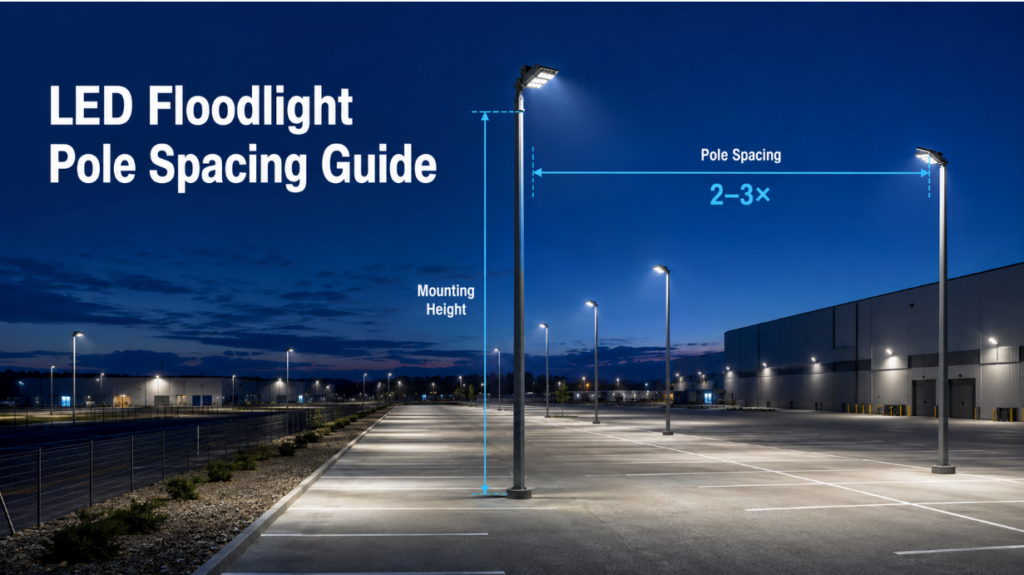
Pole Spacing Calculation Formula
Pole Spacing = 2–3 × Mounting Height
For a 10-meter pole, this gives a recommended spacing range of 20–30 meters. As a general upper limit, spacing beyond 4× mounting height is not recommended for most applications, since it significantly increases the risk of dark zones between poles.
This is a starting-point formula. The exact spacing within this range should be adjusted based on beam angle, target lux level, and required uniformity — each covered below.
Reference: Illuminating Engineering Society (IES RP-20 / RP-8, Lighting for Parking Facilities).
4 Key Factors That Affect Pole Spacing
Pole spacing isn’t a fixed number — it’s shaped by several parameters working together.
Mounting Height
Mounting height is one of the main factors determining coverage area.
Generally: taller poles cover a larger area and allow greater spacing, but ground-level illuminance decreases and higher lumen output is needed to compensate.
| Mounting Height | Typical Application |
|---|---|
| 6m | Small parking lots, plazas |
| 8m | Commercial areas |
| 10m | Industrial parks |
| 12m | Large parking lots |
| 15m+ | Sports fields, ports |
Beam Angle
Beam angle directly determines how far light spreads.
| Beam Angle | Coverage Characteristic |
|---|---|
| 30° | Long-distance projection |
| 60° | Mid-range illumination |
| 90° | Large-area coverage |
| 120° | Extra-wide coverage |
LSI keywords: Beam Angle, Light Distribution, Coverage Area, Floodlight Optics
At the same mounting height, a 120° beam angle and a 30° beam angle call for entirely different spacing recommendations. Pole spacing should never be calculated independently of beam angle.
Note: The beam angle values here (in degrees) follow the NEMA Type 1–7 beam spread classification covered in our Beam Angle Guide — this is different from the “Type III / Type V” photometric distribution patterns mentioned later in this guide, which describe distribution shape rather than beam spread angle.
Lux Requirement
Target lux level directly affects how many fixtures — and therefore how tight the spacing — a project needs. A project targeting 20 lux and one targeting 100 lux over the same area may require several times more fixtures for the higher target.
For specific lux recommendations by application, see our Parking Lot Lighting Guide and Basketball Court Lighting Guide.
Light Uniformity
Many buyers focus only on brightness. In practice, uniformity often matters more than raw lux — a well-designed lighting system avoids dark spots, hot spots, and excessive glare.
Uniformity can be expressed two ways:
- Average-to-Minimum ratio (the IES RP-20 standard) — typically targeted at 4:1 or better for parking lots
- Max-to-Minimum ratio (a stricter, comfort-focused measure) — typically targeted at 3:1 or better for sports and pedestrian-facing areas
Always confirm which ratio type a specification references before comparing values across sources or projects — the two are not interchangeable.
Pole Spacing Reference Table (90° Beam Angle)
For LED floodlight projects using a 90° beam angle, the following reference spacing applies:
| Mounting Height | Recommended Spacing (2–3× height) |
|---|---|
| 6m | 12–18m |
| 8m | 16–24m |
| 10m | 20–30m |
| 12m | 24–36m |
| 15m | 30–45m |
Pole Spacing by Application
Parking Lot Lighting
One of the most common LED floodlight applications.
| Mounting Height | Spacing |
|---|---|
| 8m | 16–24m |
| 10m | 20–30m |
| 12m | 24–36m |
LSI keywords: Parking Lot Lighting, Parking Lot Floodlight, Type III Distribution, Type V Distribution
Note: “Type III” and “Type V” here refer to IES photometric distribution patterns — asymmetric for perimeter-mounted fixtures, symmetric for center-of-lot mounting — a different classification from the NEMA beam-angle Type 1–7 system covered above.
For full lux and uniformity targets, see our Parking Lot Lighting Guide.
Industrial Yard Lighting
Industrial sites prioritize safety, vehicle movement, and loading operations.
| Mounting Height | Spacing |
|---|---|
| 10m | 20–30m |
| 12m | 24–36m |
| 15m | 30–45m |
Sports Lighting
Sports facilities require tighter uniformity than general area lighting — typically achieved through higher mounting, denser layouts, and stricter glare control.
| Court/Field Type | Mounting Height |
|---|---|
| Basketball Court | 8–12m |
| Tennis Court | 8–12m |
| Football Field | 15–25m |
For lux levels, uniformity targets, and beam angle recommendations by sport type, see our Basketball Court Lighting Guide.
Public Square Lighting
Public square lighting prioritizes pedestrian comfort, uniformity, and visual appearance. Common choices include a 90°–100° beam angle with Type V distribution for even, all-around coverage.
Real-World Calculation Example
How do you determine pole spacing for a 30m × 60m parking lot?
Site area: 30m × 60m = 1,800 m²
Assumptions: 10-meter mounting height, 90° beam angle, 20 lux target
Using the formula: Spacing ≈ Height × 2.5 (mid-range within the 2–3× formula)
Calculation: 10m × 2.5 = 25m
| Item | Value |
|---|---|
| Site Area | 1,800 m² |
| Mounting Height | 10m |
| Recommended Spacing | 20–30m |
| Estimated Pole Count | 4–6 |
This layout typically balances illuminance uniformity with cost — though the final pole count should always be verified against a lighting simulation for the site’s specific geometry.
Common Pole Spacing Mistakes
Spacing Too Wide
Results in dark spots, safety risks, and insufficient illumination.
Spacing Too Tight
Results in hot spots, unnecessary project cost, and over-illumination.
Ignoring Beam Angle
A 30° and a 120° beam angle have completely different coverage capabilities — the same spacing cannot be applied to both.
Ignoring Mounting Height
Height changes directly affect coverage area, light distribution, and uniformity — spacing calculated without it will be inaccurate.
When Do You Need a Lighting Simulation?
For small parking lots or small warehouse perimeters, the reference formula above is usually sufficient.
For the following project types, a professional photometric simulation is recommended:
- Sports fields
- Ports
- Airports
- Logistics parks
- Municipal public squares
Common simulation software includes DIALux, AGi32, and other photometric layout tools. Simulation allows you to verify lux distribution, pole spacing, beam angle, and uniformity ratio before installation — avoiding costly rework later.
Frequently Asked Questions
What is the standard pole spacing formula for LED floodlights?
Pole spacing is typically 2–3 times the mounting height, adjusted based on beam angle and target uniformity.
Is closer pole spacing always better?
No. Spacing too tight increases fixture count and cost, and can create overly bright “hot spots” alongside excessive glare.
Does beam angle affect pole spacing?
Yes — wider beam angles generally allow greater spacing between poles, while narrower beams require tighter spacing to avoid dark zones between fixtures.
What’s the difference between average-to-minimum and max-to-minimum uniformity ratios?
They measure uniformity differently — average-to-minimum (the IES RP-20 standard) compares average lux to the darkest point, while max-to-minimum compares the brightest and darkest points directly. Always check which ratio a specification references before comparing values.
Conclusion
There is no single pole spacing value that applies to every LED floodlight project. Mounting height, beam angle, lux requirements, and uniformity all shape the final layout.
For most LED floodlight projects, pole spacing of 2–3 times the mounting height is a reliable design starting point. For large parking lots, industrial parks, or sports field projects, a professional lighting simulation is still recommended to verify the final layout and achieve more uniform, efficient lighting performance.
Not sure what pole spacing fits your project? Browse our LED Floodlight Series or send us your site layout for a free spacing recommendation from our engineering team.