
Written by Chris Choi, Technical Sales Manager at MVS Lighting, with practical experience supporting overseas buyers on LED street lighting projects.
Pick the wrong distribution type for a road project and the symptoms show up fast — dark bands along one side of the road, uniformity ratios that fail inspection, or a pole spacing that was fine on paper but leaves gaps in real light coverage. The IES Type classification system exists to prevent exactly this, and understanding how it maps to the T-series shorthand used on most manufacturer spec sheets makes the selection process a lot more straightforward.
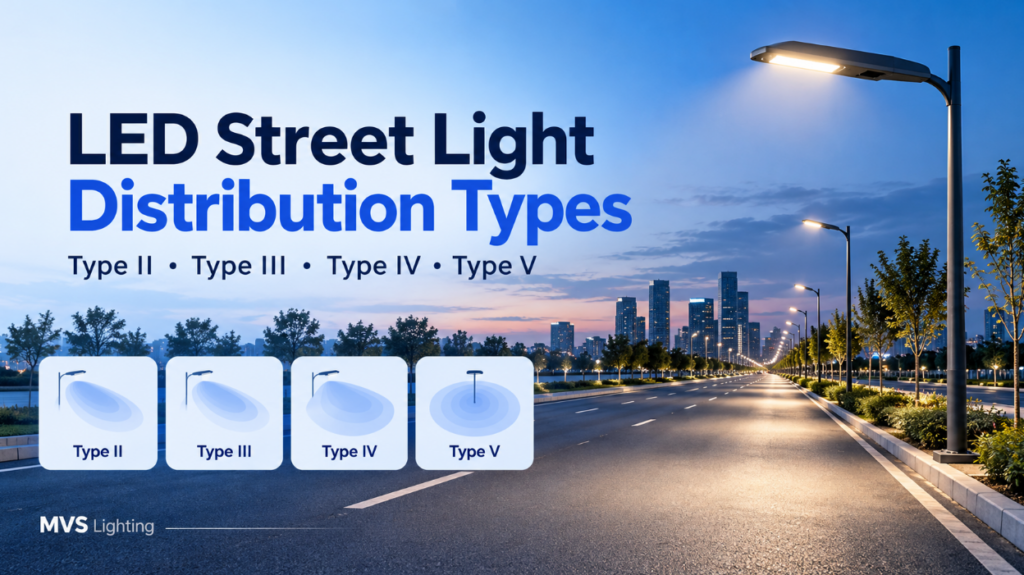
What Are IES Distribution Types (Type I–V)?
The Illuminating Engineering Society (IES) classifies roadway luminaires by how far their light throw extends laterally from the pole, measured in multiples of mounting height (MH). Type I sits centered over a narrow road. Type II, III, and IV extend progressively further to the street side, making them suited to side-of-road mounting on wider roads. Type V distributes light symmetrically in all directions, without a lateral bias toward the road.
In practice, most manufacturers — including many outside China — label these distributions with a “T” prefix on product codes and spec sheets: T1 through T5, corresponding directly to Type I through Type V. If you’ve seen a fixture spec listing “T3” or “T4” rather than spelling out “Type III” or “Type IV,” this is what it’s referring to.

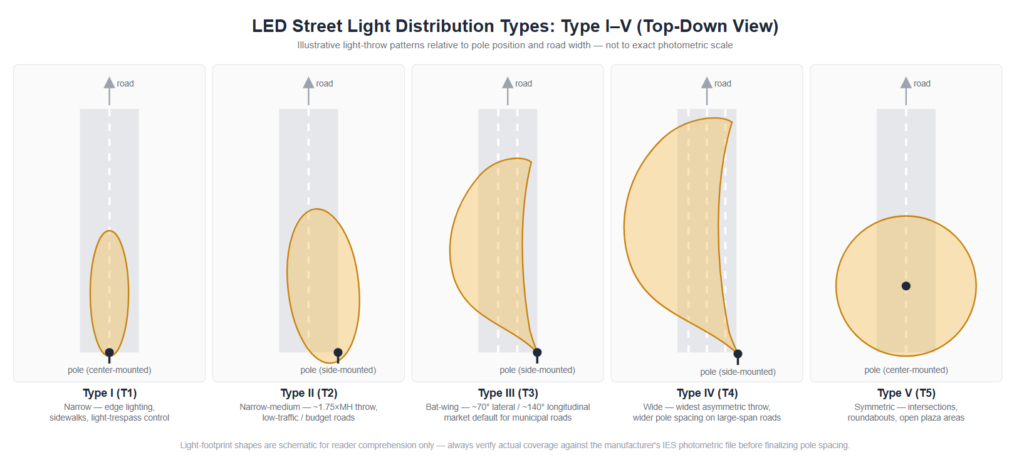
Type I and V are typically center-mounted, with light spreading evenly on both sides; Types II, III and IV are side-mounted, throwing progressively more light toward the road.
Type-to-T Naming: How Manufacturers Label These in Product Codes
| IES Classification | Common Product Code |
|---|---|
| Type I | T1 |
| Type II | T2 |
| Type III | T3 |
| Type IV | T4 |
| Type V | T5 |
This shorthand shows up constantly in optic part numbers and photometric file names (a “T3” tag in a product code, for example, means the fixture uses a Type III bat-wing optic). Knowing this mapping means you can read a manufacturer’s spec sheet or IES file name and immediately understand the distribution pattern without cross-referencing a separate glossary.
T1 (Type I) — Narrow Distribution: Edge Lighting & Light Pollution Control
Type I throws a narrow, elongated pattern centered directly over the light source, with minimal lateral spread. It’s rarely the right choice for a primary traffic lane — its coverage is too concentrated and too narrow to light a full road width efficiently.
Where it earns its place is edge lighting: sidewalks, bike paths, and narrow residential lanes where the priority is controlling exactly where the light goes rather than maximizing coverage width. Because the light stays tightly concentrated instead of spreading sideways, Type I is also one of the more effective tools for avoiding light trespass into nearby homes — it’s worth pairing with the fixture-level controls covered in our glare and light pollution guide on any project where a narrow lane runs close to residential property.
T2 (Type II) — Narrow-Medium Distribution: Budget Choice for Low-Traffic Roads
Type II extends the lateral throw slightly beyond Type I, making it a workable fit for narrower access roads, low-speed residential streets, and internal roads on campuses or industrial sites. Fixtures in this class also tend to be less expensive, which makes Type II attractive on cost-sensitive projects.
The trade-off shows up quickly if it’s specified on the wrong road: put a Type II fixture on a multi-lane arterial road and you’ll get dark bands on the far side of the road and uniformity ratios that miss inspection targets. The usual fix is closing up pole spacing to compensate, which erases whatever budget advantage the cheaper fixture offered in the first place. Type II earns its cost savings only when it’s matched to a road narrow enough for its throw pattern.
T3 (Type III) — Medium/Bat-Wing Distribution: The Market Default for Municipal Roads
Type III is the workhorse of road lighting, and it’s not close. It’s the highest-volume distribution type stocked by manufacturers and specified on municipal projects, for a straightforward reason: its bat-wing pattern is the best general-purpose fit for standard road geometry.
A typical Type III fixture throws roughly 70° laterally — enough to cover two to three lanes from a single side-of-road pole position — combined with a longer longitudinal throw of around 140°, which allows wider pole spacing without sacrificing uniformity. That combination is what makes bat-wing distribution so reliable at meeting both uniformity ratio and Threshold Increment (TI) glare targets without requiring a custom optical design.
If you’re specifying lighting for a city arterial road, a state or provincial route, or general municipal streets and you don’t have a strong reason to deviate, Type III is the default that will fit the widest range of projects with the least design risk. For guidance on translating a chosen distribution type into an actual pole layout, see our road lighting design guide.
T4 (Type IV) — Wide Distribution: Cost-Saving for Large-Span Roads
Type IV extends both the lateral and longitudinal throw further than Type III, giving it the widest practical coverage of the asymmetric distribution types. That wider throw translates directly into wider allowable pole spacing — which is the real reason project teams reach for Type IV.
On a wide highway, a long stretch of rural road, or any large-span project, the fixture and pole count is one of the biggest line items in total project cost. A Type IV distribution that lets you space poles further apart while still meeting lux and uniformity requirements can meaningfully reduce the number of poles, fixtures, and installation labor a project needs. For the specific spacing numbers this unlocks by road type, see our pole spacing and layout calculation guide.
Type IV is best matched to highways, expressways, and other wide, high-speed roads — it’s typically overkill (and a poor fit) for narrower residential streets, where the wide throw creates more spill than the road actually needs.
Type V — Symmetric Distribution for Intersections & Open Areas
Type V distributes light symmetrically in a circular pattern around the fixture, with no directional bias toward or along a road. That makes it a poor fit for standard road segments, but a useful one for intersections, roundabouts, and open plaza-style areas where light needs to cover all directions evenly rather than following a road’s lateral axis. We cover application-specific fixture selection for these scenarios in more detail elsewhere, so we won’t duplicate that here — the short version is that Type V is a supporting player in most road projects, not the primary distribution type.
How to Choose the Right Type for Your Project
The road’s geometry should decide the distribution type, not the other way around. As a starting point: Type III is the general-purpose choice for the large majority of standard road projects, Type IV is worth specifying specifically to unlock wider pole spacing on large-span roads, and Type I and Type II stay limited to narrower, lower-priority applications like edge lighting and low-traffic access roads. The same distribution logic applies to tunnel lighting projects as well, though tunnel-specific design has its own additional considerations beyond distribution type alone.
Whatever type you land on, treat the manufacturer’s IES photometric file as the final word — verify actual coverage and uniformity through simulation before finalizing pole spacing, rather than relying on the general Type classification alone.
FAQ
What is the difference between Type II and Type III street light distribution? Type III throws light further to the street side than Type II — roughly out to 2.75 times the mounting height compared to Type II’s 1.75 — which lets it cover wider roads and more lanes from the same pole position.
Can Type IV fixtures be used on narrow residential streets? Technically yes, but it’s rarely the right call. Type IV’s wide throw is built for wide roads with more lanes; on a narrow residential street it typically spills more light than the road needs, increasing the risk of glare and light trespass into nearby homes.
Does distribution type affect glare? Yes, indirectly. A distribution type mismatched to the road width — particularly one that’s wider than necessary — increases the chance of light spilling past the road into adjacent property. Distribution type is one input into overall glare performance; for the full picture including BUG ratings and fixture shielding, see our glare and light pollution control guide.