
Written by Chris Choi, Technical Sales Manager at MVS Lighting, working with outdoor lighting projects since 2020. MVS is a TUV/CE/CB certified manufacturer offering 5-year warranty support.
A cheap LED floodlight and a project-grade one can look almost identical on a spec sheet — same wattage, similar lumen claims, similar-looking housing. The difference shows up later, in how long the fixture actually lasts once it’s installed. Why cheaper fixtures tend to fail sooner is a driver-quality, thermal-design, and build-quality question we’ve already covered in detail in our Lifespan Guide — this guide picks up from that conclusion and does the math: over a real project lifetime, does the cheaper option actually save money?
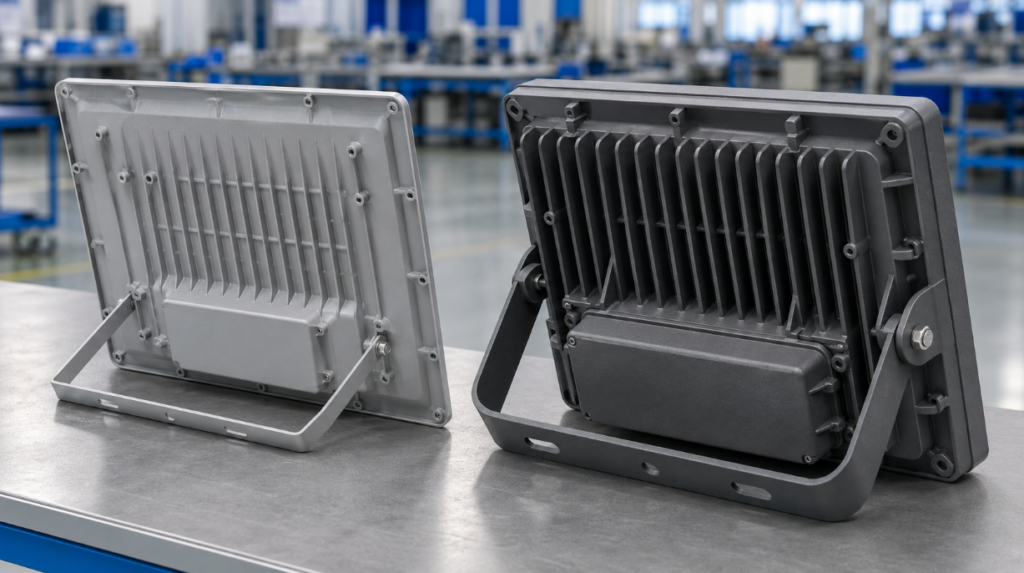
🖼️ side-by-side comparison of a thin-wall budget housing and a die-cast project-grade housing
What “Cheap” Usually Means in Practice
A lower price on a floodlight almost always means something specific was cut to get there — not a mystery, just a trade-off that isn’t always disclosed on the spec sheet:
- Thinner housing, less heat dissipation — shortens driver and LED life; see our Lifespan Guide for why heat is the main driver of early failure
- Unbranded or unverifiable driver — often the first component to fail, and the hardest to verify quality on from a spec sheet alone
- No surge protection, or an under-rated SPD — see our Surge Protection Guide for what’s actually being skipped
- IP rating claimed but not tested — a labeled IP66 with no test report behind it isn’t a verified IP66
None of these show up as a line item on the quote. They show up eighteen months later, in the field.
Climate and Installation Environment Change the Math — Usually in Favor of Paying More
The TCO gap between cheap and project-grade isn’t constant — it widens in harsher environments, and this is where the cheap option often ends up costing the most, not the least.
Extreme cold. Low-grade drivers are a common weak point below freezing — components rated for general conditions can start failing once temperatures drop well below 0°C, even if the fixture works fine in a mild climate.
Extreme heat. Desert and high-ambient-temperature regions — common across a number of our export markets — regularly see conditions above 50°C. Combined with a thin housing that already struggles to dissipate heat, this is close to a worst-case scenario for a budget driver, and failure rates climb accordingly.
Fixtures that rarely get turned off. Continuous or near-continuous operation adds up faster than intermittent use — a budget component under constant thermal load simply accumulates wear faster than the same component cycling on and off.
Why the Repair Cost Is Higher Than It Looks — Especially Outside China
This is the part of the TCO calculation that’s easy to underestimate if you’re only thinking about the part and labor cost of a single repair.
In China, a maintenance callout is generally fast and labor is comparatively inexpensive — a failed fixture gets fixed in days. In many of our export markets, that same repair can mean scheduling a project that takes months, sometimes a year or more, to actually get done — labor availability, equipment access (especially for high-mast or elevated installations), and project scheduling all move at a different pace than they do domestically. A fixture that fails early doesn’t just cost the price of a replacement part — it costs a customer months of degraded lighting, or an outage, while that repair works its way through the local process.
There’s also a cost that doesn’t show up in any spreadsheet: a customer whose newly installed lighting starts failing within a year or two takes a real hit to their own local reputation — with their own clients, tenants, or the public using that space. That’s a real cost, even if it’s not the kind of number that fits neatly into a TCO table.
The 10-Year TCO Comparison
The figures below are illustrative assumptions, not a guarantee for any specific project — actual results depend on your local labor cost, climate, and usage pattern. Use this as a framework to build your own project-specific comparison, not as a number to quote directly.
| Factor | Budget Fixture | Project-Grade Fixture |
|---|---|---|
| Initial unit price | Lower | Higher (commonly 20–40% more) |
| Expected replacements over 10 years | 2–3 (given typical early-failure patterns) | 0–1 |
| Repair/replacement labor, per event | Often higher than expected outside China — see above | Rare, but same consideration applies if it occurs |
| Downtime / degraded lighting during repair scheduling | Recurring | Minimal |
| Reputational cost to the customer | Real, hard to quantify | Minimal |
Once repeated replacement and repair-scheduling delays are factored in — not just the parts — the “cheaper” option frequently ends up costing more over a 10-year project life, not less.
Red Flags on a Quote That Suggest Corners Were Cut
- No driver brand named, or the driver brand can’t be verified
- IP or surge protection rating stated with no test report offered
- Warranty period noticeably shorter than competing quotes with similar pricing
- Unwillingness to provide a sample before a bulk order
For a fuller framework on vetting a supplier — not just a single quote — see our Manufacturer Checklist.
TCO Mistakes We See in Real RFQs
- Comparing quotes on unit price alone, with no assumption for climate. A quote that looks competitive for a mild-climate project can be a poor fit for a desert or sub-zero installation — the TCO gap widens specifically in harsh environments, and that variable often isn’t in the initial comparison.
- Repair cost estimated using domestic (China) labor assumptions. Buyers sometimes underestimate the real cost of a field repair in their own market because the reference point in their head is how fast and cheap that repair would be in China — actual local labor and scheduling realities can be very different.
- Reputational cost left out of the comparison entirely. It’s not on the spec sheet and it’s not on the invoice, but a customer whose lighting fails repeatedly pays for it in ways that don’t show up in a TCO spreadsheet.
- “Cheap now” chosen for a long-run, hard-to-access installation. The harder and more expensive a fixture is to reach for repair — high-mast, elevated, remote sites — the more the math favors paying more upfront to avoid needing to go back.
Want to Run the Numbers for Your Project?
Use our [ROI Calculator to estimate payback based on your actual quantity, wattage, electricity rate, and operating hours.
Frequently Asked Questions
Is a more expensive LED floodlight always worth it? Not automatically — it depends on installation difficulty, climate, and how long the project needs to run without maintenance. For short-term, easily accessible, or mild-climate installations, the gap narrows. For harsh climates or hard-to-reach mounting positions, project-grade fixtures usually pay for themselves.
Why do cheap floodlights fail faster in extreme climates? Budget drivers are often rated for general conditions, not extremes — sustained heat above roughly 50°C or sub-zero cold pushes lower-quality components toward failure faster than in a moderate climate. See our Lifespan Guide for the underlying failure mechanisms.
Is repair really more expensive outside China? Often yes, in terms of time rather than just money — labor availability and project scheduling in many export markets mean a repair that would take days in China can take months to complete locally, extending the period of degraded or lost lighting.
How do I know if a quote is cutting corners? Look for missing driver brand information, IP or surge ratings with no test report behind them, unusually short warranty periods, and reluctance to provide a sample before a bulk order.
Is there a real formula for calculating this, or is it just judgment? Both — the framework in this guide (replacement frequency, labor cost assumptions, downtime) gives you a structure, but the actual numbers depend on your project’s specific climate, labor market, and access difficulty. Use our ROI Calculator to build a project-specific estimate.
Conclusion
The honest answer is the simple one: you generally get what you pay for. We don’t dress up a budget spec sheet to look like a premium one, and we don’t pretend every project needs the most expensive option available — see our How to Choose an LED Flood Light Manufacturer guide for where we think we’re a genuine fit, and where we’re not.
There’s a longer-term reason we take this seriously, beyond any single order. We’re not in the business of selling one shipment and moving on — we’re supplying fixtures that our customers then stand behind with their own customers, tenants, or communities. Building a reputation in a local market takes years; a quality problem can damage it in a single incident. If a customer’s installation fails and their own clients stop trusting them because of it, that customer doesn’t come back to us for the next project either — so cutting corners to win one order would ultimately cost us more than it saves. The market has no shortage of suppliers willing to pass off a lower grade of component as equivalent to a better one. We’d rather be the supplier a customer can build a ten-year relationship on.
If your project involves a harsh climate, a hard-to-reach installation, or an export market where repairs are slow to schedule, the math in this guide is the reason to weigh the higher upfront cost seriously — not as a sales pitch, but as a real 10-year calculation.
For the mechanisms behind why cheaper components fail sooner, see our Lifespan Guide. For price structure and what actually drives cost differences between quotes, see our Price Guide.
Browse our LED Floodlight Series.