
Written by Chris Choi, Technical Sales Manager at MVS Lighting, working with outdoor lighting projects since 2020. MVS is a TUV/CE/CB certified manufacturer offering 5-year warranty support.
Commercial and residential basketball courts sit at very different points on the lighting spectrum — different budgets, different certification requirements, and different neighbors to consider. These two projects show how MVS floodlights have been configured for each.
For the full design standards behind basketball court lighting, see our Basketball Court Lighting Guide.
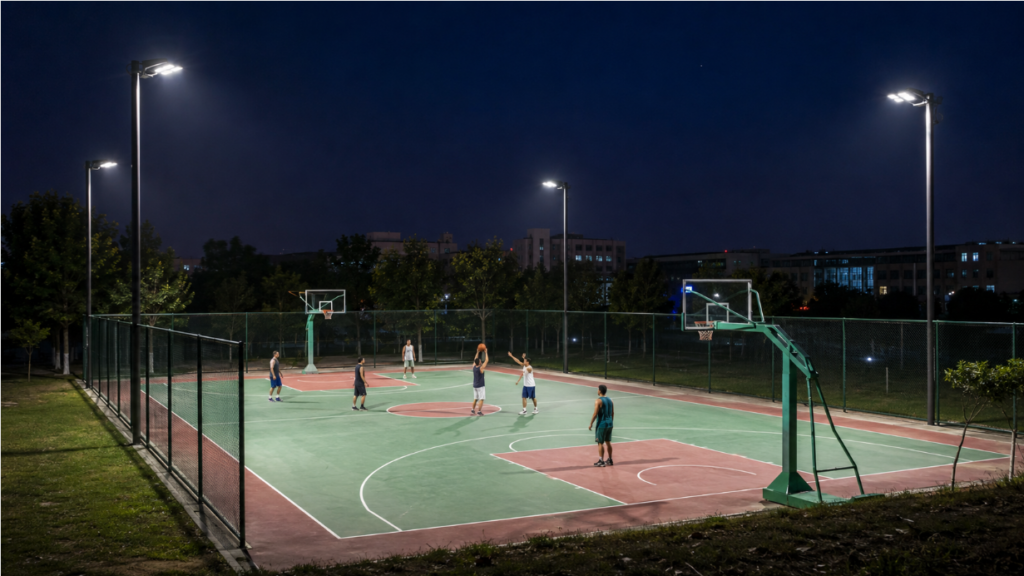
Case Study 1 — Commercial Outdoor Basketball Court, Australia
An Australian engineering contractor selected MVS 400W LED floodlights for outdoor basketball court lighting projects. Because the products would be supplied into the Australian market, the customer needed the selected floodlight model to meet local certification requirements.
The customer applied for and holds the SAA certification directly. During the certification process, MVS provided the available TÜV CE and CB documentation and cooperated with the customer on the required product and technical information. The existing certification documents supported the assessment process, and the 400W floodlight successfully passed the required SAA certification.
The initial order included 52 units of the standard 400W LED floodlight configuration. After the first order, the contractor placed several follow-up orders according to the progress and requirements of its local projects — typically in smaller batches ranging from approximately 10 to more than 20 units.
Rather than a one-off sample evaluation, this relationship progressed from certification support to an initial project order and then to multiple repeat orders — practical evidence that the 400W floodlight met the customer’s continuing requirements for outdoor basketball court projects in Australia.
| Project Detail | |
|---|---|
| Customer | Engineering contractor |
| Market | Australia |
| Application | Outdoor basketball court lighting |
| Product | 400W LED floodlight, standard configuration |
| Initial order | 52 units |
| Follow-up orders | Several batches, approximately 10–20+ units each |
| Certification | SAA (held by the Australian customer) |
| MVS support | TÜV CE and CB documentation, technical information, certification cooperation |
Case Study 2 — Residential Outdoor Basketball Court
A residential outdoor basketball court project used 24 × 100W LED floodlights, achieving an average illuminance of approximately 380 lux at 7m mounting height, or 300 lux at 8m.
Light pollution control was the defining design consideration — unlike a commercial or stadium installation, a residential court sits close to neighboring homes, and spill light beyond the court boundary is a real concern for anyone living nearby. The layout used asymmetric aiming to direct light onto the playing surface while limiting spill toward adjacent properties, rather than defaulting to a symmetric distribution better suited to open commercial sites.
| Project Detail | |
|---|---|
| Application | Residential outdoor basketball court |
| Product | 100W LED floodlight |
| Quantity | 24 units |
| Achieved illuminance | ~380 lux @ 7m, or ~300 lux @ 8m |
| Key design consideration | Light pollution / spill control via asymmetric aiming |
What These Projects Have in Common
Both projects hit their target illuminance, but the harder design problem in each case was something other than raw brightness. The Australian commercial project’s real challenge was certification logistics — getting a product that already had CE/CB documentation through the local SAA process smoothly enough to support repeat ordering. The residential project’s real challenge was controlling where the light didn’t go, not just how much of it there was. Wattage and quantity are the easy part of a basketball court lighting spec; certification pathway and spill control are where projects actually succeed or run into trouble.
For the full breakdown of lux levels, uniformity, and glare-control standards behind basketball court lighting, see our Basketball Court Lighting Guide.
Frequently Asked Questions
How many LED floodlights does an outdoor basketball court need? It depends on court size, mounting height, and target lux — as a reference point, a residential court in this case used 24 × 100W fixtures to reach 300–380 lux depending on mounting height. See our Basketball Court Lighting Guide for a full sizing approach.
Do residential basketball courts need different lighting design than commercial courts? Yes — light pollution and spill control matter more for residential installations near neighboring properties, often requiring asymmetric aiming rather than the more symmetric distribution common on open commercial sites.
Can MVS support certification for markets like Australia? MVS provides TÜV CE and CB documentation that customers can use to support local certification processes (such as SAA in Australia) — the certificate itself is typically held by the local customer or distributor, with MVS supporting the technical documentation side.
Conclusion
A commercial court and a residential court can use the same underlying floodlight technology and still require very different project support — one built around certification logistics and repeat-order reliability, the other around precise spill-light control. Matching the fixture and layout to the site’s real constraints, not just its lux target, is what separates a working installation from a technically-correct one.
Working on a basketball court lighting project? See our Basketball Court Lighting Guide for design guidance, or [contact our engineering team →] for a project-specific recommendation.
Browse our LED Floodlight Series.