
By Chris Choi, Technical Sales Manager at MVS Lighting
Street lights sit at the top of an open, exposed electrical network for their entire service life. Between direct and induced lightning strikes and switching surges from the grid itself, transient overvoltage is one of the leading causes of driver failure in road lighting projects — and unlike indoor fixtures, surge protection on a street light isn’t optional. Getting the rating wrong in either direction costs you: too low and you’re replacing drivers after every storm season, too high and you’re paying for protection the site doesn’t need.
Why Street Lights Need Surge Protection
A street light pole is typically the tallest object along its stretch of road, which makes it a more likely target for both direct lightning strikes and the induced surges that travel through nearby strikes to ground. On top of that, the grid itself generates transient overvoltage through ordinary operation — switching events, nearby equipment starting and stopping, and utility-side faults all send surges down the same line the fixture is connected to.
This combination is why a surge protection device (SPD) is a standard component in road lighting design, not an upgrade reserved for high-risk sites.
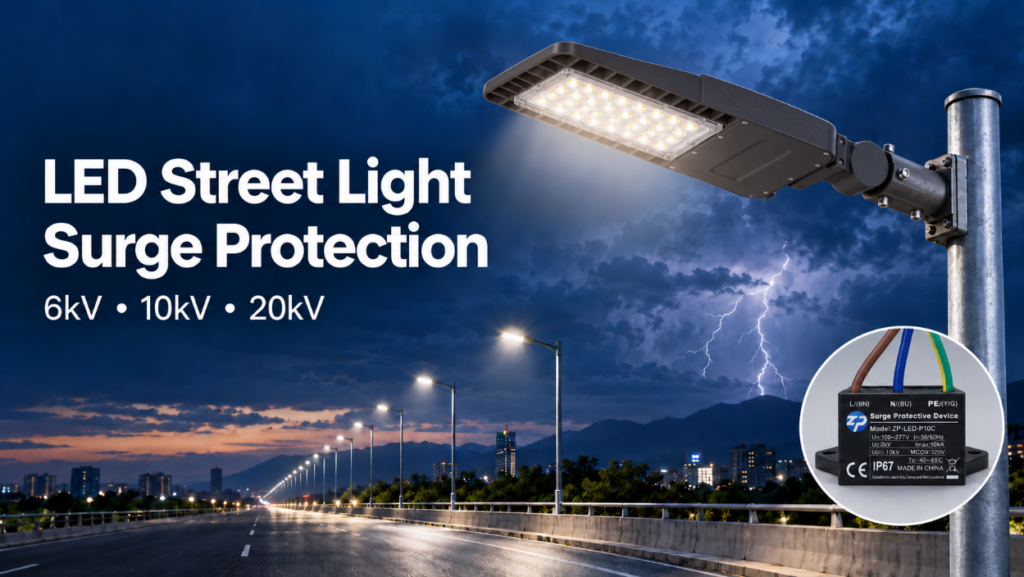
Common SPD Ratings: 6kV, 10kV & 20kV
6kV is the entry-level rating, generally adequate for lower-risk locations — inland areas with a low keraunic level (thunderstorm days per year) and a reasonably stable local grid.
10kV is the rating we see specified most often across standard municipal and commercial road projects. It’s not just a middle-ground default — clients frequently name 10kV directly in their procurement specifications rather than leaving the SPD rating to the supplier’s discretion. On a street lighting project we supplied in Kuwait, for example, the client’s procurement documents specified 10kV SPD protection explicitly.
20kV is reserved for higher-risk conditions — regions with frequent lightning activity, coastal or open-terrain installations where poles are more exposed, or projects where the contract specifically calls for a higher protection margin.
Higher isn’t automatically better here. Matching the SPD rating to the site’s actual lightning exposure and grid stability is the right approach — over-specifying adds cost without a corresponding reduction in failure risk once the rating already exceeds what local conditions call for.
Common Mode vs Differential Mode Protection
Surges don’t all travel the same electrical path, which is why a single voltage rating on a spec sheet doesn’t tell the whole story.
Common mode surges travel between a line conductor and ground. Differential mode surges travel between two line conductors. A properly designed SPD protects against both paths — a device that only addresses one leaves the fixture exposed to the other. When reviewing an SPD spec, check that both common mode and differential mode protection are explicitly covered, not just a single kV number.
Grounding — The Part Most Specs Get Wrong
An SPD’s job is to divert surge energy away from the circuit it’s protecting — but diverting energy only works if it has somewhere to go. Without a properly designed grounding system, even a correctly rated SPD has nowhere to send the surge, and its real-world protection falls well short of its spec sheet rating.
This means grounding resistance, the pole foundation’s earthing, and how the lightning protection system connects to the SPD’s ground terminal all need to be designed together, not treated as a separate checklist item. It’s also one of the most common gaps we see at project acceptance — the SPD itself meets spec, but weak grounding means the installed protection performs far below what the rating on paper suggests.
Where to Position the SPD
SPDs are typically installed either inside the fixture housing, ahead of the driver, or in the terminal box at the base of the pole. The right choice depends on maintenance access and how much cable length sits between the point of entry and the protected component — a shorter protected path generally performs better, since surge energy has less distance to induce further transients before reaching the SPD.
Choosing the Right SPD Level for Your Project
The right SPD rating comes from three inputs: local lightning frequency (keraunic level), grid stability in the area, and site exposure (open terrain and coastal sites see more induced surge activity than sheltered urban installations). For projects in regions with frequent severe weather, we’d lean toward the 10–20kV range as a starting point rather than defaulting to 6kV.
It’s also worth checking the procurement specification directly rather than assuming — as the Kuwait project above shows, some clients specify the SPD rating explicitly rather than leaving it to standard practice, and matching that requirement precisely matters more than defaulting to whatever rating is typically used in the region.
FAQ
Is 10kV SPD enough for most street light projects? For standard municipal and commercial road projects in areas without unusually high lightning exposure, 10kV is generally adequate and is the rating most commonly specified. Higher-risk sites — coastal, open-terrain, or storm-prone regions — may call for 20kV instead.
Does a higher SPD rating mean better protection? Only up to the point where the rating matches the actual surge risk at the site. Beyond that, a higher rating adds cost without meaningfully reducing failure risk, and it doesn’t compensate for poor grounding, which affects real-world performance more than the kV number alone.
Can SPD failure cause the whole street light to fail? Yes — when an SPD fails to divert a surge (often due to inadequate grounding rather than an undersized rating), the surge energy typically damages the driver next, which is usually the most expensive component to replace. This is one of the reasons surge protection and driver longevity are closely linked; see our street light lifespan and maintenance guide for more on driver failure causes.