
Written by Chris Choi, Technical Sales Manager at MVS Lighting, working with outdoor lighting projects since 2020. MVS is a TUV/CE/CB certified manufacturer offering 5-year warranty support.
Spec sheets describe what a fixture can do. Real installations show how it actually performs once mounting height, aiming angle, and site layout come into play. These two projects — a large multi-purpose stadium and a small modular seven-a-side pitch — show how MVS floodlights have been configured for genuinely different scales of sports field lighting.
For the full standards and design logic behind sports lighting, see our Sports Field Lighting Standards Guide.
Case Study 1 — Multi-Purpose Stadium, Zhejiang, China
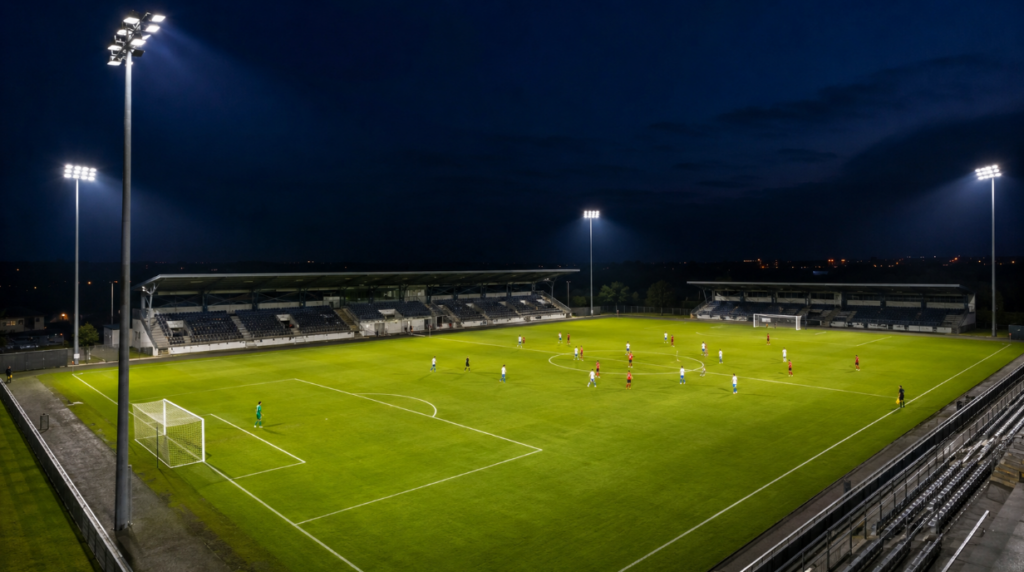
A sports venue project in Zhejiang, China — including a football field, running track, and spectator areas — required high-power lighting mounted on high poles positioned around the venue.
The core design challenge wasn’t brightness — it was aiming. In a large stadium, floodlights mounted on the same pole often need to point in different directions to cover their assigned zone of the field, track, or stands. A fixed, one-angle-fits-all mounting design doesn’t work at this scale; the rotation and adjustment range of the mounting bracket mattered as much as the raw output of the fixture itself.
MVS supplied the project as a mixed-power solution:
| Fixture | Quantity | Role |
|---|---|---|
| 500W LED floodlight | 82 units | General field and track coverage |
| 1000W LED floodlight | 54 units | High-mast, long-distance illumination |
Both fixture types were selected and positioned around the venue’s mounting structure, with installation-angle requirements coordinated directly with the customer’s on-site team rather than fixed to a single default aiming configuration.
Evidence: after installation, the customer provided site video of the completed stadium lighting in operation at night, showing the illuminated football field, running track, and the high-mast floodlight installation around the venue perimeter.
| Project Detail | |
|---|---|
| Location | Zhejiang, China |
| Application | Outdoor stadium (football field, running track, spectator areas) |
| Products | 500W LED floodlight (82 units) + 1000W LED floodlight (54 units) |
| Installation | High lighting poles, multiple fixtures per pole |
| Main design concern | Fixture rotation and aiming adjustment |
| Project evidence | Customer-provided nighttime site video |
Case Study 2 — Modular Seven-a-Side Football Field, Guangzhou
Not every sports field project is stadium-scale. A small seven-a-side football field in Guangzhou needed to retrofit lighting onto existing 15m poles — meaning the fixture had to work within a mounting height that was already fixed, rather than being specified from scratch.
MVS supplied modular 200W floodlights, paired two units together to deliver an effective 400W output per position, with a 60° beam angle suited to the smaller field dimensions of a seven-a-side pitch. The configuration achieved an average illuminance of at least 380 lux across the field.
| Project Detail | |
|---|---|
| Location | Guangzhou, China |
| Application | Small-sided (seven-a-side) football field |
| Product | 200W modular LED floodlight, 2 units combined per position (400W effective) |
| Existing infrastructure | 15m poles (retrofit, not new installation) |
| Beam angle | 60° |
| Achieved illuminance | ≥380 lux average |
What These Projects Have in Common
Different as they are in scale, both projects point to the same underlying lesson: sports field lighting isn’t just a wattage decision. The Zhejiang stadium needed adjustable aiming more than it needed more raw power; the Guangzhou pitch needed a configuration that worked within an existing 15m pole rather than an idealized new layout. In both cases, matching the fixture and mounting approach to the site’s real constraints mattered more than defaulting to a single standard spec.
For the full breakdown of lux levels, uniformity requirements, and class-specific standards behind these kinds of projects, see our Sports Field Lighting Standards Guide.
Frequently Asked Questions
Why did this stadium project use two different wattages instead of one? Different mounting positions serve different roles — general field coverage and long-distance high-mast illumination have different output and throw requirements. A mixed-power approach matched fixture output to each pole’s actual job, rather than over- or under-lighting a given zone with a single wattage.
Can LED floodlights be retrofitted onto existing poles? Yes, as shown in the Guangzhou project — retrofitting onto existing 15m poles is a common scenario, and fixture selection (in this case, a modular configuration) can be adapted to fit fixed infrastructure rather than requiring new poles.
How important is fixture aiming/rotation for stadium lighting? Very — as this case shows, mounting brackets with real rotation and adjustment range are often more important to project success than raw wattage, especially where multiple fixtures share a single high pole and need to cover different zones.
Conclusion
These two projects sit at opposite ends of the sports-field-lighting scale — a multi-fixture stadium retrofit and a small modular seven-a-side pitch — but both were solved by matching the fixture and mounting configuration to the site’s real constraints, not by defaulting to a standard spec.
Working on a sports field lighting project? See our Sports Field Lighting Standards Guide for design guidance, or [contact our engineering team →] for a project-specific recommendation.
Browse our LED Floodlight Series.