
Home > LED Flood Lights > Industrial Yard Flood Lights Guide
By Lighting Engineering Team, MVS Lighting — outdoor lighting manufacturer with 5 production lines and 15+ years of experience in industrial and large-area outdoor lighting projects, providing professional LED flood light solutions for global applications. Last updated: July 2026
Industrial yards are among the most demanding outdoor lighting environments. Unlike simple commercial areas, industrial spaces often operate throughout the night and require reliable illumination for worker safety, vehicle movement, security monitoring, and continuous production operations.
Choosing the right industrial yard flood lights is not only about selecting higher wattage fixtures. A professional lighting design must consider the yard size, mounting height, lighting uniformity, beam angle, environmental conditions, and long-term maintenance costs.
For most industrial outdoor projects, LED flood lights between 100W and 1000W are commonly used, depending on installation height and required illumination levels. Large yards with high poles usually require narrow beam optics and higher output fixtures, while smaller factory yards may use medium-power wide-beam floodlights.
This guide explains how to design an efficient industrial yard lighting system and select the right LED flood lights for different industrial applications.
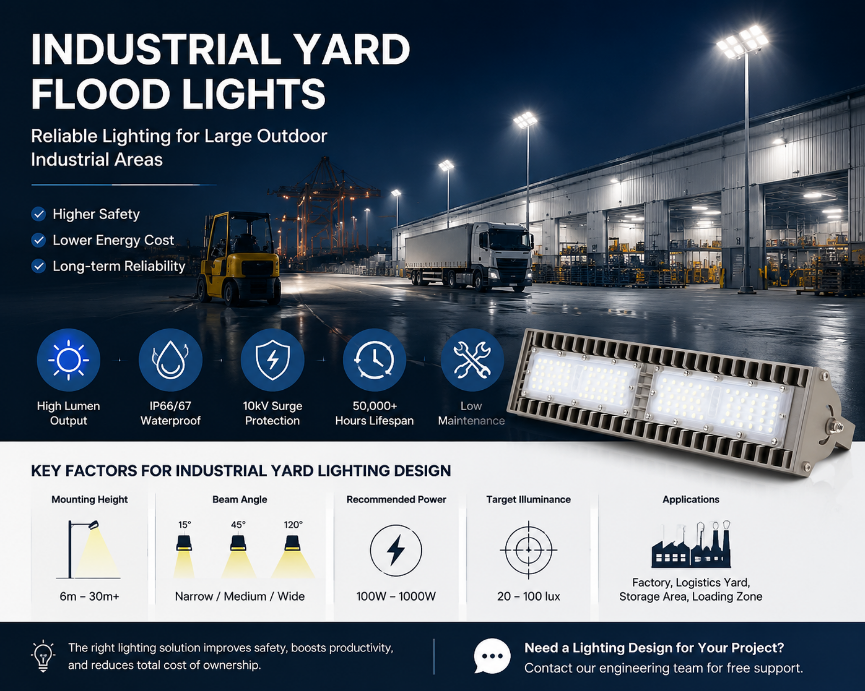
What Are Industrial Yard Flood Lights?
Industrial yard flood lights are high-output outdoor lighting fixtures designed to illuminate large open industrial areas such as:
- Factory yards
- Manufacturing facilities
- Logistics yards
- Loading and unloading areas
- Material storage zones
- Container yards
- Equipment operation areas
- Industrial park roads and perimeter zones
Compared with general outdoor flood lighting, industrial applications usually require:
- Higher lumen output
- Longer operating hours
- Better weather resistance
- More precise beam control
- Stronger surge protection
- Lower maintenance requirements
A well-designed industrial lighting system helps companies improve operational efficiency while reducing safety risks and energy consumption.
Where Are Industrial Flood Lights Used?
Industrial yards usually contain different working zones, and each area has different lighting requirements.
| Industrial Area | Main Lighting Purpose | Recommended Lighting Focus |
|---|---|---|
| Loading yard | Truck loading and unloading safety | Uniform illumination |
| Material storage area | Visibility and security | Wide-area coverage |
| Factory perimeter | Security monitoring | Continuous low-glare lighting |
| Equipment operation zone | Worker safety | Higher lux level |
| Logistics yard | Vehicle movement | Long-distance visibility |
| Container yard | Large-scale outdoor operation | High-power flood lighting |
A single lighting solution is rarely suitable for the entire industrial site. Professional projects usually divide the area into different lighting zones and design each zone separately.
Key Requirements for Industrial Yard Lighting
1. High Lumen Output for Large Coverage Areas
Industrial yards are usually much larger than commercial properties. A small number of low-power lights often creates uneven illumination, causing:
- Dark areas
- Poor visibility
- Safety concerns
- Increased security risks
High-power LED flood lights provide greater lumen output while maintaining lower energy consumption compared with traditional HID or metal halide systems.
For example:
- Small factory yard: 100W–200W LED flood lights
- Medium industrial area: 200W–400W LED flood lights
- Large industrial yard: 500W–1000W LED flood lights
However, wattage alone does not determine performance. Beam angle, installation height, and optical efficiency are equally important.
2. Proper Lighting Uniformity
Industrial lighting is not only about achieving high brightness.
A yard with extremely bright spots and dark areas can still create poor working conditions.
Professional designs focus on:
- Average illuminance
- Minimum illuminance
- Uniformity ratio
- Glare control
Good uniformity helps:
- Drivers identify obstacles
- Workers move safely
- Security cameras capture clearer images
- Equipment operators work more efficiently
3. Correct Beam Angle Selection
Beam angle determines how light spreads across the ground.
For industrial yards:
Wide Beam Angle
Suitable for:
- Open storage areas
- Low mounting heights
- Large empty spaces
Examples:
- 80°
- 90°
- 120°
Narrow Beam Angle
Suitable for:
- High poles
- Long-distance illumination
- Large industrial sites
Examples:
- 15°
- 30°
- 45°
A common mistake is selecting a very wide beam angle for high mounting heights. This may create wasted light and insufficient ground intensity.
From our experience working with industrial lighting projects, one common misunderstanding is that selecting a lighting solution is only about comparing prices or wattage.
In reality, industrial environments are different from ordinary outdoor applications. The required lighting performance depends on the actual working conditions, including installation height, operating hours, surrounding environment, and illumination requirements.
A 500W flood light, for example, does not automatically provide a better solution than a 300W model. The final result depends on optical design, beam distribution, installation layout, and whether the fixture is suitable for the application.
Therefore, professional industrial lighting projects should start with understanding the environment and requirements first, rather than simply selecting the lowest-cost fixture.
How Many Industrial Yard Flood Lights Do You Need?
The required number of flood lights depends on several factors:
- Yard area
- Target lux level
- Mounting height
- Fixture lumen output
- Beam angle
- Lighting uniformity requirement
The basic calculation method is:
Required Lumens = (Target Lux × Area) ÷ (CU × MF)
Where:
- CU = Coefficient of Utilization
- MF = Maintenance Factor
For example:
Industrial yard:
- Area: 5,000㎡
- Target illumination: 30 lux
- CU: 0.7
- MF: 0.8
Required lumens:
(30 × 5000) ÷ (0.7 × 0.8)
≈ 267,857 lumens
If using a 300W LED flood light with approximately 45,000 lumens output:
267,857 ÷ 45,000
≈ 6 fixtures
However, professional projects should always verify the layout through lighting simulation software because pole position and beam distribution significantly affect the final result.
Recommended Wattage for Industrial Yard Flood Lights
The correct wattage depends mainly on installation height and coverage requirements.
| Application | Mounting Height | Recommended Power | Beam Angle |
|---|---|---|---|
| Small factory yard | 6–8m | 100W–200W | Wide beam |
| Loading area | 8–12m | 200W–300W | Medium beam |
| Industrial storage yard | 10–15m | 300W–500W | Medium/narrow beam |
| Large logistics yard | 15–20m | 500W–1000W | Narrow beam |
| High mast industrial area | 20m+ | 750W–1000W | Narrow beam |
MVS Lighting provides a complete LED floodlight series from compact outdoor applications to high-power industrial lighting projects. Our floodlights are available in multiple wattages, beam angles, and configurations to meet different installation heights and industrial environments.
For more detailed wattage selection, refer to our LED flood light wattage guide.
Mounting Height and Pole Design for Industrial Yards
Mounting height directly affects:
- Lighting coverage
- Beam selection
- Fixture quantity
- Installation cost
Typical industrial yard installation heights:
| Application | Typical Height |
|---|---|
| Small outdoor area | 6–8m |
| Factory yard | 8–12m |
| Logistics yard | 12–18m |
| Large industrial site | 18–30m |
Higher installation heights provide wider coverage but require:
- Higher lumen output
- More accurate beam control
- Better optical design
Incorrect mounting height selection can lead to excessive fixture quantity or poor illumination.
IP Rating and Environmental Protection Requirements
Industrial outdoor environments are usually exposed to:
- Rain
- Dust
- Industrial pollution
- Temperature changes
- Chemical environments
For industrial yard flood lights, recommended protection levels include:
IP65
Suitable for:
- General outdoor areas
- Covered industrial spaces
IP66/IP67
Recommended for:
- Heavy rain areas
- Coastal environments
- Dusty industrial sites
- Long-term outdoor installation
Besides waterproof protection, industrial projects should also consider:
- Aluminum housing quality
- Thermal management
- Corrosion resistance
- UV-resistant coating
Surge Protection for Industrial Outdoor Lighting
Industrial sites often have:
- Large electrical equipment
- Long cable distances
- Outdoor poles
- Lightning exposure
These factors increase the risk of voltage surges.
Professional industrial flood lights should include:
- 6kV surge protection as a minimum
- 10kV or higher for demanding projects
Additional protection may include:
- External surge protectors
- Proper grounding systems
- Lightning protection design
A higher-quality surge protection system can significantly improve fixture lifetime and reduce replacement costs.
Industrial Yard Lighting Design Example
Project Requirement
Application:
Factory outdoor loading yard
Area:
6,000㎡
Operation:
Night-time loading and vehicle movement
Mounting height:
12m poles
Required lighting:
30–50 lux
Recommended Solution
LED flood lights:
300W high-efficiency LED flood lights
Quantity:
8–10 fixtures
Beam angle:
45° medium beam
Installation:
Pole-mounted arrangement around the yard perimeter
Advantages:
- Improved worker safety
- Better truck visibility
- Reduced energy consumption
- Lower maintenance frequency
LED Flood Lights vs Traditional Industrial Lighting
Many industrial facilities are replacing metal halide and high-pressure sodium lighting with LED flood lights.
| Comparison | LED Flood Light | Traditional HID Lighting |
|---|---|---|
| Energy efficiency | High | Lower |
| Lifetime | 50,000+ hours | Shorter |
| Warm-up time | Instant | Requires warm-up |
| Maintenance | Low | High |
| Beam control | Precise optics | Limited |
| Smart control | Available | Limited |
For industrial facilities operating 10–12 hours every day, LED conversion can significantly reduce long-term operating costs.
How to Choose the Right Industrial LED Flood Light Supplier?
For industrial projects, price should not be the only selection factor.
A reliable supplier should provide:
1. Complete Technical Documentation
Including:
- Datasheets
- IES files
- LM-79 reports
- Installation instructions
2. Project Lighting Support
A professional supplier should help with:
- Lighting layout
- Lux simulation
- Fixture selection
- Beam angle recommendation
3. Reliable Product Quality
Important factors include:
- High-quality LED chips
- Reliable drivers
- Aluminum housing
- Thermal design
- Surge protection
- Long warranty period
4. Stable Production Capability
For industrial projects, delivery reliability is critical.
Manufacturers with:
- Dedicated production lines
- Quality inspection process
- Export experience
can reduce project risks.
Another challenge in today’s LED lighting market is that one industrial project may involve multiple suppliers, distributors, or trading channels during the quotation process.
As the product passes through different channels, the final price can increase without necessarily providing additional technical value or service support.
Working directly with an experienced manufacturer helps buyers obtain a more transparent factory export price and communicate directly about product specifications, production schedules, and quality requirements.
However, successful industrial projects are rarely decided by price alone. Quality consistency, delivery reliability, technical communication, and after-sales support all play important roles in the final decision.
Frequently Asked Questions
What wattage LED flood light is best for an industrial yard?
Most industrial yards use 200W–1000W LED flood lights depending on area size, mounting height, and required lux level.
How high should industrial flood lights be installed?
Typical installation heights range from 8m to 20m. Large industrial yards may use high mast poles above 20m.
Are IP66 flood lights suitable for industrial yards?
Yes. IP66 is commonly recommended for outdoor industrial environments because it provides strong protection against dust and heavy rain.
How many flood lights are needed for a factory yard?
The quantity depends on area size, target lux, mounting height, and fixture output. A lighting simulation is recommended for accurate calculation.
Conclusion: Designing Reliable Industrial Yard Lighting
Industrial yard flood lighting requires more than simply selecting powerful fixtures.
A successful design combines:
- Correct wattage selection
- Proper mounting height
- Suitable beam angle
- Reliable IP protection
- Surge protection
- Professional lighting calculation
For factories, logistics centers, and industrial facilities, high-quality LED flood lights provide safer working environments, lower energy costs, and reduced long-term maintenance.
If you have an industrial yard lighting project, provide your site dimensions, pole height, location, and required lux level, and our lighting engineering team can help prepare a suitable LED flood light solution.