
Written by Chris Choi, Technical Sales Manager at MVS Lighting, with practical experience supporting overseas buyers on LED street lighting projects.
Coastal LED street lights require more than a standard waterproof housing. Buyers should evaluate housing material, surface treatment, fasteners, seals, cable entries and corrosion-test documentation, because salt, humidity and wind-driven rain can damage both external and internal fixture components over time — often well before the LEDs themselves would otherwise reach end of life. This is one part of the complete selection process covered in our LED street light guide. For other project types, see our street lighting applications hub.
Why Coastal Environments Damage Street Lights
Salt Deposits on Fixture Surfaces
Airborne salt accumulates on luminaire housings, screws and brackets, cable entries, drivers and connectors, and heat-dissipation surfaces. Over months and years, this buildup is what actually drives most coastal fixture failures — not a single exposure event, but repeated accumulation between cleanings.
High Humidity and Condensation
Moisture can enter through poorly sealed joints, or form inside the fixture itself when temperature changes repeatedly between day and night — condensation inside a sealed compartment can be just as damaging as external rain exposure.
Wind-Driven Rain
Coastal fixtures often experience rain exposure from multiple directions rather than only water falling vertically, which puts more demand on seals and joints than a standard inland IP rating test typically simulates.
Corrosion Between Different Metals
Contact between unsuitable metal combinations — for example, dissimilar metals at a fastener or bracket joint — can accelerate corrosion in humid, salty conditions through galvanic action, even when each material would be fine on its own.
How to Select a Corrosion-Resistant LED Street Light
Choose a Suitable Housing Material
Buyers should evaluate housing material, casting consistency, housing thickness, structural strength, heat-dissipation design, and resistance to cracking and deformation. No single material is universally the right choice for every coastal environment — the correct answer depends on the specific exposure level, budget and project requirements. For strongly corrosive coastal exposure, the common options are 316 stainless steel, or aluminium alloy with a fluorocarbon coating.
Check the Surface Treatment
Ask suppliers for details on surface preparation, the protective coating used, the powder-coating process, coating consistency, coating adhesion, and how edges and openings are treated — this is where the anti-corrosion street light coating actually does its work, and it’s worth asking for specifics rather than accepting “corrosion resistant” as a description on its own.
Inspect Screws, Brackets and Metal Accessories
Corrosion-sensitive external components include screws, washers, mounting brackets, spigots, hinges, safety cables and adjustment hardware. A protected housing doesn’t solve the problem if these smaller metal components corrode prematurely — this is one of the most commonly overlooked parts of a coastal specification. For strongly corrosive exposure, fasteners are typically 316 stainless steel or Dacromet-treated; 304 stainless steel can still rust in a coastal environment.
Evaluate Seals and Cable Entries
Check silicone seals, gaskets, cable glands, connector protection, driver-compartment sealing, and lens-to-housing joints. These are the points most likely to let moisture in over time, even on a fixture with a well-rated housing.
Confirm the Fixture’s IP and IK Ratings
Ingress and impact ratings matter, but they don’t independently prove long-term corrosion resistance — see our IP66, IK08 and corrosion protection guide for the complete rating explanation.
IP66 or IP67 for Coastal Street Lights?
Buyers evaluating an IP66 or IP67 street light for a coastal area project should understand what each rating actually confirms before treating it as the deciding factor.
- IP66 indicates protection against dust ingress and powerful water jets from any direction.
- IP67 indicates protection against temporary immersion under defined conditions.
A higher IP number is not the whole answer. IP ratings don’t directly evaluate salt corrosion, coating quality, metal compatibility, fastener corrosion, long-term UV exposure, or internal condensation cycles. A fixture can carry a high IP rating and still fail early in a coastal environment if the housing material, coating and fasteners weren’t separately evaluated for that exposure.
What Corrosion Documentation Should Buyers Request?
Salt-Spray Test Information
Ask the supplier for the test method (for example, ISO 9227 or ASTM B117), test duration, the tested material or component, the coating specification, the test result, and the laboratory information. There’s no single universal test duration that applies to every project — what matters is whether the documentation is specific and verifiable.
Material and Coating Specifications
The specification should identify the housing material, surface-treatment process, coating type, external fastener material, bracket material, and cable-gland material.
IP and IK Test Reports
Confirm that the report relates to the quoted model and configuration — a report for a different housing or component set doesn’t apply. IP ratings follow IEC 60529 and IK ratings follow IEC 62262.
Product Drawings and Component Information
Drawings and component lists let a buyer verify the housing, mounting parts, seals and electrical compartment against what’s actually being quoted. For the complete procurement process from specification through delivery, see our LED street light buying guide.
Standard and Coastal Street Lights Compared
| Selection point | Standard inland fixture | Coastal fixture |
|---|---|---|
| Environmental exposure | Low salt and humidity exposure | High salt spray, humidity and wind-driven rain |
| Housing evaluation | Standard casting and thickness | Casting consistency and structural resistance to cracking under coastal exposure specifically evaluated |
| Surface treatment | Standard coating process | Coating specified and tested for salt-spray resistance |
| Fasteners | Standard hardware | Corrosion-resistant hardware evaluated separately from the housing |
| Sealing | Standard gaskets and glands | Sealing evaluated for wind-driven rain from multiple directions |
| Documentation | Standard IP/IK report | IP/IK report plus salt-spray test documentation |
| Maintenance | Standard inspection interval | More frequent inspection for salt buildup and coating damage |
This table is a starting comparison point, not a fixed specification — actual requirements should be confirmed against the specific project’s distance from the coastline and exposure conditions.
Coastal Street Light Installation Considerations
Protect the Mounting Connection
The connection between the fixture, bracket and pole shouldn’t leave untreated metal exposed to the environment.
Use Suitable Cables and Connectors
Cable glands, connectors and junction points need to match the coastal exposure conditions, not just meet a general electrical code minimum.
Check Grounding and Electrical Connections
Grounding points and terminals should remain protected from moisture while staying accessible for inspection.
Avoid Damaging the Coating During Installation
Scratches, drilling and improper tools can expose the underlying metal during installation and create a corrosion starting point that wasn’t part of the original fixture design.
Maintaining Street Lights in Coastal Areas
Inspect the Fixture Regularly
Regular inspection points include the housing surface, screws and brackets, cable entries, seals, lens joints, coating damage, and any signs of water ingress.
Remove Salt and Surface Contamination
Maintenance frequency depends on the specific project environment and the manufacturer’s instructions — a fixture 200 meters from the coastline and one right on a seawall don’t need the same maintenance schedule.
Repair Coating Damage Promptly
Exposed metal areas shouldn’t be left untreated, since a small coating breach is where corrosion typically starts and spreads.
Record Repeated Failure Points
Maintenance records can reveal whether failures are originating from the coating, sealing, fasteners, the driver compartment or the installation itself — this pattern is often more useful than any single inspection. For the broader relationship between environmental exposure and expected service life, see our guide to LED street light lifespan.
Common Coastal Street Light Selection Mistakes
Selecting a Fixture by IP Rating Alone
An IP rating doesn’t replace corrosion-resistant materials and coating evaluation — the two need to be checked separately.
Ignoring Screws and Mounting Hardware
Small external components can corrode even when the main housing remains intact.
Accepting a Salt-Spray Claim Without Documentation
Buyers should confirm what was tested, how it was tested, and whether the result actually applies to the configuration being quoted.
Using Inland Specifications for a Coastal Project
The surrounding environment should influence material, coating, sealing and maintenance requirements — a specification that works inland isn’t automatically adequate near the coast.
Assuming Every Port Area Needs the Same Fixture
This guide covers environmental protection for coastal exposure. Lighting for port traffic routes, loading areas and logistics operations is a separate topic — see our port and logistics road lighting guide.
My View: Specify the Housing and Screws for the Site, Not Just the IP Rating
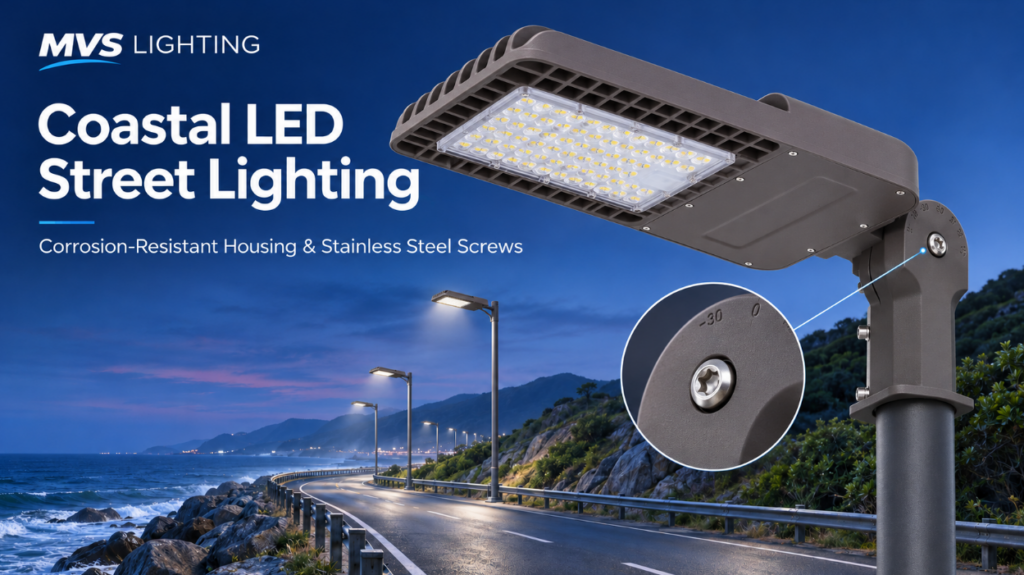
In my view, a coastal project should be specified from its environment rather than from a standard catalog fixture. Sea air, salt and humidity act on the housing and on every small metal part, so a high IP rating on a standard housing is not enough. On one coastal project the customer asked two direct questions: what is the housing made of, and what are the fasteners made of? Their requirement was WF2-level corrosion protection, for which the recommended options are 316 stainless steel or aluminium alloy with a fluorocarbon coating for the housing, and 316 stainless steel or Dacromet treatment for the fasteners. 304 stainless steel can still rust in a coastal environment, so for seaside projects I would specify 316. We met that requirement with a housing made specifically for the coastal environment and stainless steel screws. Before comparing prices, I would put the same two questions to every supplier: what is the housing made of, and what are the fasteners made of?
One example is a coastal road project in Qingdao, mainland China, where we supplied 560 sets of 100 W LED street lights with a housing made specifically for the coastal environment and stainless steel screws.
FAQ
Should I choose IP66 or IP67 for a coastal street light? Both ratings describe protection against dust and water, not salt corrosion. IP66 covers powerful water jets and IP67 covers temporary immersion, but neither confirms coating quality, fastener corrosion or housing material. Choose the rating for the water exposure on site, then evaluate corrosion resistance separately.
What corrosion documents should I ask a coastal street light supplier for? Ask for salt-spray test information (method, duration, tested component, result and laboratory), the material and coating specification, IP and IK test reports that match the quoted model, and drawings or component lists showing the housing, mounting parts and seals.
Do the screws and brackets matter on a coastal street light? Yes. Screws, washers, brackets, spigots and hinges are exposed to the same salt and humidity as the housing, and a corrosion-resistant housing doesn’t help if these parts corrode early. For strongly corrosive coastal exposure, the usual choices are 316 stainless steel or Dacromet-treated fasteners, and 304 stainless steel can still rust near the sea. Ask for the fastener and bracket materials in the specification, and check that mixed metals at joints won’t corrode each other.
How far from the coast do I need a corrosion-resistant fixture? There is no single distance that applies to every project. A fixture 200 meters from the coastline and one on a seawall face different exposure, so confirm the requirement against your site’s distance from the coast and local conditions, and tell the supplier before the quotation.
How often should coastal street lights be inspected? More often than inland fixtures. Maintenance frequency depends on the site and the manufacturer’s instructions, and inspections should cover the housing surface, screws and brackets, cable entries, seals, lens joints, coating damage and any sign of water ingress. Keep records so repeated failure points become visible.
Request a Coastal Street Lighting Proposal
Send MVS Lighting your project location, distance from the coastline, road dimensions, pole conditions, required quantity, input voltage and corrosion-protection requirements. Our team can review the environmental conditions and recommend a suitable fixture, coating, component and documentation package.
Request a Coastal Lighting Proposal View the LED Street Light Series