Timer control floodlight solutions are designed for commercial and industrial outdoor lighting projects that require fixed on/off schedules, predictable operation, and lower manual management cost. By using preset time programs, floodlights automatically switch on and off at defined hours, ensuring consistent illumination, reduced energy waste, and stable site operation across parking areas, façades, yards, and public spaces.
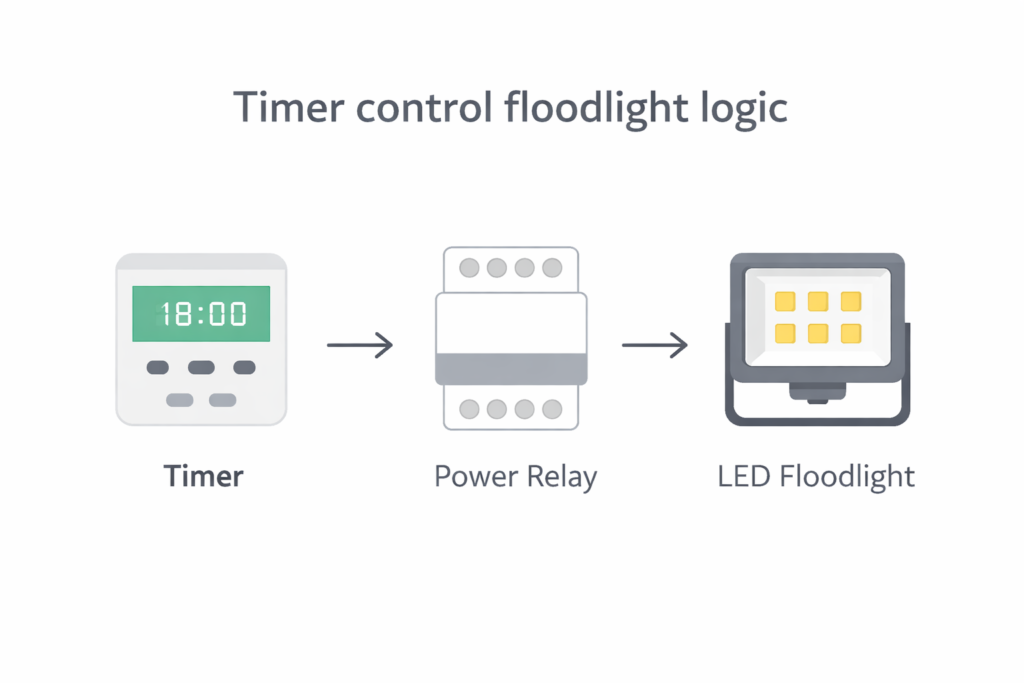
Timer control floodlight systems use a preset time schedule to automatically switch floodlights ON and OFF without manual operation. Once the working hours are programmed, the lighting follows a repeatable daily cycle, ensuring stable illumination for outdoor projects that operate on fixed timelines.
From a project and procurement perspective, timer control focuses on simplicity, reliability, and cost control, especially for sites where lighting hours rarely change.
Automatic ON/OFF by Schedule
Floodlights follow preset daily timing without on-site operation.
Stable for Fixed-Time Projects
Ideal for sites with predictable lighting hours and schedules.
No Manual Switching Required
Reduces labor cost and avoids human error in daily operation.
Key characteristics:
Scheduled operation: Lights turn on/off at fixed times every day
Reduced manpower: No need for manual switching or daily supervision
Predictable energy usage: Easy to calculate operating hours and costs
Timer control floodlights are widely used in outdoor projects because they deliver measurable operational benefits, not just basic automation. For sites with fixed working hours, timer-based control provides a low-complexity, high-reliability lighting solution that is easy to deploy and manage.
Reduced energy waste
Floodlights operate strictly within preset hours, avoiding unnecessary overnight or daytime operation.
Lower operating labor cost
No daily manual switching or on-site supervision is required once the timer is configured.
Predictable lighting management
Fixed schedules make operating hours, energy consumption, and maintenance planning easier to estimate.
Stable and repeatable operation
Ideal for projects where lighting requirements remain consistent throughout the year.
Timer-controlled floodlights can be implemented in different ways depending on
wiring design, control scope, and site management needs. The table below compares
common solutions used in outdoor lighting projects.
| Control Method | Wiring Complexity | Best For | Key Notes |
|---|---|---|---|
| External Timer Switch | Low | Small sites, single lighting zones | One timer can control one or multiple floodlights via relay output |
| Timer + Power Relay | Medium | Parking areas, building façades, yards | Allows higher load control and group switching |
| Timer + Photocell (Hybrid) | Medium | Outdoor areas with seasonal daylight changes | Timer defines operating window, photocell adjusts to ambient light |
| Smart Timer Controller | Medium to High | Large projects, multi-zone lighting | Centralized scheduling, remote adjustment, higher system flexibility |
Timer control floodlights are commonly deployed in outdoor areas where lighting
requirements follow a predictable daily schedule. Proper timer settings help
balance visibility, safety, and energy efficiency.
Parking Lots
Recommended schedule: 18:30 – 06:30
Provides full-night coverage with no daytime operation.
Building Façades
Recommended schedule: 19:00 – 23:30
Maintains visual impact while limiting late-night power use.
Factory Yards
Recommended schedule: Shift-based
Timer programs adjusted to production or security shifts.
Billboards & Signage
Recommended schedule: Sunset – 24:00
Ensures visibility during peak viewing hours only.
In practical projects, the real value of a timer-controlled floodlight is not simply the on/off schedule, but how the light output is managed over time.
Our Timer Control Floodlight allows customers to define specific operating periods, such as switching on at 18:00 and reducing brightness after 23:00. During production, the driver can be pre-programmed so that after five hours of operation, the output is gradually reduced instead of remaining at full power.
The drivers we select support up to five independent dimming stages, allowing the light output to be adjusted step by step until final shut-off. This multi-stage dimming strategy better matches real nighttime usage patterns and, without compromising basic lighting requirements, can help reduce overall energy consumption during long-hour operation.
To ensure stable timer-based operation, both the floodlight and control components
must meet basic electrical and environmental requirements. The table below summarizes
key considerations commonly reviewed during project planning.
| Input Voltage | AC 100–277V or AC 200–240V, depending on regional power standards |
| Supported Wattage Range | Depends on relay rating and circuit design; single or grouped floodlights supported |
| Timer Output Type | Dry contact or powered output, matched to relay or driver requirements |
| Relay Capacity | Must exceed total connected load, including inrush current |
| Environmental Protection | Outdoor timer or control box should meet appropriate IP rating |
| Surge Protection | Floodlights with built-in surge protection recommended for outdoor grids |
| Control Expansion | Can be combined with photocell or smart controllers if future upgrade is required |
Proper wiring and component selection are essential for stable timer-based control.
The points below summarize typical considerations reviewed during outdoor lighting installation.
Outdoor timers or control units should be installed inside weatherproof enclosures
with appropriate IP ratings to protect against moisture and dust.
The relay must be rated higher than the total connected floodlight load,
including inrush current during startup.
One timer can control multiple floodlights when grouped through a common relay
or distribution circuit, subject to electrical design limits.
Timers with built-in battery backup or memory retention are recommended to
maintain schedules after temporary power outages.
Timer-based systems can be designed to allow future integration with photocells
or smart controllers if project requirements change.
Yes. One timer can control multiple floodlights when connected through a properly
rated relay or control circuit. Load calculation and inrush current must be considered.
Timers with battery backup or memory retention will keep the programmed schedule.
This feature is recommended for outdoor projects with unstable power supply.
Yes. A hybrid solution is commonly used, where the timer defines the operating window
and the photocell adjusts switching based on ambient light conditions.
For large or multi-zone projects, timer control can be used alone or as part of a
centralized control system, depending on management and expansion requirements.
Typically required details include site application, floodlight wattage, quantity,
control method preference, local voltage standard, and installation environment.
For outdoor lighting projects requiring reliable timer-based control, we support customers with solution selection, control configuration, and technical coordination based on real site conditions.
Whether for parking areas, façades, factory yards, or signage lighting, timer control floodlights can be specified to match operating schedules, load requirements, and future expansion plans.