Dimmable floodlights are widely used in outdoor industrial, commercial, and municipal projects where lighting output must adapt to different time periods, activities, and energy-saving requirements.
This page explains how dimmable floodlights work, available dimming methods, control systems, and project-level application guidance for professional buyers and engineers.
A dimmable floodlight is an outdoor LED floodlight designed to adjust light output smoothly or step-by-step through compatible drivers and control systems.
Unlike simple ON/OFF lighting, dimmable floodlights enable energy savings, visual comfort, and intelligent control integration.
Dimmable floodlights are widely adopted in professional outdoor projects because they provide operational flexibility and long-term cost efficiency, rather than simply higher brightness.
For industrial facilities, municipalities, and commercial developments, dimming capability is a functional requirement, not an optional feature.
Energy Optimization Across Operating Hours
Dimmable floodlights allow lighting levels to be reduced during low-traffic periods, helping projects lower energy consumption and operating costs without compromising safety or visibility.
Improved Visual Comfort and Glare Control
By adjusting brightness based on real usage scenarios, dimmable floodlights help minimize glare and light overshoot, improving visual comfort in large outdoor areas such as yards, facades, and parking zones.
Extended System and Component Lifespan
Operating luminaires at reduced output for extended periods can reduce thermal stress on LED chips and drivers, contributing to longer service life and lower maintenance frequency.
Compatibility With Smart and Automated Lighting Systems
Dimmable floodlights are designed to work with time schedules, sensors, and centralized control platforms, making them suitable for smart city infrastructure and modern outdoor lighting management systems.
Selecting the correct dimming method is critical for outdoor floodlight projects.
Different dimming technologies offer varying levels of control accuracy, system compatibility, and long-term stability, especially in large-scale or harsh outdoor environments.
Floodlight Dimming Method Comparison
| Dimming Method | Control Principle | Outdoor Suitability | Typical Applications |
|---|---|---|---|
| 0–10V Dimming | Analog voltage signal controls driver output | High | Industrial yards, parking areas, logistics zones |
| DALI Dimming | Digital addressable lighting interface | Very High | Smart city projects, stadiums, complex lighting layouts |
| PWM Dimming | Pulse-width modulation at driver level | Medium | Precision control systems, customized driver solutions |
| TRIAC Dimming | Phase-cut AC dimming | Low | Mainly indoor, not recommended for outdoor engineering |
0–10V is favored for outdoor floodlights due to its simplicity, stability, and cost efficiency.
DALI enables individual fixture addressing and grouping, making it ideal for projects requiring centralized control and zoning.
PWM dimming offers fine output control but requires careful driver selection to avoid flicker at low levels.
TRIAC dimming is rarely suitable for outdoor floodlights because of flicker risk and limited compatibility with high-power LED drivers.
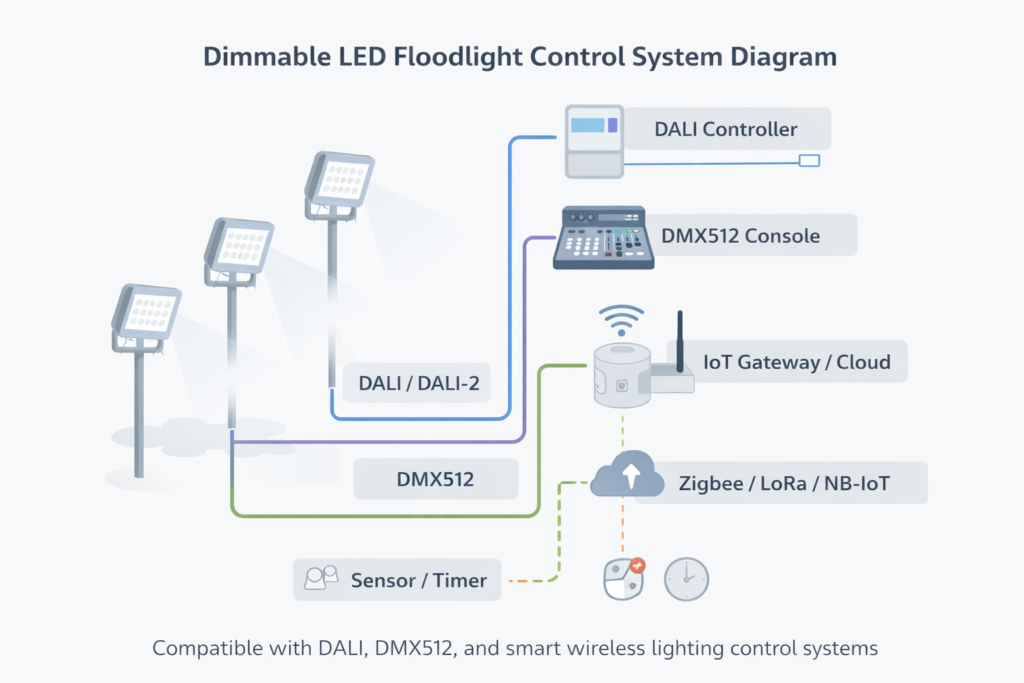
Dimmable floodlights are rarely operated as standalone fixtures in professional projects.
In B2B outdoor lighting applications, they are typically integrated into centralized or distributed lighting control systems, enabling coordinated dimming, automation, and remote management.
DALI / DALI-2 Lighting Control Systems
DALI-based systems allow individual addressing, grouping, and scene control of floodlights. They are widely used in stadiums, large public spaces, and smart city infrastructure where centralized management and scalability are required.
DMX512 Control for Architectural Lighting
DMX512 is commonly applied in architectural façade and landscape floodlighting, where dynamic brightness adjustment and synchronized lighting effects are needed across multiple luminaires.
Wireless Smart Lighting Networks
Technologies such as Zigbee, LoRa, and NB-IoT enable remote dimming control, monitoring, and scheduling of floodlights across wide outdoor areas, reducing wiring complexity in large-scale projects.
Sensor-Based and Time-Based Dimming Logic
Dimmable floodlights can be linked with motion sensors, ambient light sensors, and time schedules, allowing brightness levels to automatically adjust based on real-time usage conditions.
Dimmable floodlights are widely applied in outdoor projects where lighting demand varies by time, activity level, or functional zone.
By adjusting brightness dynamically, these systems help project owners balance visibility, safety, and energy efficiency across different operating conditions.

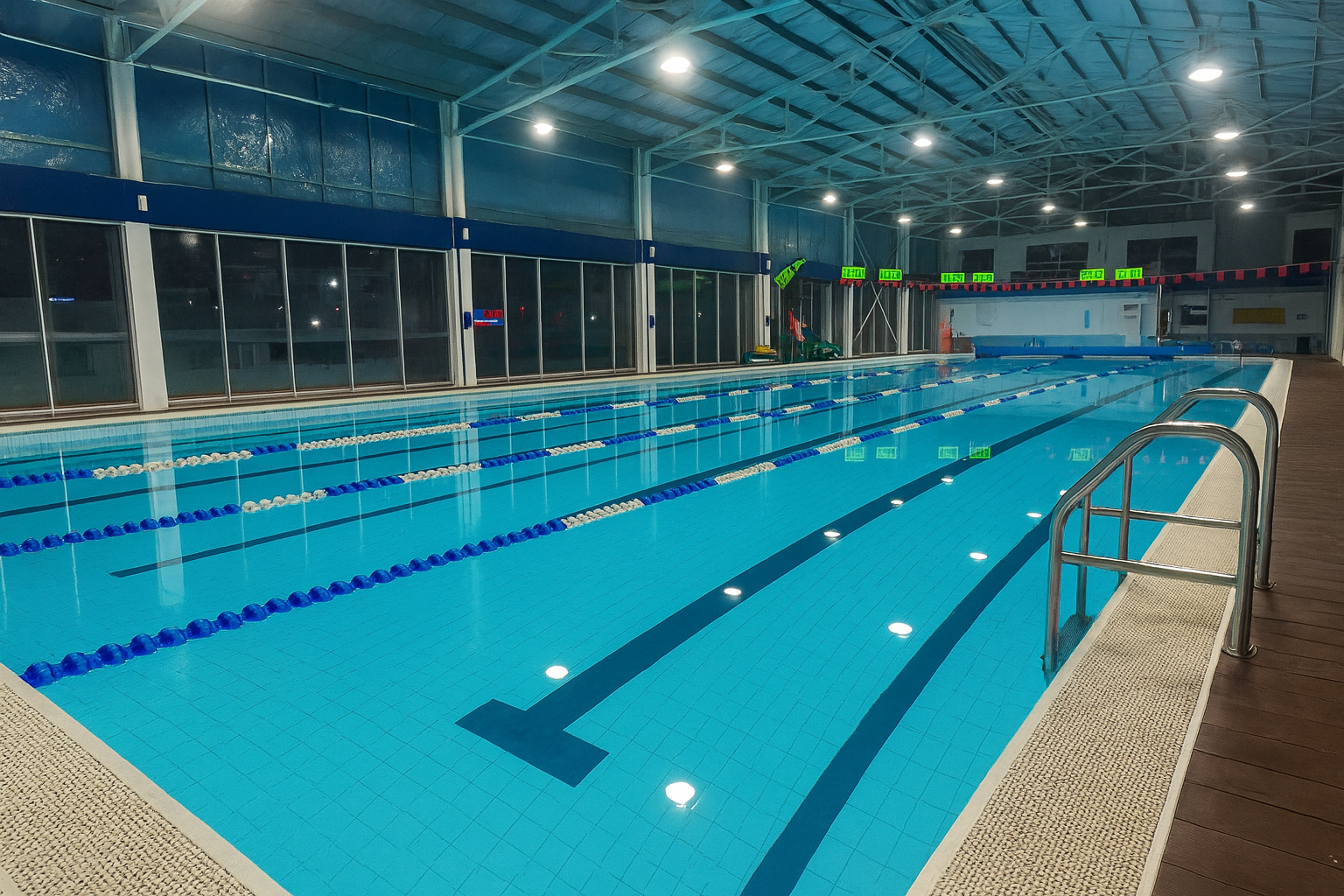
Dimming allows lighting levels to be adjusted for training sessions, competitions, and maintenance periods, reducing energy use when full output is not required.

Large outdoor working areas benefit from time-based and zone-based dimming, maintaining safety standards while lowering operating costs during low-activity hours.

Dimmable floodlights enable controlled brightness and visual consistency, supporting architectural aesthetics without excessive light output.
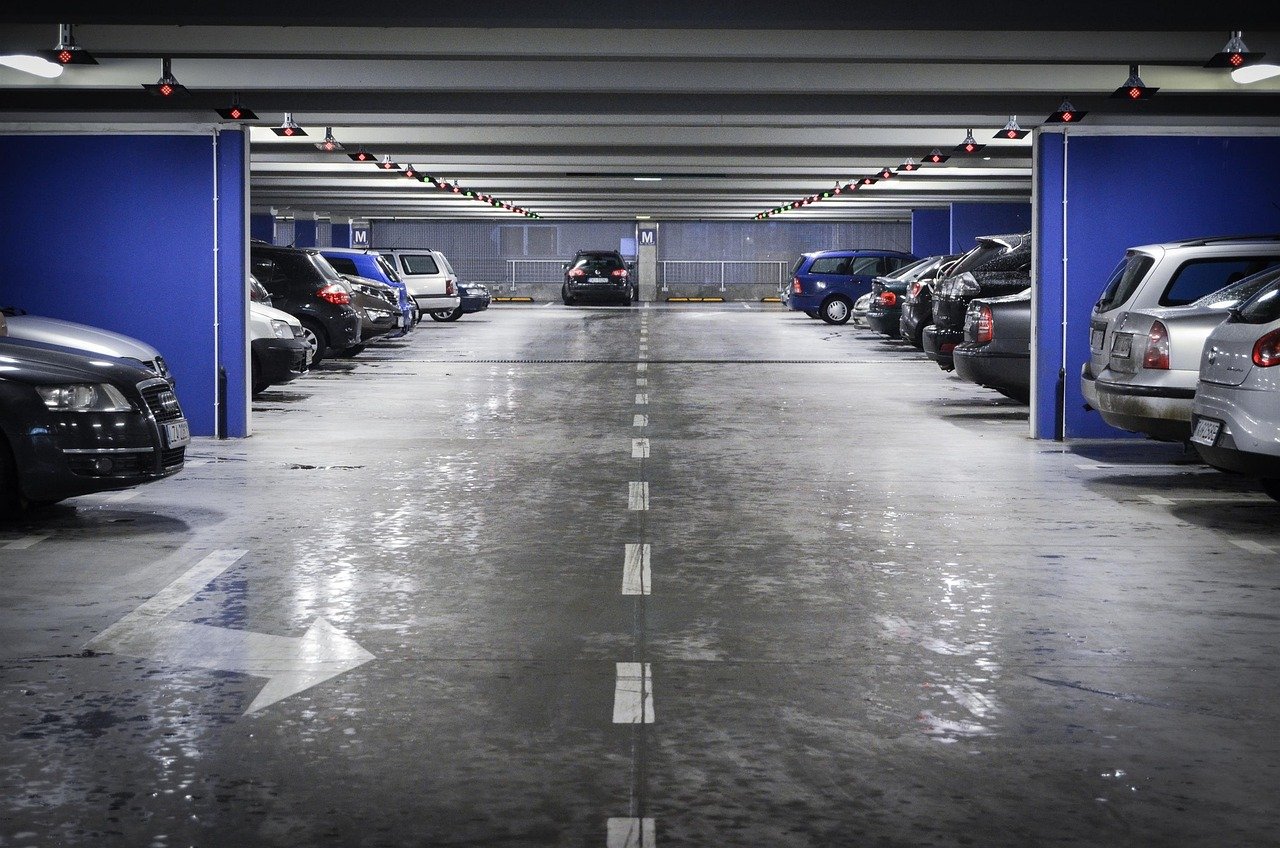
Brightness can be reduced late at night or during off-peak hours, improving energy efficiency and visual comfort while maintaining essential illumination.

Not all LED floodlights are suitable for dimming in outdoor environments.
Before specifying a dimmable floodlight for a project, engineers and procurement teams must evaluate driver compatibility, control stability, and long-term reliability, rather than focusing only on wattage or lumen output.

The LED driver must fully support the selected dimming method (0–10V, DALI, PWM, etc.). Mismatch between driver and control protocol can lead to unstable dimming behavior or system failure

Poorly designed dimming systems may cause visible flicker when brightness is reduced. For outdoor projects, low-flicker performance at reduced output is essential to maintain visual comfort and safety.

Dimming-capable components must maintain stable IP protection under long-term outdoor exposure. Signal ports, control cables, and driver housings should be designed to prevent moisture ingress.

In large outdoor installations, long cable runs and electromagnetic interference can affect dimming accuracy. Proper system design is required to ensure stable signal transmission across the entire lighting network.
For outdoor projects, choosing between dimmable and non-dimmable floodlights is not only a technical decision, but also a long-term operational strategy.
The comparison below highlights how dimming capability impacts energy efficiency, control flexibility, and total cost of ownership.
| Aspect | Dimmable Floodlight | Non-Dimmable Floodlight |
|---|---|---|
| Light Output Control | Adjustable based on time or activity | Fixed output only |
| Energy Efficiency | High, optimized for variable usage | Lower, constant power consumption |
| System Integration | Compatible with control systems | Limited or standalone operation |
| Visual Comfort | Reduced glare through brightness control | Higher glare risk in low-activity periods |
| Initial Cost | Slightly higher | Lower |
| Long-Term Operating Cost | Lower due to energy savings | Higher due to fixed operation |
Dimmable LED floodlights allow customers to choose different control solutions based on their specific application requirements, enabling flexible lighting strategies across a wide range of projects.
With adjustable light output, these floodlights can be adapted to different operating periods, usage intensities, and control system configurations. This controllability expands the application scope of floodlights and makes it possible to achieve different lighting control effects depending on project objectives.
When combined with a suitable driver and control interface, dimmable floodlights help optimize lighting performance while maintaining required illumination levels, making them well suited for long-term outdoor and industrial lighting applications.
Dimmable floodlights are most effective when properly matched with control systems, operating scenarios, and long-term project goals.
Our team supports professional buyers and engineers with project-level dimmable floodlight solutions, covering control method selection, system compatibility, and outdoor reliability considerations.
What We Support
Selection of suitable dimming methods and control protocols
Driver compatibility and system stability evaluation
Custom power, beam angle, and control integration
Technical support for large-scale outdoor projects
Explore our full LED Floodlight Series and related control solutions for industrial, commercial, and infrastructure projects:
30W Floodlight|50W Floodlight |65W Floodlight | 100W Floodlight | 150W Floodlight | 200W Floodlight | 300W Floodlight| 400W Floodlight | 500W Floodlight| 750W Floodlight | 1000W Floodlight
DALI Dimmable LED Floodlight |Dimmable LED Floodlight |Floodlight ON OFF Control |Timer Control Floodlight |Remote Control LED Floodlight |Smart LED Floodlight |
RGBW Floodlight